Names the fibre standard, the bend grades it matches and the 8-degree angle
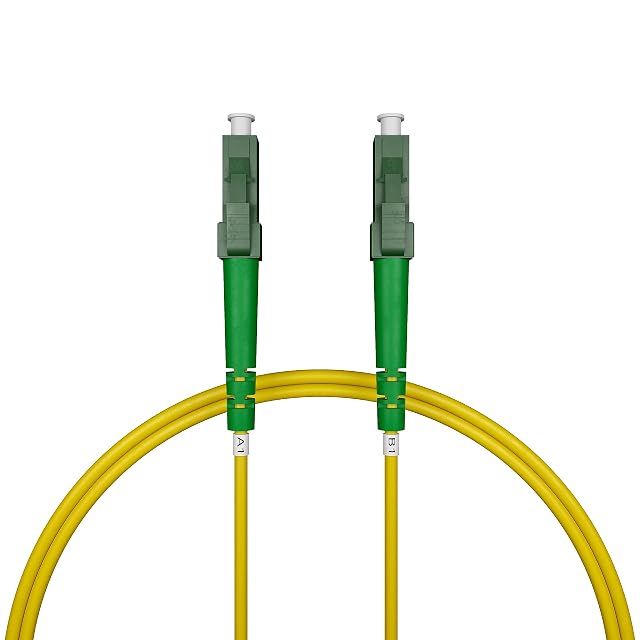
nexinex 1 m simplex OS2 LC/APC to LC/APC, G.652D, 3.0 mm LSZH
The lead that documents its glass better than any other here — a fibre standard, two bend grades and the polish angle in degrees — and then publishes not one figure for what its connectors actually lose.
Specifications
- Fibre type
- Single-mode — stated in the title and in the third bullet as OS2 single-mode 9/125 µm
- Fibre grade
- OS2 — stated in the title and in the first and third bullets. The third adds the fibre standard G.652D and says it is compatible with G.657.A2 and B2; the fifth calls it a laser-optimised OS2 fibre
- Connector types at each end
- LC/APC at both ends — stated in the title and in the first bullet, which gives the APC angle as 8 degrees, the only lead on this shelf to print it
- Simplex or duplex
- Simplex — stated in the title and in the first and third bullets. One strand, one connector at each end
- Polarity arrangement
- Not published on the listing, and a simplex lead has no pair to cross. What the first bullet gives in its place is colour: a yellow jacket and green connectors
- Length
- 1 m — stated in the title and in the first and third bullets
- Jacket rating
- LSZH — stated in the third bullet with a diameter of 3.0 mm, and explained in the fourth as Low Smoke Zero Halogen, producing far less toxic smoke in a fire than a PVC cable and recommended for interiors and public areas
- Polish type
- APC — carried by the LC/APC designation and given as an 8-degree angle in the first bullet. No insertion loss and no return loss figure appears anywhere on the page
- Armouring
- Not published on the listing — no armour is named. The fifth bullet lists applications instead: FTTH, 10 Gigabit, and two designations printed as 40GBase-SR4 and 100GBase-SR10, the first of them carrying a stray character in front of the number
- Amazon reference
- B0CDQC1VJR (same reference on 5 Amazon marketplaces)
- EAN
- 4744999640040
On the listing
A 1 m simplex single-mode fibre patch cable, OS2, with LC/APC connectors at both ends given an 8-degree angle, a yellow jacket and green connectors; a fibre described as 9/125 µm to G.652D and compatible with G.657.A2 and B2, in a 3.0 mm LSZH sheath; a stated use between a fibre termination point and an ONT for FTTH, FTTB and FTTx, with providers named from Deutsche Telekom and Vodafone to M-Net, NetCologne and o2, and routers such as the FRITZ!Box; an explanation of LSZH as producing very little toxic smoke in a fire compared with PVC; and a laser-optimised OS2 fibre offered for FTTH, 10 Gigabit and two higher designations.
OS2, G.652D and the 8-degree angle
Three published facts about the glass and the face, where most listings on this shelf publish one.
The grade is OS2. The fibre standard behind it is G.652D. The bend grades it is said to match are G.657.A2 and B2. Then the first bullet does something no other lead in this hub does: it prints the polish angle, 8 degrees.
That angle is what APC means. It is why an angled connector cannot be pushed into a flat-faced socket and expected to work, and why the two are given different colours in the first place. Printing the number turns a pair of letters into a measurement.
One strand where the duplex leads carry two
Simplex, stated three times over.
That is the right shape for the job this lead is sold for. The second bullet lists a page of German providers and puts the lead between a fibre termination point and an ONT, which on those installations is a single-strand connection, and four of the seven leads on this shelf are built the same way.
The trade is that a simplex lead has nothing to offer a two-strand transceiver in a cabinet, where a duplex pair does. It is a lead for the wall socket, not for the switch.
The yellow jacket and the green connectors
Colour is doing real work on this page and it deserves its own line.
Yellow is how a single-mode lead is told from a multimode one when both are in the same drawer, and green is how an angled connector is told from a flat one. Neither is decoration: the two commonest fibre mistakes are running the wrong glass and mating the wrong face, and both are visible from across a room if the colours are right.
The first bullet states both, which is more than most listings bother with.
What the page never measures
No insertion loss. No return loss. Not a decibel anywhere on the page.
Four of the seven leads on this shelf publish both figures, and one of them publishes a return loss of 60 dB or better. Here the connectors are described as high-quality and the fibre as laser-optimised, and adjectives are what you get.
The fifth bullet adds a list of applications — FTTH, 10 Gigabit, and two designations printed as 40GBase-SR4 and 100GBase-SR10, the first with a stray character in front of it — without saying which of them a 1 m lead is specified for. That is a claim about the fibre family rather than about the object in the bag.
Before ordering
Check that both sockets are APC, because 8 degrees is not a preference and a flat face will not meet it. Confirm you need one strand rather than two. And if the connector quality matters for your run, note that this page publishes none of the numbers that would describe it — three of its neighbours do.
Availability
Priced from 7 € to 11 € across the German, French and Spanish Amazon stores the day this page was checked.
In the British and Italian Amazon catalogues with no live offer against it: the reference exists, nobody is filling it.
The American Amazon store returned nothing at all, so the buy button there opens a search in that country rather than a page that would not load.
Every figure in this section is what Keepa held on the day this page was last updated. Stock and prices move without warning.
Prices quoted in this text were read on 10 September 2026. The live price is at the top of the page.