Four slots at once, and a note of what it will not read
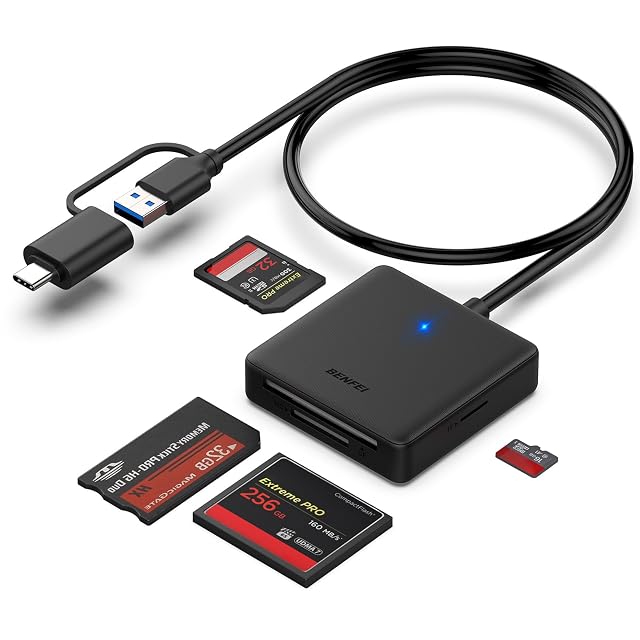
BENFEI 4-in-1 reader, USB-C and USB 3.0, SD, microSD, MS and CF, four cards at once, 160 MB/s UHS-I
A four-slot reader that reads all four at once, publishes the condition on its own rate, and then names three card formats it will not accept — two of which its slot list appears to cover.
Specifications
- Host interface standard
- USB 3.0 — stated in the first bullet, which describes an integrated USB-C and USB 3.0 reader, and again in the second, which names a USB 3.0/2.0 slot or a Type-C slot as the two ways of connecting. Backward compatibility with USB 2.0 and 1.1 is stated in the second bullet
- Stated link rate
- Up to 160 MB/s in UHS-I mode — stated in the second bullet. The same bullet ends with the maker’s own note that the final data transfer speed depends on the card and on the type of USB port, which makes it one of two listings on this shelf to qualify its own figure in writing. No rate in gigabits per second is published
- Connector type
- Type-A and Type-C — stated in the first bullet as a 2-in-1 design, with the second naming the newest USB Type-C slot (Thunderbolt 3) alongside a USB 3.0 or 2.0 socket
- Internal or external form
- External — described throughout as an adapter used with a computer or a laptop. No bay mounting and no motherboard header is named
- Slot count
- Four — stated in the first bullet, which names access to four different card types: SD, microSD (TF), MS and CF
- Formats accepted
- SD, microSD or TF, Memory Stick and CompactFlash — stated in the first bullet. The fourth bullet then carries a marked exclusion: not compatible with Memory Stick (standard), Memory Stick Micro (M2) or CF Type I. The two halves of that are printed on the same page and the listing does not reconcile them, so both are reported here as written
- Simultaneous slot access
- Four cards at once — stated in the third bullet, which calls it a simultaneously working reader able to read four cards at the same time. It is the joint highest count on this shelf
- Stated protocol support
- UHS-I — named in the second bullet as the mode the 160 MB/s figure belongs to. No UHS-II mode is claimed
- Cable arrangement
- Not published on the listing — no lead is described and no length is given. The product is called an adapter throughout, and the fourth bullet lists laptops and phones as hosts without saying how the reader reaches them
- Amazon reference
- B08P517NW5 (same reference on 6 Amazon marketplaces)
- EAN
- 6971785942189
On the listing
An integrated USB-C and USB 3.0 card reader offering high-speed access to four card types — SD, microSD (TF), Memory Stick and CompactFlash — usable with a computer or laptop through a USB 3.0 or 2.0 socket or through the newest USB Type-C slot; transfer rates in UHS-I mode of up to 160 MB/s with backward compatibility to USB 2.0 and 1.1, and a note that the final data transfer speed depends on the card and on the USB port type; an advanced IC chip handling the signal, with the reader described as working simultaneously and able to read four cards at once; a compatibility list covering MacBook, iPad Pro, Surface Book 2, Galaxy, HTC, Pixelbook, Dell XPS and other Type-C devices, a note that SDXC cards of 64 GB and above use the exFAT file system which older versions of Windows and macOS do not support, and a marked exclusion of Memory Stick (standard), Memory Stick Micro (M2) and CF Type I; and an unconditional 18-month warranty.
Four slots, four cards, at the same time
The third bullet states it plainly: this reader works simultaneously, and four cards can be read at once.
That is the line worth looking for on any multi-slot reader, because the alternative is common and is rarely described. A multiplexed reader accepts four cards and addresses one, so a copy between two of them becomes two operations. A simultaneous one presents all four as separate volumes, and a drag from one to another is a single job.
Four is the joint highest count on this shelf. Two readers here manage five at once out of seven slots; three manage two; one never states a number at all.
A hundred and sixty megabytes, and the sentence after it
The second bullet gives up to 160 MB/s in UHS-I mode and then adds the qualification in its own brackets: the final data transfer speed depends on the card and on the type of USB port.
That is the correct way to publish a rate for this kind of product, and only one other listing in this hub does the same. A reader is one link in a chain that also contains a card, a plug and a socket, and the slowest link settles the result. A UHS-I card rated below 160 MB/s is the ceiling regardless of the reader; a USB 2.0 socket at the far end is a lower ceiling still.
No gigabit figure appears anywhere, so the host link is described by generation — USB 3.0 — and by this megabyte figure, and not by a class rate.
The exclusion note, printed against the slot list
The fourth bullet ends with a marked warning: not compatible with Memory Stick (standard), Memory Stick Micro (M2) and CF Type I.
Set that against the first bullet, which names Memory Stick and CompactFlash among the four card types the reader accepts, and the two do not sit comfortably together. Both are printed on the same page, and neither is qualified by the other.
This page reports the pair as written and does not choose between them. What follows practically is a simple piece of advice: if a specific card is the reason you are buying this reader, name that card to the seller and get the answer in writing rather than reading it off the bullets.
The exFAT paragraph, and who it is for
The same bullet carries a note about SDXC cards of 64 GB and above using exFAT, which Windows XP, Windows Vista before SP1 and macOS before 10.6.6 do not support.
That is accurate and it is aimed at a machine most buyers no longer own. It is worth reading for what it says about the age of the product description rather than for the compatibility warning itself.
Eighteen months
The fifth bullet publishes a warranty period and calls it unconditional.
Card readers are cheap and warranty terms on them are usually absent. Three of the seven listings in this hub publish a period; the other four say nothing. That is a commercial term rather than a statement about the electronics, and it is still a term you either have in writing or do not.
Before ordering
Confirm the exact card types you need against the exclusion note, because the slot list and the note disagree on this page. Check the socket at the machine end, since the 160 MB/s figure depends on it by the maker’s own account. And note that no cable is described anywhere, so how the reader physically reaches your machine is something the photograph will have to answer.
Availability
Priced from 8 € to 11 € across the German, French, Italian and Spanish Amazon stores the day this page was checked.
It is stocked on the American and British Amazon stores as well, in that country’s own currency. The range above leaves those out: it counts euro stores and no others.
Every figure in this section is what Keepa held on the day this page was last updated. Stock and prices move without warning.
Prices quoted in this text were read on 10 September 2026. The live price is at the top of the page.