Specifications
- Host interface standard
- USB 3.1 — stated in the first bullet as a USB-C 3.1 multi-card reader and again in the second and third, which describe a 3.1 reader on a Type-C 3.1 cable. No Gen 1 or Gen 2 suffix appears
- Stated link rate
- Up to 5 Gbit/s — stated in the title and in the second bullet, which puts it at ten times USB 2.0 and gives that class as 480 Mbit/s. No megabyte figure appears and no condition is attached to the rate
- Connector type
- Type-C — stated in the title and in the first, fourth and fifth bullets. The fifth names it as a reinforced Type-C 3.1 cable
- Internal or external form
- External, on an attached lead — the fourth bullet lists MacBook, iMac, iPad Pro, Surface and Chromebook machines with Type-C sockets as the hosts. No bay mounting is described
- Slot count
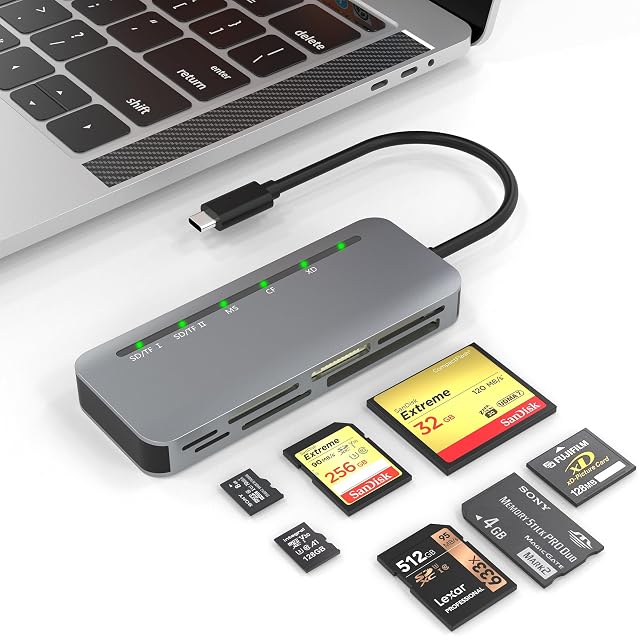
- Seven — stated in the first bullet as one CF slot, two SD, two TF (microSD), one MS and one XD. The five-card working figure sits two below the slot count and the listing does not explain the difference
- Formats accepted
- CF, SD, SDXC, SDHC, microSD, microSDXC, microSDHC, TF, MS and XD — stated in the third bullet, which names the complete XD-Picture series including Olympus and Fujifilm cards of 1 GB and 2 GB
- Simultaneous slot access
- Five different cards at once — stated in the first bullet as reading and writing five cards at the same time, and repeated in the title. The second bullet adds an independent green LED on each slot and a steady green light for normal operation
- Stated protocol support
- Not published on the listing — no UHS-I and no UHS-II mode is named, and no SD version number is quoted. The page lists card formats and never the bus modes behind them
- Cable arrangement
- A reinforced Type-C 3.1 cable, attached — stated in the fifth bullet. No length is given. The same bullet names a built-in smart chip guarding against overcurrent, overvoltage, short circuit and high temperature, and credits the aluminium housing with carrying heat outwards
- Amazon reference
- B0CD6NYP8B (same reference on 6 Amazon marketplaces)
- EAN
- 0671891482604
On the listing
A 7-in-1 multi-card reader in aluminium on USB-C 3.1, with one CF slot, two SD, two TF (microSD), one MS and one XD, able to read and write five different cards at the same time; high-speed transfer at 5 Gbit/s, given as ten times USB 2.0 at 480 Mbit/s, with a steady green light for normal operation and an independent green LED on every slot; card compatibility covering CF, SD, SDXC, SDHC, microSD, microSDXC, microSDHC, TF, MS and the complete XD-Picture series including Olympus and Fujifilm cards of 1 GB and 2 GB, with a note to check which way round a card goes before inserting it; system compatibility with MacBook Pro 2016 to 2023, MacBook Air 2018 to 2023, MacBook 12, recent iMac, iMac Pro and iPad Pro, Surface Pro 9, Surface Book and Surface Go with USB-C, Chromebook and other Type-C machines, plug and play with hot-swap and no drivers; a reinforced Type-C 3.1 cable, a built-in smart chip against overcurrent, overvoltage, short circuit and high temperature, and an aluminium housing credited with better heat dissipation; and a compact, portable body which the maker says has been tested thousands of times, with 18 months of warranty.
The Type-C end, which is the point of this one
Four of the seven readers in this hub never name a plug shape at all. This one names Type-C four times.
That is the practical difference it is sold on. A laptop with nothing but Type-C sockets and a bag full of CompactFlash and XD cards is a specific problem, and the usual answer is a Type-A reader plus an adapter — two things to lose instead of one, and an extra junction in a chain that already has several.
The fourth bullet is where the case is made, and it is made by listing machines: MacBook Pro and Air of recent years, iPad Pro, Surface Pro 9, Chromebook. Those are Type-C-only bodies, and they are exactly the ones a legacy card collection is hardest to reach from.
Seven holes, five cards
The first bullet publishes the layout and the working limit together: one CF, two SD, two microSD, one Memory Stick, one XD, and five cards read and written at once.
Seven and five are two apart, and the page does not say where the difference goes. Readers of this shape commonly pair certain slots on one channel; which pairs, here, is not written. Assuming a mechanism would be inventing one.
Five is therefore the figure to plan a session around, and any particular combination of five is a question for the seller rather than for this page.
Five gigabits, and what stands between you and it
The second bullet gives 5 Gbit/s and sets it against USB 2.0 at 480 Mbit/s.
Both of those are class figures — the rates their generations are defined at — and neither is a statement about a card. The chain here has four links: the card itself, the reader’s controller, the Type-C cable, and the socket in the laptop. Every one of them has a ceiling, and the lowest ceiling is the one you experience.
The cards are usually the lowest. A CompactFlash card from an older camera body, an XD-Picture card of 1 or 2 GB, a microSD from a dashcam: none of those is in the same territory as five gigabits, and no reader changes that.
The listing also names no bus mode. Neither UHS-I nor UHS-II appears, so on a modern SD card the older mode is what a buyer should expect.
The aluminium shell and the protection chip
The fifth bullet is the most technically specific on the page.
An aluminium housing, credited with carrying heat outward more readily. A reinforced Type-C 3.1 cable. And a built-in smart chip named as guarding against overcurrent, overvoltage, short circuit and high temperature.
Those are claims about robustness rather than about performance, and they are stated as design features rather than as measurements. The same bullet, and the sixth, carry the maker’s own words about the product having been tested thousands of times — that is Suejezt’s statement and it is reported here as Suejezt’s.
What is missing beside all that specificity is the cable length, which is the number that decides whether a desk reader reaches a machine on the floor.
No reference to look it up by
This is the only listing on this shelf that publishes no manufacturer part number.
The consequence is narrow and worth naming. Ordering is unaffected — the barcode and the shop’s own reference identify the item. What becomes difficult is everything after that: finding a datasheet, checking whether a firmware note exists, or reading anybody else’s account of the same unit. A product with no part number is a product that can only be researched where it is sold.
Before ordering
Check the socket at the laptop end is Type-C, since that is the only plug on this reader. Plan around five cards rather than seven. And expect the older bus mode on fast SD cards, because no mode is named anywhere on the page.
Availability
Priced at roughly 21 € on the German, French, Italian and Spanish Amazon stores the day this page was checked.
It is stocked on the American and British Amazon stores as well, in that country’s own currency. The range above leaves those out: it counts euro stores and no others.
Every figure in this section is what Keepa held on the day this page was last updated. Stock and prices move without warning.
Prices quoted in this text were read on 10 September 2026. The live price is at the top of the page.