Writes down the condition attached to its own 170 MB/s
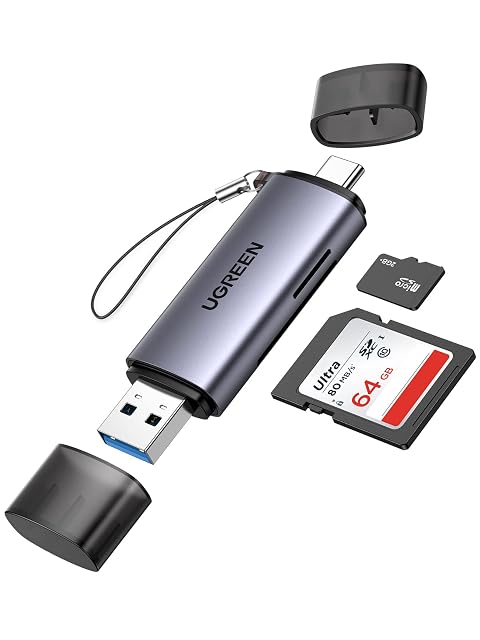
UGREEN 2-in-1 reader, USB-A and USB-C, SD 3.0, two slots read at once, 5 Gbps and 170 MB/s stated
The reader on this shelf that qualifies its own headline number in the same breath as printing it: 170 MB/s, and a note saying you get it only if the card can do it too.
Specifications
- Host interface standard
- Not published as a USB generation — no 3.0, 3.1 or 3.2 designation appears in the title or the bullets. What the title does name is SD 3.0, which is the card-side standard rather than the host one, and the second bullet gives the host link as a rate instead: up to 5 Gbps
- Stated link rate
- Up to 5 Gbps — stated in the second bullet, with up to 170 MB/s named for use with a UHS-I card. The same bullet carries the maker’s own note in brackets: the 170 MB/s figure holds only where the SD or microSD card supports that speed as well. It is one of two listings on this shelf to attach a written condition to its own figure
- Connector type
- Type-A and Type-C on one body — stated in the title and in the first bullet, which describes connecting a memory card to a computer or a phone through either interface
- Internal or external form
- External — a compact body that plugs straight into a socket. The fourth bullet describes it as a direct plug-in adapter with no lead, and the fifth names low weight and portability as the point
- Slot count
- Two — stated in the first bullet, one for full-size SD and one for microSD
- Formats accepted
- SD, SDHC, SDXC, microSD, microSDHC and microSDXC — stated in the first bullet, with cards of up to 2 TB named. No CF, MS or XD support is claimed anywhere
- Simultaneous slot access
- Both slots at once — stated in the first bullet, which says the two slots allow two cards to be read at the same time. It is written as a capability rather than left to be discovered
- Stated protocol support
- UHS-I — named in the second bullet as the card mode the 170 MB/s figure applies to. No UHS-II mode is claimed, and the title names SD 3.0 as the card standard
- Cable arrangement
- No cable — the reader plugs directly into the socket, stated in the fourth bullet as doing away with tangled leads and bulky multi-function adapters. The third bullet adds a practical caveat: a case on a phone can stop the Type-C plug seating properly, and the maker recommends removing it
- Amazon reference
- B07D1J88CF (same reference on 6 Amazon marketplaces)
- EAN
- 6957303857067
On the listing
A 2-in-1 card reader with a USB-A and a USB-C interface, joining a memory card to a computer or a phone; two slots taking SD, SDHC, SDXC, microSD, microSDHC and microSDXC cards up to 2 TB, with both readable at the same time; data transfer of up to 5 Gbps through a high-performance chipset, and up to 170 MB/s in combination with a UHS-I card, followed by a bracketed note that the 170 MB/s figure is reached only when the card supports that speed too; a compatibility list running from recent iPhones and iPads to Galaxy, Xiaomi, Surface and Dell machines, with a warning that a phone case may prevent the Type-C plug from seating and a recommendation to remove it; plug-and-play with an eject mechanism holding the card firmly in its slot; and a small, light body meant to be carried.
Five gigabits, a hundred and seventy megabytes, and the sentence in brackets
The bracket is the most useful thing on this page.
The second bullet prints two figures — up to 5 Gbps for the link and up to 170 MB/s in combination with a UHS-I card — and then adds, in its own words, that the 170 MB/s figure holds only where the card supports that speed as well.
That is the rule this whole shelf turns on, written by the maker rather than inferred by a reviewer. A card reader sits in the middle of a chain: the card, the reader, the plug, the socket. The slowest of the four settles the outcome, and no figure printed on one link says anything about the other three.
Five of the seven readers in this hub print a rate with no such note. Reading the qualification here is not a criticism of the product; it is the reason to trust the number.
The host side, named by rate rather than by generation
The title names SD 3.0. That is a card standard — it describes what the slot speaks to the card — and it is not the same as the host link.
For the host link the page gives a rate, up to 5 Gbps, and no generation. There is no USB 3.0, no 3.1, no 3.2 anywhere on the listing. Six of the seven readers in this hub name a generation outright.
The practical consequence is small but real: to know what socket to look for, you have to work from the rate rather than read a familiar label off the box.
Two slots, two cards, at the same time
The first bullet publishes something several readers leave implicit. Both slots work at once.
That means a card in each is presented as its own volume, and a copy from the microSD to the SD is one operation rather than two with a swap in the middle. The alternative arrangement — slots that share a controller and take turns — is common and is rarely admitted to on a listing.
Alongside it the bullet names the formats and the ceiling: SD, SDHC and SDXC on one side, microSD, microSDHC and microSDXC on the other, up to 2 TB. No CF, no Memory Stick, no XD. This is a two-format reader and it says so.
A body with no lead, and a warning about phone cases
The fourth bullet makes the case for the shape: plugged straight into the socket, no cable to untangle, nothing bulky. The eject mechanism is named as what keeps the card seated.
The third bullet carries something unusual — an admission. If your phone has a case on it, the maker writes, the Type-C plug may not click home, and taking the case off is recommended for a stable connection.
That is a real limitation of every short, capless Type-C plug and almost no listing mentions it. Publishing it costs the seller something and saves the buyer a return.
Before ordering
Look at the card first: a UHS-I card that is rated well below 170 MB/s is the ceiling of the job, whatever the reader is capable of. Then look at the socket, since 5 Gbps needs a port of that class to mean anything. And if the Type-C end is meant for a phone that lives in a thick case, take the maker’s own warning at face value.
Availability
Priced from 6 € to 9 € across the German, French, Italian and Spanish Amazon stores the day this page was checked.
It is stocked on the American and British Amazon stores as well, in that country’s own currency. The range above leaves those out: it counts euro stores and no others.
Every figure in this section is what Keepa held on the day this page was last updated. Stock and prices move without warning.
Prices quoted in this text were read on 10 September 2026. The live price is at the top of the page.