Three USB rates printed, with the unit letters not matching
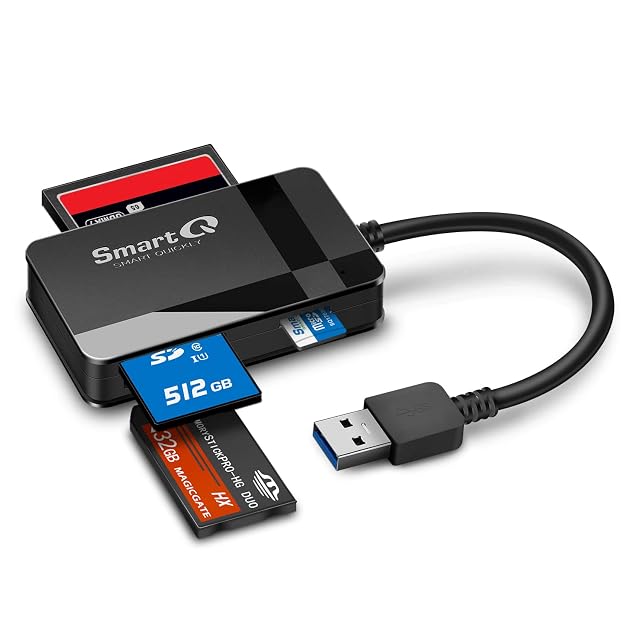
smartQ C368 multi reader, USB 3.0, CF, SD, MMC and Memory Stick families, four cards at once
The longest format list on this shelf, from CompactFlash down to Mini SD and the Memory Stick family, on a page that prints three USB rates and gets their unit letters into three different shapes.
Specifications
- Host interface standard
- USB 3.0 — stated in the title. The first bullet names three tiers rather than one: Super-Speed, High-Speed and Full-Speed, which are the class names of three USB generations
- Stated link rate
- Printed as Super-Speed (5 Gpbs), High-Speed (480 MBps) and Full-Speed (12 MBps) in the first bullet. The spellings and the unit letters are the listing’s own and they do not follow one another: the first reads as gigabits, the second and third carry a capital B where the class figures they name are bit rates. All three are quoted here exactly as the page prints them, and none is converted or corrected
- Connector type
- Not published on the listing — neither Type-A nor Type-C is named in the title or in the four bullets. The title states only that power is drawn over USB
- Internal or external form
- External and powered over USB — stated in the title, which names USB as the power source. No bay mounting and no internal header is described
- Slot count
- Not published on the listing as a number of slots. The third bullet gives a working limit instead: up to four different cards can be accessed at the same time. It is the only reader on this shelf that never states a slot count
- Formats accepted
- CF, SD, SDHC, SCXC, MMC, MMC Micro, RS MMC, Mini SD, Micro SD, MS Duo, MS Pro, MS Pro Duo and MS Pro HG Duo — the second bullet’s list, quoted in the order and the spelling the listing uses, including SCXC where the format family is normally written SDXC. It is the longest format list published on this shelf
- Simultaneous slot access
- Up to four different cards at once — stated in the third bullet as simultaneous access for simultaneous downloads
- Stated protocol support
- Not published on the listing — no UHS-I and no UHS-II mode is named anywhere, and no card-side standard is quoted. The page describes formats and never the bus modes behind them
- Cable arrangement
- Not published on the listing — no lead and no length is described. The title states that power comes over USB, which describes the supply and not the connection
- Amazon reference
- B06Y1G18KS (same reference on 6 Amazon marketplaces)
- EAN
- 4710836010376
On the listing
A SmartQ C368 USB 3.0 multi-card reader, plug and play, compatible with Apple and Windows machines, powered over USB and supporting CF, SD, SDHC, SCXC, MMC and MMC Micro among others; data transfer speeds given as Super-Speed (5 Gpbs), High-Speed (480 MBps) and Full-Speed (12 MBps); support for most standard memory cards including CF, SD, SDHC, SCXC, MMC, MMC Micro, RS MMC, Mini SD, Micro SD, MS Duo, MS Pro, MS Pro Duo and MS Pro HG Duo; simultaneous access to several cards for simultaneous downloads, up to four different cards; and plug-and-play operation with no software required.
Three rates, three shapes of unit
The first bullet is the one that needs quoting exactly, because tidying it would be inventing.
It reads: Super-Speed (5 Gpbs), High-Speed (480 MBps), Full-Speed (12 MBps).
Those three names are the standard class labels for three generations of USB, and the numbers beside them are the figures those classes are defined at. What does not follow is the notation. The first is written with its letters transposed; the second and third carry a capital B against figures that name bit rates. Read literally, the three units are not the same unit.
This page reports all three as the listing prints them. Correcting a maker’s printed figure is how a report quietly becomes a rewrite, and the shelf already carries one listing that prints the same number in two different units within a single page.
What the three tiers do communicate accurately is the fallback behaviour: this reader connects at whatever class the socket provides, and an older port produces an older class.
Thirteen names in the second bullet, and several of them have not appeared in a camera for fifteen years.
CF and SD and Micro SD are the modern part. MMC, MMC Micro, RS MMC and Mini SD are the middle era. MS Duo, MS Pro, MS Pro Duo and MS Pro HG Duo are the Memory Stick family, which lived and died inside one manufacturer’s cameras and camcorders.
That list is the longest on this shelf by some distance, and it is the whole argument for this reader. A modern two-slot SD and microSD unit will not touch most of it.
One entry is worth flagging as printed: the list includes SCXC, where the format family is normally written SDXC. The page quotes the list in the maker’s spelling.
Four cards at once, and no slot count at all
The third bullet gives simultaneous access to up to four different cards.
What it does not give — and what no line on this page gives — is how many slots the body actually has. Every other reader in this hub states a number: two, four or seven. Here the working limit stands in for the physical count, and those are not the same thing. A body may hold more slots than it can address at once, which is precisely the arrangement two other readers on this shelf publish.
So the honest reading is: at least four slots, four usable together, and the total unstated.
The bus modes that are never mentioned
No UHS-I. No UHS-II. No SD version number.
For the legacy formats that headline this listing that is irrelevant, since CF and MMC and Memory Stick do not use UHS modes at all. For a modern SDXC card it matters, because a slot with no UHS mode negotiated falls back to the older, slower bus, and the page gives no basis for expecting anything else.
Two readers in this hub name UHS-I and one names UHS-II. This one takes far more formats than any of them and says nothing about the modes behind any of them.
Before ordering
Buy this for the breadth of the format list rather than for a rate, because the rate section is the weakest part of the page. Expect the older bus mode on modern SD cards. And note that the connector shape is never named, so what plugs into the machine has to be confirmed with the seller.
Availability
Priced from 8 € to 10 € across the German, French, Italian and Spanish Amazon stores the day this page was checked.
It is stocked on the American and British Amazon stores as well, in that country’s own currency. The range above leaves those out: it counts euro stores and no others.
Every figure in this section is what Keepa held on the day this page was last updated. Stock and prices move without warning.
Prices quoted in this text were read on 10 September 2026. The live price is at the top of the page.