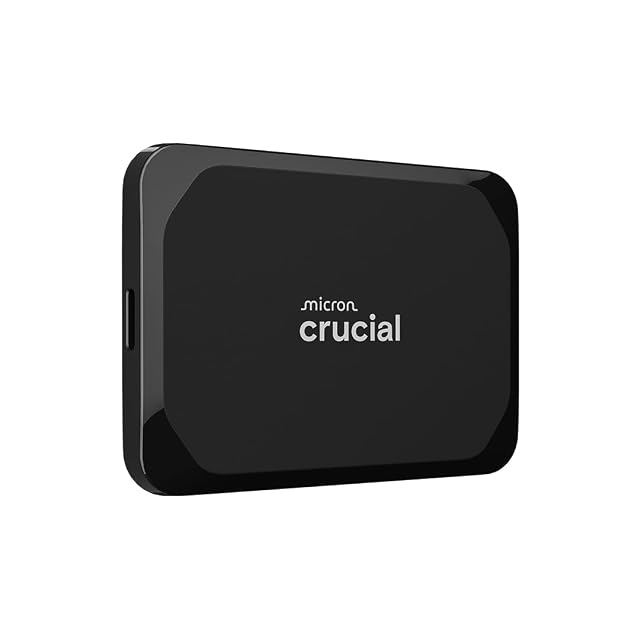
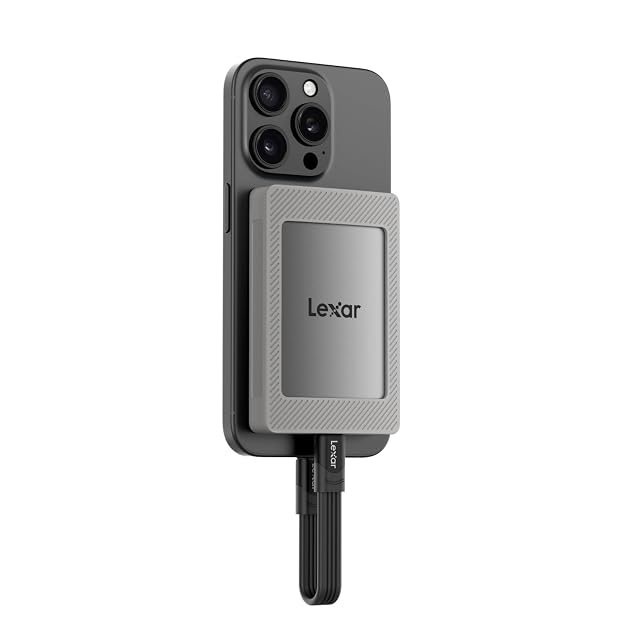
Two portable drives that both stop short in different places. The Crucial X9 1 TB prints USB-C 3.2 and stops before the generation — Gen 1 and Gen 2 are far apart in what they carry — and gives a reading rate with no writing rate beside it. The Lexar ES4 2 TB names USB 3.2 Gen 2 in full, publishes both rates, and ships a magnetic silicone case and a magnetic ring for hanging off a telephone. Neither states a warranty term.
Crucial X9 1 TB, a drop height and a generation left unfinished
X9 1 TB, a drop height and a generation left unfinished
ES4 2 TB, a magnet kit and an explicit limit on it
Capacity
1 TB, printed twice in the title; up to 4 TB is named across the range
2 TB, in the maker’s unit, no conversion applied
Interface standard
USB-C 3.2 — the connector shape and the family, stopping before the generation; Gen 1 and Gen 2 differ widely and neither is named
USB 3.2 Gen 2, written out in full twice
Stated link rate
Not published — no figure in gigabits per second
Not published as a figure in gigabits per second — the generation is named and both rates are in megabytes per second
Connector type
The symmetrical connector, in the title and named again for the lead
Not published as a socket on the drive — two leads are counted and neither names the end that meets the drive
Stated sequential read figure
Up to 1050 MB/s, beside multiples against portable spinning drives and flash sticks
Up to 1050 MB/s, named as a reading speed both times
Stated sequential write figure
Not published — storing games, photographs and video is described where a rate would go
Up to 1000 MB/s, fifty below the reading figure
Stated ingress or drop rating
Drop resistance from up to 2 m, with resistance to shock, vibration and temperature swings; no ingress code
Not published — no ingress code, no drop height, no shell material, on a drive supplied with a silicone case
Dimensions
Not published — the drive is called robust and reliable with no figure
Not published, on a product whose attachment to a telephone depends on its size
Weight
Not published
Not published, on a drive held to the back of a telephone by magnets
Cable supplied
A lead of the symmetrical shape is named as how the drive connects; no box list, so no length and no far-end plug
Two leads — one between symmetrical connectors, one ending in the older rectangular plug — with a magnetic silicone case and a magnetic ring; no length given
TBW rating
Not published
Not published
Stated MTBF
Not published
Not published
Warranty length
Not published, on a page that does give the lengths of two software trials in months
Not published, on a page that does name an encryption application
A tick means one listing published something the other did not, or published
a better figure. It does not mean the product is better, and the column is not
a score out of anything: a maker who says less loses lines here without losing
a comparison. The two verdicts below are where the page is settled.
Which one, for whom
Buy the Crucial X9 1 TB, a drop height and a generation left unfinished
The X9 is the smaller drive with the better armour claim: 2 m of drop resistance, plus shock, vibration and temperature. It names its connector plainly. What it will not tell you is how fast it writes — no figure appears anywhere — or which generation of USB 3.2 the socket belongs to, and those two omissions travel together, because the second decides the first.
Buy the Lexar ES4 2 TB, a magnet kit and an explicit limit on it
The ES4 is twice the capacity with both rates published and the generation stated in full, which makes it the better documented drive on the numbers that matter. The magnetic case and ring are a genuine use case rather than a gimmick — a drive that clings to the back of a phone while it records. Against that, no ingress code, no drop height, no weight and no dimensions, on a product whose whole premise is that it hangs off something.
The questions that come up before an order
Why is “USB-C 3.2” not enough?
Because 3.2 is a family, not a speed. Gen 1 and Gen 2 of that family carry very different amounts, and a page that stops at the family has not said which. The Lexar page writes Gen 2 out; the Crucial page does not, which is why the interface row goes to Lexar even though both drives quote 1050 MB/s for reading.
Does a magnetic case affect the drive?
The listing does not say. What it does say is where the magnets stop: wireless charging through them is not supported, stated outright on the page, which is exactly the assumption the design invites. This site records the accessory as supplied and makes no claim about what magnets do to a solid-state drive, because the maker makes none either.
1 TB · USB-C 3.2, generation not published · up to 1050 MB/s read · drop resistance to 2 m · one lead named, no length · no write figure · no TBW, no MTBF, no warranty
A one-terabyte portable drive that publishes a drop height and a single reading figure, names a lead without measuring it, and stops its interface designation one word short of a generation.
Best for: A laptop bag where a drive gets knocked about, and where the published drop height and the named backup arrangements matter more than a second rate.
2 TB · USB 3.2 Gen 2 · up to 1050 MB/s read · up to 1000 MB/s write · magnetic case and ring supplied · two leads in the box · encryption at 256 bits · no dimensions, no weight · no TBW, no MTBF, no warranty
A two-terabyte portable drive supplied with a magnetic case and ring, whose first bullet states outright what the magnets will not do, and whose page publishes both rates and no endurance quantity.
Best for: A recent telephone used for filming, where the magnetic case is the point and the drive will spend its life attached rather than in a bag.