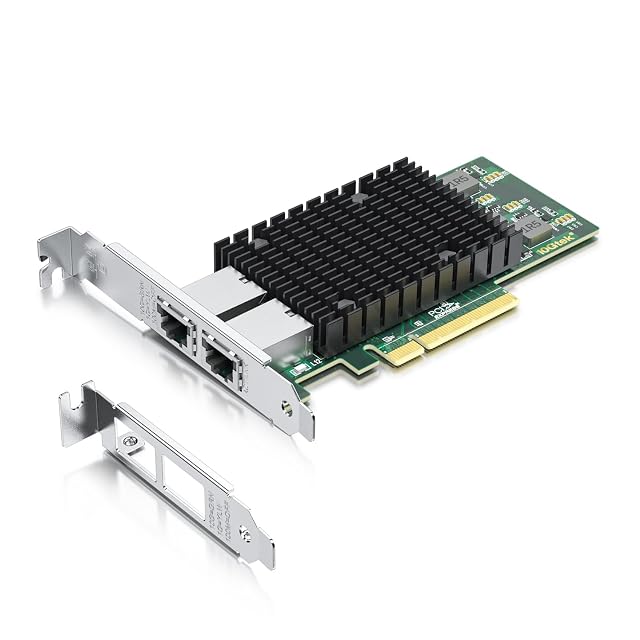
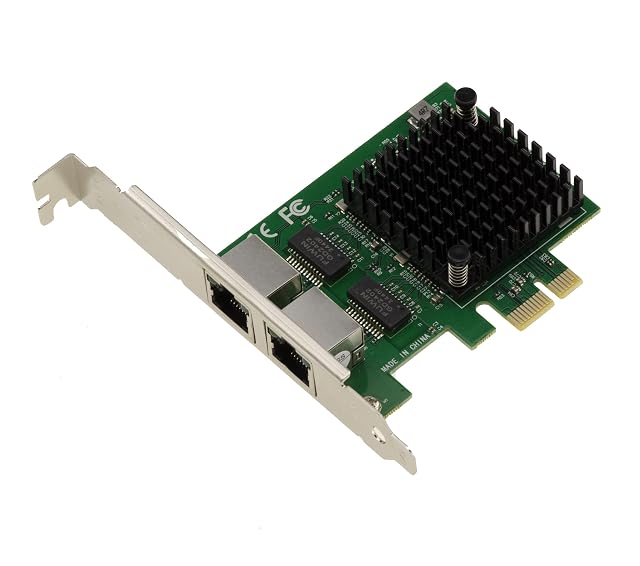
10Gtek X540-T2, dual-port ten-gigabit copper card on PCIe 2.1 ×8 vs KALEA-INFORMATIQUE 11888237, dual-port 2.5-gigabit card on PCIe 3.1 ×1 with two Intel I226 controllers
Ten gigabits on eight lanes, or two-and-a-half on one lane that fits anything?
The two best documented cards on this shelf, pulling in opposite directions. The 10Gtek X540-T2 is 10GBASE-T on an Intel X540, PCIe 2.1 ×8, and states outright that 2.5G and 5G are not supported — an unusually useful sentence. The KALEA-INFORMATIQUE 11888237 is PCIe 3.1 ×1, fits any connector from ×1 upwards, carries two Intel I226 controllers behind an ASM bridge, and lists operating systems back to Windows 98SE.
10Gtek X540-T2, dual-port ten-gigabit copper card on PCIe 2.1 ×8
X540-T2, dual-port ten-gigabit copper card on PCIe 2.1 ×8
11888237, dual-port 2.5-gigabit card on PCIe 3.1 ×1 with two Intel I226 controllers
PCIe generation
PCI Express 2.1, with a signalling figure of 5.0 GT/s
PCIe 3.1, described as a ×1 card compatible with ×1, ×2, ×4, ×8 and ×16 connectors
Lane count
Eight, named as an ×8 arrangement suitable for ×8 and ×16 connectors — the only card here to pair its lane count with the connectors that accept it
One, stated as the requirement of the card; what the two sockets can carry through it together is never said
Port speed standard
10GBASE-T over copper, supporting 100M, 1G and 10G, and stating in the same sentence that 2.5G and 5G are not supported
2500BASE-T, 1000BASE-T, 100BASE-TX and 10BASE-Te, with IEEE 802.3bz, 802.3ab, 802.3u and 802.3 named behind them
Port count
Two copper RJ45
Two RJ45 on a dual-chipset card
Controller family
Intel X540, named as the original controller chip with intelligent offloads
Two Intel I226, marked SRKTU, joined by an ASM bridge — the only card here with two controllers rather than one
Bracket heights supplied
Stated twice and not identically — one bullet names a standard and an additional low-profile bracket, the contents list names one card and one low-profile bracket and stops
Two, high-profile and low-profile
Cooling arrangement
Not published — no heatsink, no fan, no reference to temperature, on the only ten-gigabit copper card here
Not published — no heatsink, no fan, no reference to temperature, on a card carrying two controllers and a bridge
Stated operating system support
Windows Server 2003, 2008 and 2012, Windows 7 and 8, Linux and ESX or ESXi 6 and 7, with Windows 11 usable only by hand and buyers asked to make contact first
Windows ME through 11 in 32-bit and 64-bit, Windows Server including 2025, FreeBSD, Linux, VMware and Mac — by some distance the longest such list here
A tick means one listing published something the other did not, or published
a better figure. It does not mean the product is better, and the column is not
a score out of anything: a maker who says less loses lines here without losing
a comparison. The two verdicts below are where the page is settled.
Which one, for whom
Buy the 10Gtek X540-T2, dual-port ten-gigabit copper card on PCIe 2.1 ×8
The X540-T2 is the ten-gigabit card, and the sentence that makes it worth buying is the one saying what it will not do: no 2.5G, no 5G. A switch offering only those rates will fall back to a gigabit, and knowing that before ordering saves an afternoon. It needs an ×8 connector, it runs an Intel X540, and its own page tells Windows 11 users to get in touch before buying — which is a warning, and should be read as one.
Buy the KALEA-INFORMATIQUE 11888237, dual-port 2.5-gigabit card on PCIe 3.1 ×1 with two Intel I226 controllers
The 11888237 fits anything with a PCIe connector, including a ×1, which is what makes it the card for a small or old machine. Two Intel I226 controllers behind a bridge, standards named socket by socket, both brackets in the box, and an operating system list running from Windows 98SE to Server 2025. What it never says is what a single lane can carry with both sockets busy — and on a card whose whole selling point is that lane, that is the number worth having.
The questions that come up before an order
Will the 10Gtek card work on a 2.5-gigabit switch?
Its page says 2.5G and 5G are not supported, so the link would negotiate down to the highest rate both ends share — a gigabit. That is the value of the sentence: a card that lists 100M, 1G and 10G and excludes the two in between is telling you exactly which switches it suits. Very few listings on this shelf are that direct.
Is one PCIe lane enough for two 2.5-gigabit sockets?
The listing does not say, and this site will not put a figure on it that the maker did not publish. What the page does establish is the requirement — a ×1 connector — and what it leaves open is the throughput of both sockets at once. If both are going to run hard at the same time, that gap is the thing to weigh.
two RJ45 sockets · 10GBASE-T copper · 100M / 1G / 10G, no 2.5G or 5G · PCIe 2.1 ×8 · Intel X540 · Cat 6A to 100 m, Cat 6 to 55 m
A dual-socket ten-gigabit copper card that publishes its slot, its cable grades and its distances, and states in as many words the two intermediate rates it does not support.
Best for: A server or a workstation with a real ×8 connector and copper runs already in the walls, where ten gigabits are the point and the intermediate rates are not needed.
two RJ45 sockets · 2500/1000/100/10 BASE-T · PCIe 3.1 ×1 · dual Intel I226 SRKTU with an ASM bridge · high and low brackets · jumbo frames to 9.5 KB
The only card on this shelf that publishes a PCIe generation and a lane count, and it puts two 2.5-gigabit sockets behind a single lane and says so.
Best for: A small server or a workshop machine that needs two separate 2.5-gigabit sockets from one slot, where the ×1 requirement is a fit rather than a compromise.