Skip to content

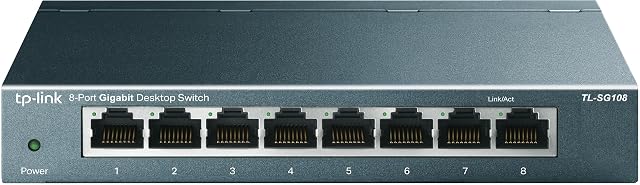
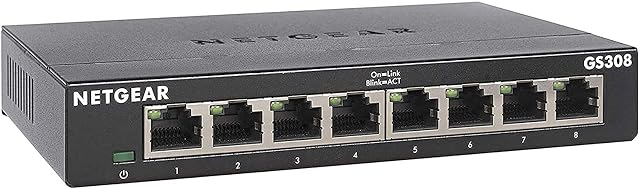
TP-Link TL-SG108, eight-port unmanaged gigabit switch in a metal case vs NETGEAR GS308, eight-port unmanaged gigabit switch with an on-off switch

Two near-identical switches — what is left when everything else matches?

Eight gigabit sockets, unmanaged in that word, fanless, metal, desk or wall. The TP-Link TL-SG108 and the NETGEAR GS308 agree on all of it. What separates them is small and real: the TP-Link names 802.1p and DSCP traffic priority and IGMP snooping as built-in behaviours and lists an external adapter in the box; the NETGEAR names Cat5e and Cat6, an on-off switch on the case, and never says where its power comes from.

TP-Link TL-SG108 eight-port gigabit network switch in a blue metallic metal case

TP-Link TL-SG108, eight-port unmanaged gigabit switch in a metal case

Wins 2 of 8

Check price

≈ £22 / 21 €

NETGEAR GS308 eight-port gigabit network switch in a metal case with an on-off switch

NETGEAR GS308, eight-port unmanaged gigabit switch with an on-off switch

Wins 2 of 8

Check price

≈ 21 €

Line by line

Compared on TL-SG108, eight-port unmanaged gigabit switch in a metal case GS308, eight-port unmanaged gigabit switch with an on-off switch
Port count Eight RJ-45 sockets Eight Ethernet sockets at 1.0 Gbps
Port speed 10/100/1000 Mbit/s on all eight; no BASE-T designation printed 1.0 Gbps negotiated automatically, with Cat5e and Cat6 named as the cable grades
Managed or unmanaged Unmanaged, in that word, with no configuration required; the 802.1p and DSCP priority and the IGMP snooping named are built-in behaviours rather than settings Unmanaged, in that word, with no software to install; the unit is described as Layer 2
Stated switching capacity Not published — no whole-unit total, and the only rate given belongs to one socket Not published — no whole-unit total, and the only rate given is the 1.0 Gbps of one socket
Fanless or fan-cooled Fanless, in the title, with no fan named anywhere Fanless, twice, with 802.3az energy-efficient Ethernet named as lowering consumption without reducing speed
Case material Metal, in blue metallic, named twice Metal, named twice, described as robust and compact
Desktop or rack mounting Desk or wall; no rack ears and no rack unit height named Desk or wall; no rack ears and no rack unit height named
Power supply type External adapter, listed in the box with the unit and a quick installation guide Not published — an on-off switch is named on the case, and nothing says whether the power behind it is external or internal

A tick means one listing published something the other did not, or published a better figure. It does not mean the product is better, and the column is not a score out of anything: a maker who says less loses lines here without losing a comparison. The two verdicts below are where the page is settled.

Which one, for whom

Buy the TP-Link TL-SG108, eight-port unmanaged gigabit switch in a metal case

The TL-SG108 is the one that tells you what arrives in the box: unit, guide, power adapter. It also names the traffic-priority behaviours it applies without being asked — 802.1p, DSCP, IGMP snooping — which on an unmanaged switch is worth knowing precisely because you cannot change them. Everything else here matches its rival almost line for line.

Buy the NETGEAR GS308, eight-port unmanaged gigabit switch with an on-off switch

The GS308 names the cable grades its sockets expect and puts 802.3az behind its fanless claim, which is the mechanism rather than the assertion. Its on-off switch is a genuinely useful thing on a switch that lives behind a desk. The gap is the supply: the page names a switch on the case and never says what feeds it, so whether a brick has to be found room for is unanswered.

The questions that come up before an order

Does “unmanaged” mean nothing is happening?

No. The TP-Link page names 802.1p and DSCP traffic priority and IGMP snooping, all of which apply automatically; the NETGEAR names Layer 2 operation and 802.3az. Unmanaged means there is no page on which to change any of it. The behaviours are fixed in the hardware, which is why the listing is the only place to find out what they are.

Neither publishes a switching capacity. Should it worry me?

On an eight-socket gigabit switch, rarely. The quantity counts every socket running at full rate in both directions at once, and units of this class are normally built for it. It is worth having on the page — the ZYXEL GS-108BV5 on this shelf publishes 16 Gbps — but its absence here is a documentation gap rather than an obvious limitation.

The full reviews

Every price named in a summary was read on the date that review carries. What a shop asks today is shown beside the product, and it moves.