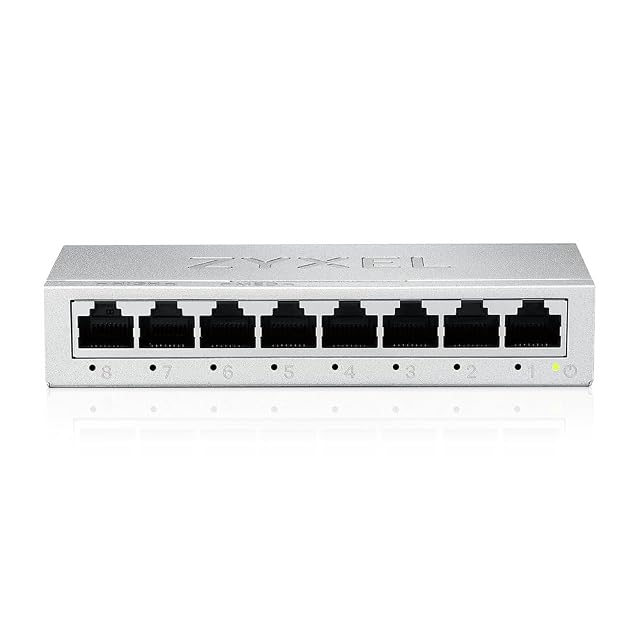
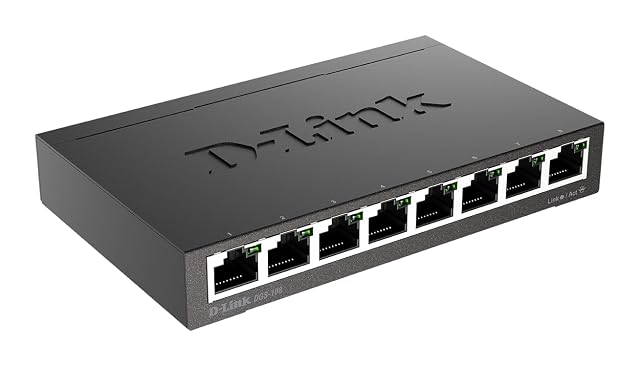
Both are eight-socket gigabit switches in fanless metal cases, and only one of them publishes a figure for the whole unit. The ZYXEL GS-108BV5 gives 16 Gbps of switching capacity, 11.5 Mpps of forwarding, a 192 KB buffer, 9 KB jumbo frames and 0.57 W at idle. The D-Link DGS-108 quotes up to 2000 Mbit/s per socket in full duplex — which is one gigabit link with its two directions added together.
ZYXEL GS-108BV5, eight-port unmanaged gigabit switch with fixed traffic priority
GS-108BV5, eight-port unmanaged gigabit switch with fixed traffic priority
DGS-108, eight-port Layer 2 gigabit switch in a metal case
Port count
Eight, all at the same rate with no setup
Eight, with fast exchange between up to eight devices described
Port speed
Up to 1000 Mbps on all eight, with computers, storage, telephones and printers named as the devices for them
Gigabit, quoted by the maker as up to 2000 Mbit/s per socket in full duplex — the two directions of one link added together rather than a rate in either direction
Managed or unmanaged
Unmanaged, in that word, with a fixed priority arrangement: sockets 7 and 8 carry voice at high priority, 5 and 6 carry transfers at medium, with no page on which to change it
Not published as either word — the unit is ready to use straight away, and its QoS and multicast filtering are built-in behaviours with no page on which to change them; the title names it Layer 2
Stated switching capacity
16 Gbps, with 11.5 Mpps of forwarding, a 192 KB buffer and 9 KB jumbo frames — the capacity counts every socket at full rate in both directions at once, which is what the quantity means
Not published as a whole-unit total — a non-blocking architecture is named and no figure adds the eight sockets together
Fanless or fan-cooled
Fanless, quoted at 0 dBA at all times, with 802.3az named as bringing idle consumption to 0.57 W
Fanless, in the title, with no fan named in any bullet
Case material
Metal, robust, with a wall-mounting kit supplied
Metal, in black, named twice
Desktop or rack mounting
Desk, wall or cupboard, with the wall-mounting kit included; no rack ears and no rack unit height named
Not published — no mounting arrangement of any kind, and no holes, feet, ears or brackets
Power supply type
Not published — the idle draw of 0.57 W is given and nothing says whether the power behind it is external or internal
Not published — automatic power-saving is named and nothing says where the power comes from
A tick means one listing published something the other did not, or published
a better figure. It does not mean the product is better, and the column is not
a score out of anything: a maker who says less loses lines here without losing
a comparison. The two verdicts below are where the page is settled.
Which one, for whom
Buy the ZYXEL GS-108BV5, eight-port unmanaged gigabit switch with fixed traffic priority
The GS-108BV5 is the best documented unmanaged switch on this shelf. It publishes the whole-unit capacity, the forwarding rate, the buffer, the jumbo frame size and the idle draw, and it supplies a wall-mounting kit. Its fixed priority arrangement is worth reading before buying rather than after: sockets 7 and 8 favour voice, 5 and 6 favour transfers, and no page exists on which to move that.
Buy the D-Link DGS-108, eight-port Layer 2 gigabit switch in a metal case
The DGS-108 is a sound eight-socket switch behind a figure that needs unpicking. Up to 2000 Mbit/s per socket in full duplex is one gigabit link counted in both directions at once — it is not two gigabits of traffic in either. Beyond that, the page names a metal case and a non-blocking architecture and stops: no capacity total, no mounting, no supply, and neither the word managed nor unmanaged anywhere on it.
The questions that come up before an order
Is 2000 Mbit/s per socket twice as fast as 1000?
No. It is the same gigabit link with its two directions added together — a thousand out and a thousand back, counted once. Nothing on a single connection moves at two gigabits. It is a legitimate way to state full duplex and a misleading number to compare against a per-direction figure, which is why this comparison prints it with the explanation attached.
What is a switching capacity actually counting?
Every socket running at full rate in both directions at the same time. On an eight-socket gigabit switch that comes to 16 Gbps, which is the figure ZYXEL publishes — so the unit is built to carry all eight without a bottleneck inside. D-Link names a non-blocking architecture instead, which says the same thing in words and not in numbers.
An unmanaged switch that publishes a capacity, a forwarding rate, a buffer size and an idle consumption, and prioritises voice traffic on two fixed sockets without a settings page.
Best for: A home office running a telephone over the network, where the two priority sockets can be used as the maker intends and where the unit has to be silent.
eight gigabit sockets · up to 2000 Mbit/s per socket in full duplex, stated · non-blocking architecture · Layer 2 · fanless · metal case, black
An eight-socket gigabit switch whose headline figure counts both directions of one socket at once, and which never says where the unit is meant to be mounted.
Best for: A shelf or a desk where the unit can simply sit, and where multicast television and a quiet metal case matter more than knowing how it mounts.