Twenty-two switch makers named, and one strand carrying both directions
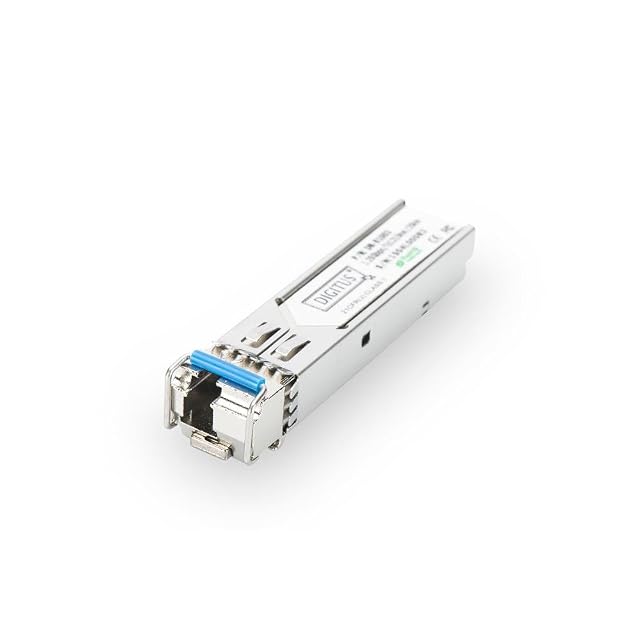
DIGITUS DN-81003, bidirectional single-mode SFP, Tx 1310 / Rx 1550 nm, 20 km stated
A single-strand module that sends on one wavelength and listens on another, sold with the longest list of switch makers on this shelf and without the reversed counterpart that a link of this kind cannot work without.
Specifications
- Module form factor
- SFP, called a mini GBIC in the title — the gigabit cage. The second bullet gives the operating mode as single-mode, LC simplex, bidirectional
- Module rate
- Up to 1.25 Gbit/s — stated in the title and in the fourth bullet, and repeated in the seventh as a maximum data rate of 1.25 Gbps. The eighth bullet names IEEE 802.3z as the gigabit standard it meets
- Optical or copper medium
- Optical — the sixth bullet calls it a plug and play fibre connection, and the second names a single-mode simplex LC port
- Fibre type
- Single-mode — stated in the title and in the second bullet. The grade is not published on the listing: no OS1 or OS2 designation appears, and the maker gives a pair of wavelengths and a distance instead
- Stated reach
- Up to 20 km — stated in the title and in the fourth bullet, which prints the rate and the distance in the same line
- Connector type
- LC simplex — a single position rather than a duplex pair, stated in the title and in the second bullet, because both directions travel on the same strand of glass
- Wavelength
- Tx 1310 nm and Rx 1550 nm — stated in the title and in the third bullet. A module with those two reversed has to sit at the far end, and the listing does not say whether one is supplied, sold beside it or left to the buyer to find
- Vendor coding stated
- Twenty-two makers are listed in the first bullet — Ubiquiti, Allied Telesis, Allnet, CISCO, D-Link, Edimax, Intellinet, KTI Networks, Level One, PLANET, Tenda, TP-Link, TRENDnet, ZyXEL, ZTE, Avaya, Mikrotik, ENTERASYS, FINISAR, FORCE 10, RIVERSTONE and Fortinet. No coding scheme and no part number is named against any of them
- Operating temperature range
- 0 °C to +70 °C — stated in the fifth bullet as the operating temperature range
- Amazon reference
- B00609EB0K (same reference on 6 Amazon marketplaces)
- EAN
- 4016032305682
On the listing
A gigabit SFP module described as a mini GBIC, single-mode, LC simplex and bidirectional, transmitting at 1310 nm and receiving at 1550 nm, with a data transfer rate given as up to 1.25 Gbit/s and a transmission range of up to 20 km; an operating temperature range of 0 °C to +70 °C; compliance with the IEEE 802.3z gigabit standard; a plug and play fibre connection; and a first bullet listing twenty-two makers whose equipment the module is said to be compatible with, from Ubiquiti and Cisco to Fortinet.
One strand, two wavelengths
Every other optical module on this shelf uses two strands of glass. This one uses one. It transmits at 1310 nm and receives at 1550 nm, and because those are different wavelengths the two directions can travel down the same fibre without ever meeting.
That is a real saving where glass is the expensive part — a duct with two strands in it becomes a duct with two links in it. The title says 20 km and the fourth bullet says the same, so the saving holds over a serious distance.
The module at the other end
Here is what the page does not tell you, and it is the thing that decides whether this purchase works at all.
A module transmitting at 1310 and listening at 1550 can only speak to a module transmitting at 1550 and listening at 1310. Two of these, bought together, would be deaf to each other. The far end has to be the mirror image, and this listing describes one module without saying where the mirror image comes from, whether it is stocked, or what it costs.
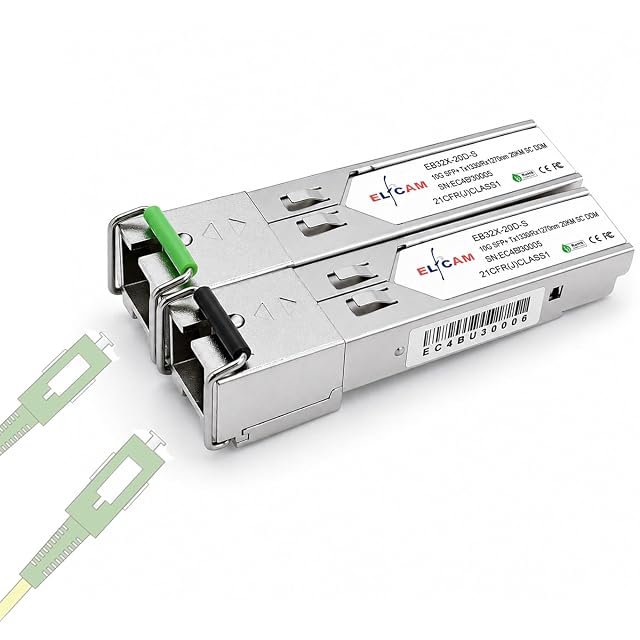
Neither of the two bidirectional listings on this shelf is priced per link. One of them ships the pair; this one does not say.
Twenty-two names and no part numbers
The first bullet is the longest compatibility statement in this hub: twenty-two makers, from the household ones to Enterasys, Force 10 and Riverstone.
Read what it actually contains. Brands, and nothing under them — no switch model, no module part number, no coding scheme. A switch that reads a vendor code is not checking a brand list; it is checking a string. So this bullet tells you where the seller believes the module has worked, and the switch maker’s own published module list remains what tells you whether yours will accept it.
Before ordering
Buy two, or confirm that the reversed counterpart exists and is available, because a single bidirectional module cannot form a link with anything. Check your switch maker’s module list rather than the twenty-two names here. Then ask what grade of single-mode fibre is in the duct — the page gives wavelengths and kilometres, and never the glass they assume.
Availability
Priced from 13 € to 20 € across the German, French, Italian and Spanish Amazon stores the day this page was checked.
It is stocked on the American and British Amazon stores as well, in that country’s own currency. The range above leaves those out: it counts euro stores and no others.
Every figure in this section is what Keepa held on the day this page was last updated. Stock and prices move without warning.
Prices quoted in this text were read on 10 September 2026. The live price is at the top of the page.