Names its power supply and its switch, which most docks never do
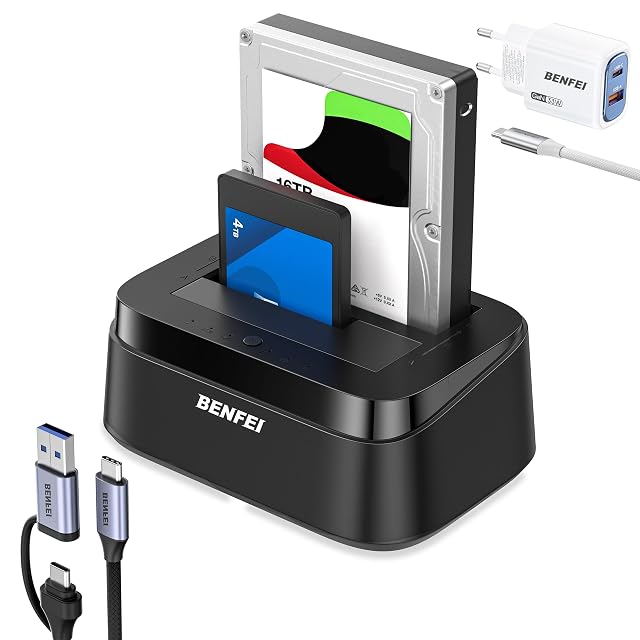
BENFEI dual-bay SATA dock, USB 3.0 at 5 Gbps, offline clone on a three-second press, 12 V/2.5 A supply
The dock that publishes the two things most of this shelf leaves out — a 12 V/2.5 A supply rated for two spinning drives, and a power switch to protect them while they are fitted.
Specifications
- Bay count
- Two — stated in the title and in the first bullet, which describes reading, writing and transferring in parallel between two 2.5-inch or 3.5-inch drives
- Supported drive sizes
- 2.5-inch and 3.5-inch — stated in the title and in the first bullet
- Supported drive interfaces
- SATA hard discs and solid-state drives — stated in the title and in the first bullet. No SATA revision is named
- Solid-state slot support
- Not published on the listing — no M.2 position is named. Solid-state drives are supported in the two SATA bays and no separate slot exists
- Offline cloning
- Stated — the second bullet says the CLONE button is held for three seconds to transfer all data from the source drive to the destination without a computer, and notes that the destination must be equal to or larger than the source
- Interface standard
- Two designations are published: the title says USB 3.0 and the third bullet says USB 3.1 Gen 1. Both are printed and neither is withdrawn
- Stated link rate
- Up to 5 Gbit/s — stated in the title and in the third bullet
- Connector type
- Type-C — stated in the title as a USB-C docking station. No cable is named in any bullet
- UASP support
- Stated — the third bullet names UASP, the USB Attached SCSI Protocol, and claims it speeds transfers by up to 20 % against conventional USB 3.0. The same maker’s 2.5-inch enclosure on the enclosures shelf of this site puts the figure at 70 %
- Power supply
- A dedicated 12 V/2.5 A adapter — stated in the fourth bullet, which says it gives a stable supply to both bays and reliable operation even with two demanding 3.5-inch hard discs. It is the higher of the two current ratings published on this shelf
- Per-bay controls
- A single integrated power switch is stated in the fourth bullet, described as protecting the drives while they are connected and removed, with an instruction to switch the unit off before fitting or removing a drive. No per-bay switch and no per-bay indicator is published
- Amazon reference
- B0GTVMFGPT (same reference on 5 Amazon marketplaces)
- EAN
- 6971785945371
On the listing
A USB-C dual-bay drive docking station with offline cloning for 2.5-inch and 3.5-inch SATA HDDs and SSDs, USB 3.0, 5 Gbps, UASP, tool-free; parallel reading, writing and transfer between two drives, offered for backups, migrating a system to a new drive and expanding storage; offline cloning at the press of the CLONE button held for three seconds, transferring all data from the source to the destination without a computer, with a note that the destination must be equal to or larger than the source; USB 3.1 Gen 1 transfer at up to 5 Gbit/s with UASP claimed to speed transfers by up to 20 % against conventional USB 3.0; a dedicated 12 V/2.5 A power supply giving a stable supply to both bays even with two demanding 3.5-inch hard discs, with an integrated power switch protecting the drives during connection and removal and an instruction to switch off first; and an 18-month warranty.
Twelve volts, two and a half amps
Five of the seven docks in this hub never mention how they are powered. This one gives both numbers and says what they are for.
Two 3.5-inch mechanisms spinning up simultaneously is the peak load a dock ever sees, and it is where an inadequate adapter fails — not with a bang, but with a drive that disappears mid-copy or a device that works with one disc and not two.
The fourth bullet gives 12 V and 2.5 A and names that exact case: reliable operation even with two demanding 3.5-inch hard discs. It is the higher of the two current ratings published on this shelf.
That is a claim a buyer can check rather than trust, which is the whole difference between a specification and an adjective.
The switch, and the instruction with it
The same bullet describes an integrated power switch and then tells you when to use it: switch the unit off before connecting or removing drives.
A SATA connector mated under power is the moment things go wrong, and every dock user has done it because there was no switch and no reason given. Publishing the instruction alongside the hardware that makes it possible is the useful version of a safety note.
Three seconds, and the capacity rule
The second bullet covers the clone in one line: hold CLONE for three seconds, and the destination must be equal to or larger than the source.
Both halves are worth having and one of them has a sting. Equal or larger is the condition; what follows from it, and what the bullet does not say, is that everything already on the destination is overwritten.
This site describes the function as duplication rather than as a way of keeping data safe. The first bullet uses the word backup for it; a clone is a copy of one moment on the same desk, and it survives none of the events a backup arrangement exists for.
Two names for one interface
The title says USB 3.0. The third bullet says USB 3.1 Gen 1.
Both are printed and both describe a five-gigabit link — they are two naming conventions for the same class, adopted at different times. Nothing on the page reconciles them, so both are reported here rather than one being tidied away.
Twenty per cent, and seventy
The third bullet puts the UASP gain at up to 20 % against conventional USB 3.0.
The same maker’s 2.5-inch enclosure, on the enclosures shelf of this site, puts it at 70 %.
Both figures are the maker’s own and both appear where they appear. The gap is a reminder of what such a percentage is: the result of one measurement in one set of conditions, not a property of the protocol. UASP is worth having either way, and the number attached to it should be read as a claim rather than a constant.
Before ordering
Note that no capacity ceiling is published anywhere on this page, unlike four of the other docks here, so a very large drive is a question for the seller. Ask what cable is in the box. And use the switch: the listing tells you to, and it is the reason it is there.
Availability
Priced from 24 € to 33 € across the German, French, Italian and Spanish Amazon stores the day this page was checked.
In the British Amazon catalogue with no live offer against it: the reference exists, nobody is filling it.
The American Amazon store returned nothing at all, so the buy button there opens a search in that country rather than a page that would not load.
Every figure in this section is what Keepa held on the day this page was last updated. Stock and prices move without warning.
Prices quoted in this text were read on 10 September 2026. The live price is at the top of the page.