Use solid cable for the run and stranded cable for the leads
The two are not interchangeable, and the reason is mechanical rather than electrical.
A solid conductor is a single wire. It is what a fixed run wants: it terminates cleanly into the displacement contacts of a keystone module or a patch panel, it holds its position, and it takes the crush of a wall plate without deforming. It does not like being flexed repeatedly, which is exactly what a fixed run never asks it to do.
A stranded conductor is many fine wires. It bends endlessly without fatiguing, which is what a lead between a faceplate and a laptop needs, and it does not seat reliably in the contacts designed for a solid wire.
So: solid cable from the cabinet to the faceplate, factory-made stranded leads at both ends. Buying a box of solid cable and crimping plugs onto both ends of it is the arrangement that produces intermittent faults a year later, and intermittent is the worst kind.
Decide the category once, for the whole building
A category is a grade the finished channel has to meet, written in terms of frequency, loss and crosstalk. It belongs to the link, not to the jacket the words are printed on: a Category 6A cable terminated into Category 5e modules gives you a Category 5e channel and an expensive drum of cable.
Choose one grade, then buy modules, panels and faceplates rated for it. Mixing grades within a run is the commonest way to spend money on a specification and not receive it.
Screening is a separate decision from the category, and one with a condition attached: a screened cable only earns its keep when the screen is continuous through the modules, the panel and the equipment, with a path to earth that the manufacturer’s instructions define. A screened cable terminated into unscreened modules is an unscreened channel that was more difficult to install. In most homes, unscreened cable of an appropriate category is the ordinary answer, and the exception is a run that has no choice but to travel alongside something noisy.
Plan the route on paper, then pull it gently
Work out where the cable enters and leaves, what it passes through and what it passes near, before the first hole. Two things then govern the pull itself, and both are published by the cable maker rather than invented on site.
The first is pulling tension. Cable makers state a maximum, and exceeding it stretches the conductors and disturbs the twist that the category depends on. In practice: pull by hand, never with a winch or a car, and never round a corner — feed at the corners instead.
The second is bend radius. Makers publish a minimum, usually as a multiple of the cable’s outside diameter, and a cable folded tighter than that has had its geometry changed permanently. The place this happens is not the long route but the last ten centimetres behind a faceplate, where the installer has forced the slack into a shallow back box.
Pull more cable than the measurement says. Slack at both ends is what lets you terminate a second time after the first attempt fails a test, and the first attempt sometimes does.
Terminate into a module or a panel, and crimp a plug only where you must
At a faceplate, a keystone module is the right termination; in a cabinet, a patch panel is the same idea in quantity. Both use insulation displacement contacts, which cut through the insulation as the conductor is pushed home, and both are designed around solid cable.
Crimping a plug directly onto a run is the arrangement to avoid where a module is possible. It is harder to do repeatably, it leaves the cable’s end unprotected, and it turns every future change at that end into a re-crimp. Where a plug genuinely is the answer — a run into a device with no socket to put a faceplate near — use plugs matched to the conductor type and to the cable’s outside diameter, and use a crimping tool that seats all eight contacts in one stroke.
The pass-through style of plug, where conductors emerge from the front and are trimmed by the tool, exists because it makes ordering easier to verify. It is still a crimp, and it still needs the right plug for the right cable.
Keep the twist right up to the contact
This is the one step that separates a run that certifies from a run that mostly works, and it costs nothing.
Each pair in the cable is twisted at its own rate, and that twist is what cancels interference between it and its neighbours. Every millimetre of untwisted conductor at the termination is a millimetre with no cancellation. So: strip only as much jacket as the module needs, keep the pairs twisted as close to the contacts as the module’s own layout allows, and untwist only the last part that has to lie flat.
Two habits follow from the same principle. Do not strip a long tail of jacket to make the wires easier to sort — sort them short. And do not over-tighten cable ties on the bundle behind the panel; a tie pulled hard enough to dent the jacket has changed the spacing of the pairs inside it. Hook-and-loop wraps, done up loosely, hold a bundle perfectly well.
Label both ends before you close anything up
Write the same identifier on the panel port and on the faceplate, in permanent marker on the cable jacket as well as on the label window. A run without a label is a run somebody traces with a tone probe in five years, and tracing takes far longer than labelling.
Number the ports in an order that matches the building rather than the order you happened to terminate them in, and put a printed map inside the cabinet door.
Test each run before you move to the next one
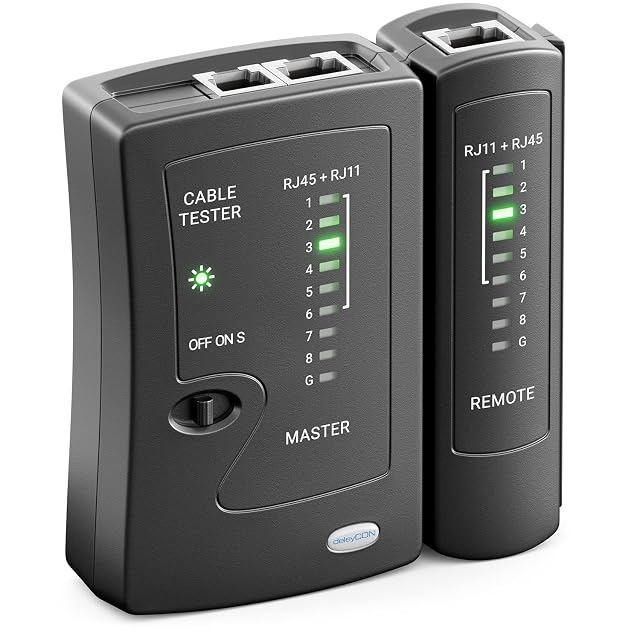
Terminate both ends, put a wiremap tester on the pair of them, and confirm that all eight conductors arrive where they should, in the right pairs, with nothing shorted and nothing crossed. That is the fault class that termination introduces, and it is far quicker to fix while the tools are still out.
Testing at the end of the day, after eight runs, means finding one fault and not knowing which of eight terminations caused it. Testing as you go means finding it while your hands are still on it.
A wiremap check is not a category certification. Certifying a channel against a grade needs an instrument that measures loss and crosstalk against the published limits, and that is the tool an installer brings.
Where the run goes near the fixed wiring, the rules are not ours
Separation from mains cabling, what may cross a fire compartment, which jacket materials a route requires, penetrations through a floor or a ceiling, and anything at all involving the fixed electrical installation are governed by the wiring and building rules that apply where you live, and by the manufacturer’s instructions for the products involved. Those rules differ between countries and they are not a matter of preference. Plan the route, then have anything that touches the fixed installation done by somebody qualified to do it.
The questions that come up before an order
Can I just run a long ready-made patch lead instead?
For a single room, along a skirting board and inside trunking, yes — and it is a perfectly respectable answer. It stops being the right one when the lead has to pass through a wall or a floor, because the moulded plug forces a hole far larger than the cable needs, and because stranded cable is not built for a fixed installation.
Does it matter which of the two wiring schemes I use?
Only that you use the same one at both ends of every run in the building. The two schemes swap a pair over; a run terminated to one at the panel and the other at the faceplate produces a crossover, which some equipment quietly works around and some does not. Pick one, write it on the cabinet door, and never think about it again.
How do I know the run is good before the walls close up?
Terminate both ends and put a tester on it while the cable is still reachable. A basic wiremap tester tells you that all eight conductors arrive at the pin they should, in the right pairs, which is the fault class that termination introduces. Anything more searching than that is a job for an instrument that certifies against the category.
Last reviewed 10 September 2026