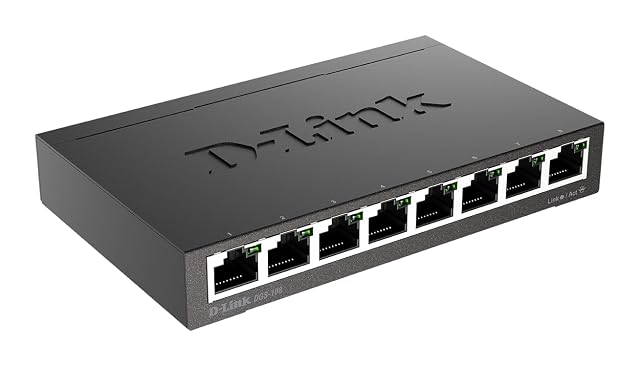
An unmanaged switch that publishes a capacity, a forwarding rate, a buffer size and an idle consumption, and prioritises voice traffic on two fixed sockets without a settings page.
The bottom line The most numerate page on this shelf, and the numbers are the right ones: a capacity, a forwarding rate, a buffer, an idle draw. The priority arrangement is real but fixed, so it only helps if the cables are plugged in where the maker assumed.
On the listing
Eight sockets delivering up to 1000 Mbps with no setup; voice traffic prioritised on sockets 7 and 8 and transfers on sockets 5 and 6; a robust metal case with a wall-mounting kit supplied, for desk, wall or cupboard; a completely fanless design quoted at 0 dBA with IEEE 802.3az energy-efficient Ethernet bringing idle consumption down to 0.57 W; and a switching capacity of 16 Gbps with an 11.5 Mpps forwarding rate, a 192 KB buffer and 9 KB jumbo frame support.
The capacity and the rate, side by side
16 Gbps and 11.5 Mpps. The first adds up every socket running at full rate in both directions at the same time, which is the definition of a switching capacity rather than a speed anything reaches. The second counts packets, not bits, and it is the figure that runs out first when traffic is made of many small frames rather than a few large ones. A page that prints both is describing the unit from two directions.
Priority without a settings page
The second bullet is the interesting one. Sockets 7 and 8 favour voice, sockets 5 and 6 favour transfers, and none of it can be changed. This is priority as a wiring diagram: useful if the telephone goes where the maker expects, invisible otherwise.
The idle figure
0.57 W, with 802.3az named as the standard behind it. That is a specific claim tied to a specific mechanism, and it is checkable in a way that the words energy-efficient are not.
Before ordering
Decide which sockets the telephone and the conferencing machine will use before the unit is mounted. On this switch, that decision is the configuration.
Availability
Priced from 19 € to 20 € across the German, French, Italian and Spanish Amazon stores the day this page was checked.
It is stocked on the American and British Amazon stores as well, in that country’s own currency. The range above leaves those out: it counts euro stores and no others.
Every figure in this section is what Keepa held on the day this page was last updated. Stock and prices move without warning.
Prices quoted in this text were read on 10 September 2026. The live price is at the top of the page.
Where it holds up, and where it stops
Strengths
Publishes four separate figures for what the unit can carry — capacity, forwarding rate, buffer size and jumbo frame support — where most pages on this shelf publish none
Gives an idle consumption of 0.57 W with the standard it comes from named, which is a figure that can be checked against an electricity bill rather than an adjective
The wall-mounting kit is stated as supplied, so the wall option does not turn into a second order
Compromises
The traffic priority on sockets 5 to 8 is fixed and cannot be moved, so a telephone plugged into socket 1 gets no benefit from it
A quoted 0 dBA is a claim about a unit with no fan rather than a measurement any room can reproduce
The power arrangement is unstated on a page otherwise generous with numbers
Specifications
Port count
Eight — stated in the title and in the first bullet, where all eight are described as delivering the same rate with no setup
Port speed
Up to 1000 Mbps on all eight sockets — stated in the first bullet, with computers, network storage, telephones and printers named as the devices meant for them; no BASE-T designation is printed
Managed or unmanaged
Unmanaged — stated in the title. The second bullet describes a fixed priority arrangement rather than a configurable one: sockets 7 and 8 carry voice traffic at high priority and sockets 5 and 6 carry transfers at medium priority, with no page on which to change it
Stated switching capacity
16 Gbps — stated in the fifth bullet, together with a forwarding rate of 11.5 Mpps, a 192 KB buffer and support for 9 KB jumbo frames. The capacity counts every socket running at full rate in both directions at once, which is what the quantity is defined to mean
Fanless or fan-cooled
Fanless — stated in the fourth bullet as completely fanless, quoted at 0 dBA at all times, with IEEE 802.3az energy-efficient Ethernet named as bringing idle consumption down to 0.57 W
Case material
Metal — stated in the third bullet as a robust metal case, supplied with a wall-mounting kit
Desktop or rack mounting
Desk, wall or cupboard — stated in the third bullet, with the wall-mounting kit included; no rack ears and no rack unit height are named
Power supply type
Not published on the listing — the idle draw of 0.57 W is given, and nothing says whether the power behind it comes from an external adapter or an internal supply
Amazon reference
B0DNZDV4FF (same reference on 6 Amazon marketplaces)
EAN
4718937638949
The questions that come up before an order
What does fixed priority on sockets 7 and 8 mean in practice?
That traffic entering those two sockets is forwarded ahead of the rest when the switch is busy, and that the arrangement is built in rather than set. It helps a telephone or a conferencing device plugged into one of them. Anything plugged elsewhere is treated normally, and there is no page on which to change which socket is favoured.
Is a forwarding rate the same thing as a switching capacity?
No. The capacity, quoted here as 16 Gbps, adds together the rates of all sockets in both directions. The forwarding rate, quoted as 11.5 Mpps, counts packets rather than bits and describes how many decisions the unit can make each second. Small packets exhaust the second figure long before the first.
eight gigabit sockets · up to 2000 Mbit/s per socket in full duplex, stated · non-blocking architecture · Layer 2 · fanless · metal case, black
An eight-socket gigabit switch whose headline figure counts both directions of one socket at once, and which never says where the unit is meant to be mounted.
Best for: A shelf or a desk where the unit can simply sit, and where multicast television and a quiet metal case matter more than knowing how it mounts.
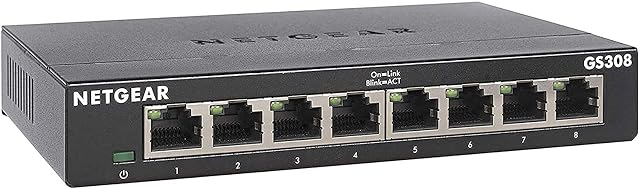
eight sockets at 1.0 Gbps · unmanaged, stated · Layer 2 · Cat5e or Cat6 named · fanless · metal case · on-off switch
An eight-socket unmanaged switch that names the cable grades its sockets expect and puts a power switch on the case, and publishes no figure for the unit as a whole.
Best for: A cupboard or a desk where the switch will occasionally need restarting, and where the wiring is already Cat5e or Cat6 and expected to stay that way.
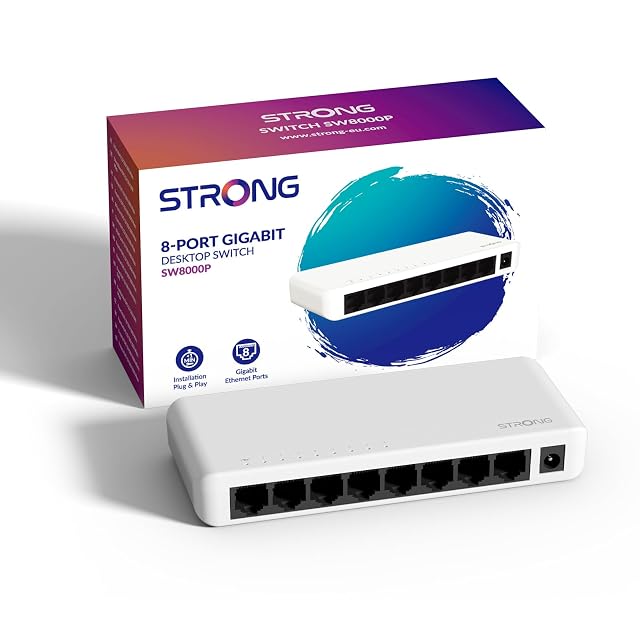
An eight-socket gigabit switch that publishes both the material of its case and a switching capacity, which is two answers more than most of this shelf gives.
Best for: A room that needs eight quiet wired sockets and a unit light enough to hang on a wall, where a plastic shell is a fair trade for the price.