The bottom line The quietest way to power sixteen sockets on this shelf, with the recovery feature that saves the most time. The shared 120 W sets the limit, so it belongs on modest devices rather than hungry ones.
On the listing
Sixteen RJ45 sockets at 10/100/1000 Mbit/s; sixteen PoE+ sockets carrying data and power on one cable, conforming to IEEE 802.3af and 802.3at, with up to 30 W at each PoE socket and 120 W for all of them; up to 250 m of data and power reach in extended mode, named for camera surveillance; a priority mode holding sockets 1 to 4 at high priority for sensitive applications; a one-click isolation mode separating client traffic; automatic PoE recovery restarting failed or unresponsive powered devices; plug and play with no configuration; and a fanless design with lower consumption and less operating noise.
Sixteen sockets, no fan
That is the line worth buying on. A switch of this size usually has one, and a fan in an office is heard for eight hours a day. Doing without it puts a ceiling on the power budget, which is exactly where the 120 W comes from.
The budget, shared sixteen ways
120 W in total. The 30 W belongs to one socket at a time. Add up what the telephones, cameras or access points on the plan actually draw, then compare the sum with the total. A handful of hungry devices will exhaust it long before the socket count runs out.
The priority mode has an address
Sockets 1 to 4, and only those. It is a wiring instruction rather than a setting: put the sensitive devices in the first four sockets, or the mode does nothing at all.
Recovery, and the ladder it saves
A powered device that hangs gets its socket cycled automatically. On anything mounted high, that is the feature that pays for the switch.
Before ordering
Total the draw of every device that will be powered, and leave headroom. The socket count is generous here; the budget is the constraint.
Availability
Priced from 113 € to 142 € across the German, French, Italian and Spanish Amazon stores the day this page was checked.
In the British Amazon catalogue with no live offer against it: the reference exists, nobody is filling it.
The American Amazon store returned nothing at all, so the buy button there opens a search in that country rather than a page that would not load.
Every figure in this section is what Keepa held on the day this page was last updated. Stock and prices move without warning.
Prices quoted in this text were read on 10 September 2026. The live price is at the top of the page.
Where it holds up, and where it stops
Strengths
Sixteen powered sockets with no fan, which is the combination that lets a switch of this size sit in an office rather than a cupboard
Automatic PoE recovery restarts a device that has failed or stopped responding, without anyone climbing to it
The extended mode is stated as reaching 250 m for both data and power, which is the figure that decides whether a distant camera needs a second switch
Compromises
A 120 W total shared across sixteen powered sockets is modest, and four devices at the 30 W ceiling would exhaust it
The priority mode is fixed to sockets 1 to 4, so anything plugged elsewhere receives no benefit from it
Neither the word managed nor unmanaged appears, so what the built-in modes can and cannot be changed to has to be inferred
Specifications
PoE standard supported
IEEE 802.3af and 802.3at — stated in the title and in the second bullet, where the sockets are described as PoE+
Per-port power budget
Up to 30 W at one PoE socket — stated in the second bullet as the ceiling a single socket can reach
Total power budget
120 W for all PoE sockets together — stated in the title and in the second bullet. It is what all sixteen powered sockets share, and it is the figure the sum of the connected devices has to fit inside
Powered port count
Sixteen — stated in the second bullet as sixteen PoE+ sockets, which is every socket on the unit
Port count
Sixteen — stated in the title and in the first bullet as sixteen RJ45 sockets at 10/100/1000 Mbit/s
Port speed
10/100/1000 Mbit/s on all sixteen sockets — stated in the first bullet; no BASE-T designation is printed behind the figures
Managed or unmanaged
Not published on the listing as either word — the title says plug and play and the seventh bullet says no configuration is required, while a priority mode fixed to sockets 1 to 4, a one-click isolation mode and automatic PoE recovery are named as built-in modes in the fourth, fifth and sixth bullets
Uplink type
Not published on the listing — all sixteen sockets carry power and are counted as one group, and none is set aside as an uplink or given a type of its own
Cooling
Fanless — stated in the title in that word and in the eighth bullet, which ties the fanless design to lower consumption and less operating noise
Amazon reference
B0C4SSQGV3 (same reference on 5 Amazon marketplaces)
EAN
4895252500301
The questions that come up before an order
Can sixteen powered sockets really share 120 W?
They share whatever they need, up to that total. The question is what the connected devices draw: a set of telephones drawing a few watts each fits comfortably, while cameras with heaters do not. The per-socket ceiling of 30 W describes what one socket can reach and never what sixteen can reach together.
What does automatic PoE recovery do?
It watches a powered device and, when it stops responding, cycles the power on its socket to restart it. On an installation with cameras on a roof or access points in a ceiling, it turns a callout into a pause. This listing names it as a built-in behaviour rather than something to configure.
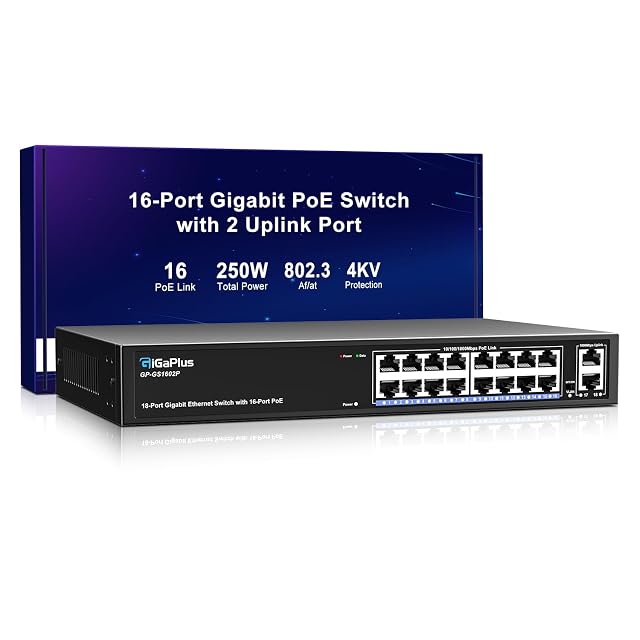
802.3af and 802.3at · 250 W total, no per-socket figure · sixteen powered of eighteen · two gigabit uplinks · one-key VLAN mode · unmanaged
An eighteen-socket switch with sixteen powered sockets and a 250 W shared budget, which never states what one socket can deliver and contradicts itself about how it mounts.
Best for: A building with a dozen or more cameras where the total draw is known and the switch will live in a cupboard, and where the per-socket question can be settled with the seller first.
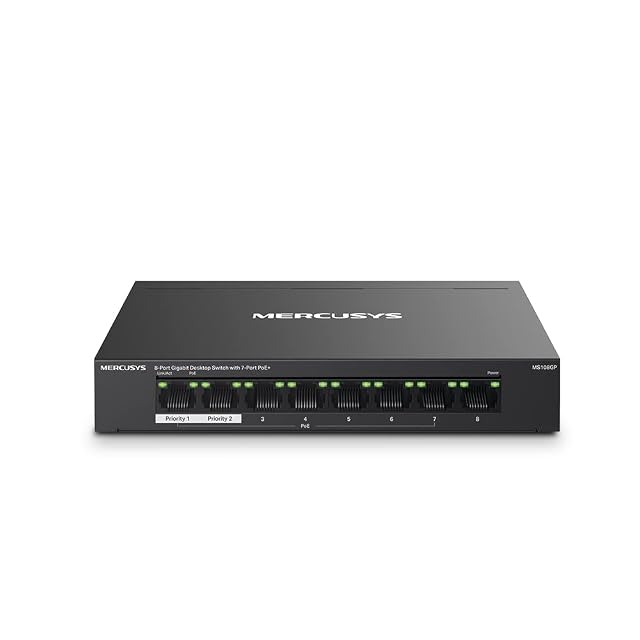
802.3af and 802.3at · up to 30 W per socket · 65 W total · seven powered of eight · gigabit · fanless · metal case
A gigabit switch that powers seven of its eight sockets and states both halves of the power question: 30 W at one socket and 65 W for all of them together.
Best for: A small installation of three or four cameras or access points that draw modestly, where the switch has to be silent and sit in the open.
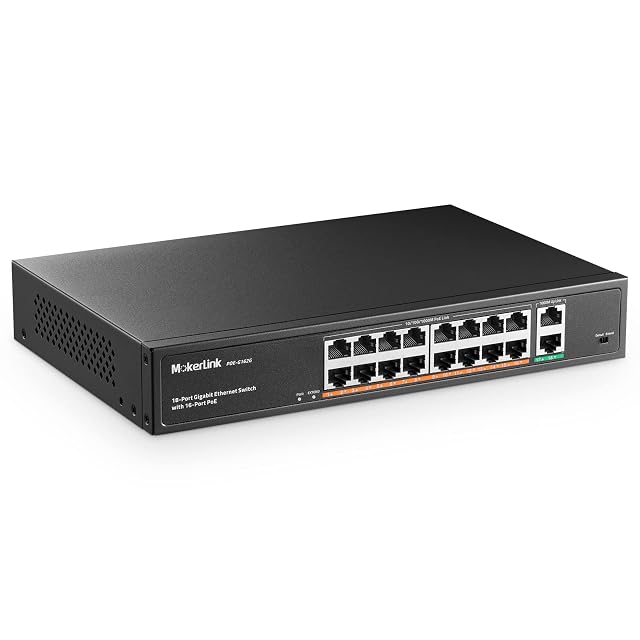
802.3af and 802.3at · up to 30 W per socket · 250 W total · sixteen powered of eighteen · uplinks numbered 17 and 18 · internal supply · fan-cooled
A rack-mounted eighteen-socket switch with sixteen powered sockets, an internal power supply and fans, which numbers its uplinks and isolates the powered sockets from each other.
Best for: A rack in a cupboard or a small server room carrying a camera installation, where fans are inaudible and an internal supply saves space.