The bottom line A well specified little tester on everything except the question of what it runs on. The four named faults are the useful part of this page and the missing battery line is the odd one.
On the listing
A network cable tester for RJ11, RJ12 and RJ45 connections; for testing ISDN and LAN network wiring at Cat 6, Cat 7 and Cat 8, described as universally usable; check lights for testing and verifying ISDN lines and RJ45 patch leads; examination of a line for continuity, a short circuit, a swapped conductor and a cable defect; and a remote unit with an integrated display of lights for the eight individual conductors.
Four faults, named
Continuity. Short circuit. Swapped conductor. Cable defect. Four separate things, listed as four, in a family where most pages write fault diagnosis and stop. The list is worth reading closely because of what is not on it: a pair that is continuous but wrongly twisted passes all four of these tests and still degrades a run.
Eight conductors on the remote
The remote unit carries the display, which is the right place for it. On a run already in the wall the person doing the work stands at the far end reading the lights, and the master sits by itself at the other, plugged in and forgotten.
Nothing about the battery
Five bullets, and not one of them says what powers the unit. Every other simple tester in this group manages a line about cells, and two of them say plainly that the cells are not supplied. Here the question is simply absent.
Before ordering
Add cells to the order, or ask which ones. The page does not say, and a tester with a flat battery is a tester left in the van.
Availability
Priced from 11 € to 14 € across the German, French, Italian and Spanish Amazon stores the day this page was checked.
It is stocked on the British Amazon store as well, in that country’s own currency. The range above leaves those out: it counts euro stores and no others.
In the American Amazon catalogue with no live offer against it: the reference exists, nobody is filling it.
Every figure in this section is what Keepa held on the day this page was last updated. Stock and prices move without warning.
Prices quoted in this text were read on 10 September 2026. The live price is at the top of the page.
Where it holds up, and where it stops
Strengths
Names four faults separately — continuity, short circuit, swapped conductor and cable defect — instead of promising fault diagnosis in general
Accepts three connector sizes and names ISDN wiring, which puts telephone lines in a house within its reach as well as network runs
A light for each of the eight conductors on the remote, so the fault is named rather than reported
Compromises
Nothing at all about what powers it, which is the one line every comparable unit here manages
No split pair detection, which the fourth bullet very nearly implies by naming swapped conductors and does not cover
No tone and probe, so it tests the lead in front of it and cannot identify one among many
Specifications
Tester type
A continuity tester in two pieces — the fifth bullet names a remote unit with an integrated display of lights for the eight individual conductors, and the third names check lights for testing ISDN lines and RJ45 patch leads. No screen and no distance measurement appears anywhere
Connector types accepted
RJ11, RJ12 and RJ45 — stated in the title and in the first bullet; the second names ISDN and LAN wiring at Cat 6, Cat 7 and Cat 8 and describes the unit as universally usable
Wire map detection
Yes — the fifth bullet gives a light for each of the eight conductors on the remote unit, and the fourth names swapped conductors among the faults the unit examines a line for
Split pair detection
Not published on the listing — the fourth bullet names continuity, a short circuit, a swapped conductor and a cable defect, and a pair that is continuous but wrongly twisted is none of those four
Length reporting
Not published on the listing — no distance, no screen and no measurement in metres appears in the title or in any of the five bullets
Tone and probe function
Not published on the listing — no tone generator and no probe is named, so the unit checks a lead it is already attached to and does not find one
Remote units supplied
One — stated in the fifth bullet as a remote unit with its own display of lights
PoE detection
Not published on the listing — power over the network cable is not named in either direction anywhere on the page
Power source
Not published on the listing — no cell type, no cell count, no rechargeable pack and no note about cells being supplied appears in the title or in any of the five bullets. Every other simple tester in this group states this in one line
Amazon reference
B09MQQR5LQ (same reference on 6 Amazon marketplaces)
EAN
4250580157533
The questions that come up before an order
What is the difference between a swapped conductor and a split pair?
A swapped conductor arrives at the wrong pin, and a row of lights shows it immediately because the order is visibly wrong. A split pair arrives at the right pins, so the lights are perfectly correct, while two conductors that should be twisted together are not. The first is on this list. The second is not on any list in this group.
Does testing ISDN wiring still matter?
It matters wherever telephone wiring is still in the walls, which is most older houses, and the sockets and conductors are the same problem in a smaller form. A tester that accepts RJ11 and RJ12 as well as RJ45 covers both jobs from one bag, which is what this page is describing.
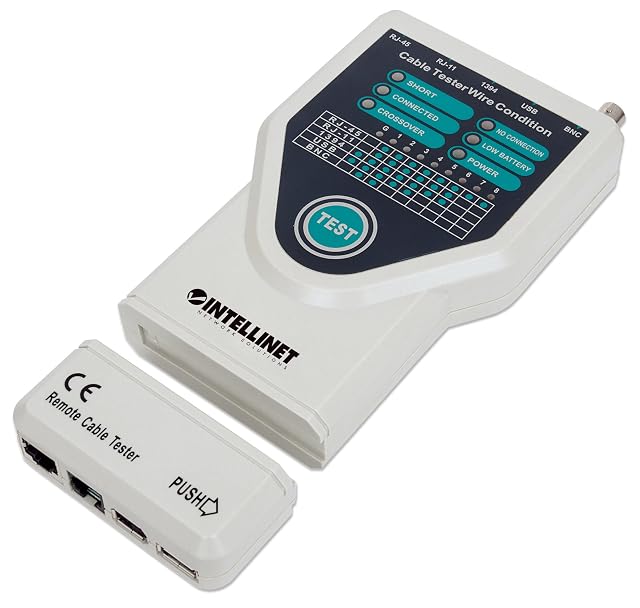
continuity tester · RJ45, RJ11, USB A and B, six-pin FireWire and coaxial · lights for eight conductors and the shield · three faults named · case and coaxial adapter supplied · no remote listed
A tester that reaches beyond network leads to USB, FireWire and coaxial, and whose contents list holds a case and an adapter and no remote unit.
Best for: A bench or a workshop drawer of assorted leads, where the network cables are only part of what needs checking and everything is within reach.
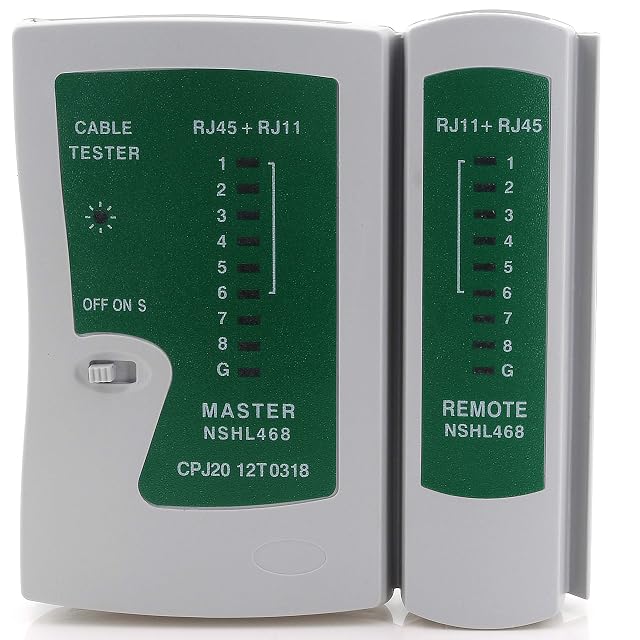
continuity tester · RJ11, RJ12 and RJ45 · separate lights for pins 1 to 8 and for ground · shielding scanned automatically · scan speed low or high · 9 V block, not supplied
A two-piece tester that gives ground its own indicator alongside the eight pins, scans the shield automatically, and lets the scan speed be set.
Best for: Shielded leads and shielded sockets, where whether the screen is actually connected is as much a question as whether the eight conductors are.
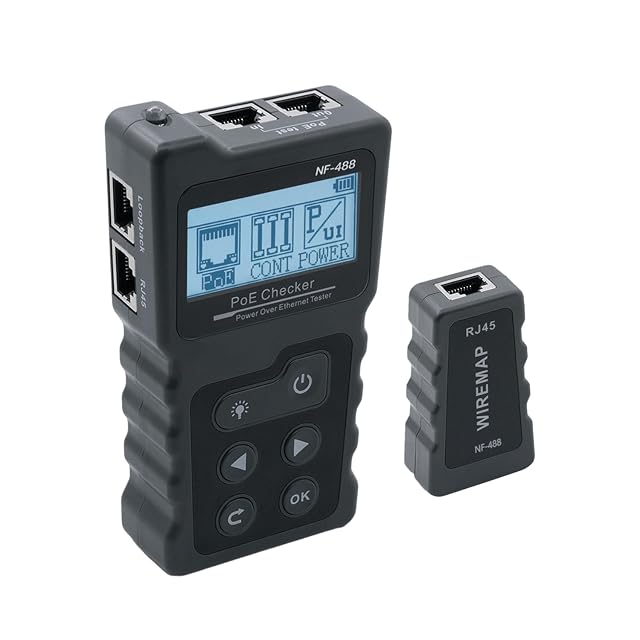
multifunction tester with an LCD · RJ45 · Cat 5e, Cat 6 and Cat 6a · PoE to af and at · loopback · cable tracing ruled out in writing · voltage described two ways
A screen-based RJ45 tester whose last bullet states in writing what it cannot do, and whose second and sixth bullets disagree about what its PoE test measures.
Best for: A network with powered devices on it, for a buyer who wants the limits of the instrument written down before it is ordered rather than found afterwards.