Eaton 3P700UD, standby at 700 VA and 420 W, with the whole specification in the title vs Green Cell UPS01LCD, line-interactive at 360 W, with a VA figure given twice and differently
Four sockets and a bigger watt rating, or a page that names the battery inside?
These two split the specification between them. The Eaton 3P700UD puts everything in its title — standby topology, 700 VA, 420 W, four Schuko sockets of which three carry the battery — and its three bullets add nothing. The Green Cell UPS01LCD is line-interactive at 360 W, names a 12 V 7 Ah AGM battery and a modified sine wave output, and prints its volt-ampere rating two different ways on the same page.
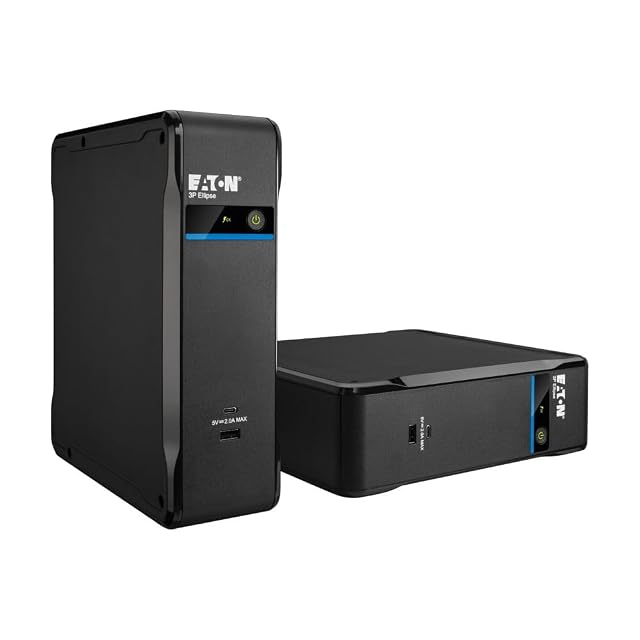
Eaton 3P700UD, standby at 700 VA and 420 W, with the whole specification in the title
3P700UD, standby at 700 VA and 420 W, with the whole specification in the title
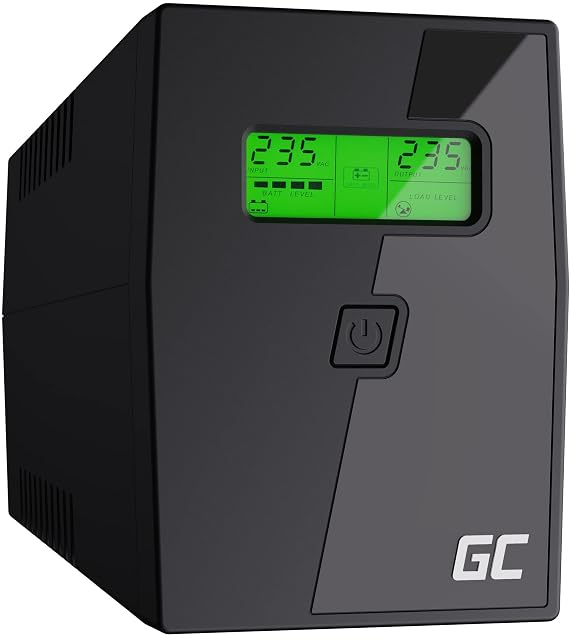
UPS01LCD, line-interactive at 360 W, with a VA figure given twice and differently
Topology
Standby, printed as off-line: the load runs from the mains until the mains fails and a relay hands it to the inverter
Line-interactive, with automatic voltage regulation correcting a low or high supply through a transformer instead of calling on the battery
Stated classification
Not published — the topology is named in words with no code beside it
Not published — the topology is named in words with no code beside it
VA rating
700 VA, the left-hand half of a pair
Two figures on one page — 600 VA in the title, and a band of 600 VA to 999 VA in two bullets; both reported as printed, neither chosen over the other
Watt rating
420 W, published beside the VA figure and kept apart from it, neither derived from the other
360 W, given three times and the same figure each time
Stated runtime at a named load
Not published — no time in the title, and three bullets carrying the brand, the reference and the words for an uninterruptible power supply
Not published at a named load — up to 20 minutes is given, said to depend on the load, without naming the load it was quoted against
Output waveform
Not published
Modified sine wave — a stepped approximation rather than a curve, stated plainly enough to be checked against a power supply that objects to one
Socket count
Four — three carrying battery and surge protection, one carrying surge protection only
Two
Socket type
Schuko on all four; the USB charging ports named beside them are not mains outputs and are not counted
Schuko; whether either socket is filtered only rather than battery-backed is not said
Battery type
Not published — no voltage, no amp-hour figure, no chemistry
One 12 V, 7 Ah AGM battery — construction, voltage, capacity and count all given
Battery replaceability
Not published
Not published — the battery is described in detail and nothing says whether the pack can be changed by the owner
Communication port
USB, listed apart from the USB charging ports; what it speaks to, and under which systems, is not stated
Not published — software that manages the unit and draws live charts is described, and the socket carrying any of it is never named
A tick means one listing published something the other did not, or published
a better figure. It does not mean the product is better, and the column is not
a score out of anything: a maker who says less loses lines here without losing
a comparison. The two verdicts below are where the page is settled.
Which one, for whom
Buy the Eaton 3P700UD, standby at 700 VA and 420 W, with the whole specification in the title
The 3P700UD is the larger unit on both ratings and the one whose title does the work: 700 VA, 420 W, standby, four Schuko sockets, three of them battery-backed and one filtered only. Knowing which sockets do what before you buy is rarer on this shelf than it should be. Everything else is absent — no runtime, no waveform, nothing about the battery — and standby is the simpler topology, which means a brief handover rather than continuous correction.
Buy the Green Cell UPS01LCD, line-interactive at 360 W, with a VA figure given twice and differently
The UPS01LCD is the better-described box and the smaller one. Line-interactive with voltage regulation, a 12 V 7 Ah AGM battery named outright, and a modified sine wave stated plainly — that last one matters, because some computer power supplies object to a stepped waveform, and most listings on this shelf simply do not say. Against that: 360 W, two sockets, and a volt-ampere rating printed two different ways on the same page.
The questions that come up before an order
Which topology should I want?
Line-interactive corrects a supply that is merely low or high through a transformer, without discharging the battery; standby waits for the mains to fail and then hands over. On a supply that sags often, the correction is worth having. Both of these pages name their topology in words, which not every listing here does, and neither prints the classification code from the standard.
Is a modified sine wave a problem?
It can be, for equipment that expects a curve — some computer power supplies and some motors object to a stepped approximation. Whether it matters depends on what you are plugging in. The point of the row is that Green Cell says which it produces, and Eaton does not say at all, so on the Eaton the question cannot be answered from the page.
700 VA · 420 W · standby topology stated · 4 sockets, 3 on battery and surge and 1 on surge only · Schuko · USB port plus USB charging ports · runtime, waveform and battery not published
A standby unit whose title publishes both power ratings, the topology, the split between battery-backed and surge-only sockets and a communication port, above three bullets that carry three words between them.
Best for: A desk where three machines need the battery and a fourth needs filtering only, chosen on that socket split rather than on a runtime the page never gives.
600 VA in the title, 600–999 VA in the bullets · 360 W · line-interactive with AVR · modified sine wave · up to 20 minutes, load not named · 2 Schuko sockets · one 12 V 7 Ah AGM battery · transfer of 2 to 6 ms
A line-interactive unit whose watt figure is printed three times without changing, whose volt-ampere figure appears as one number in the title and as a range in two bullets, and whose backup time is quoted with no load behind it.
Best for: A desk where the supply sags more often than it fails, and where a stepped waveform has been checked against the power supply that will sit behind the unit.