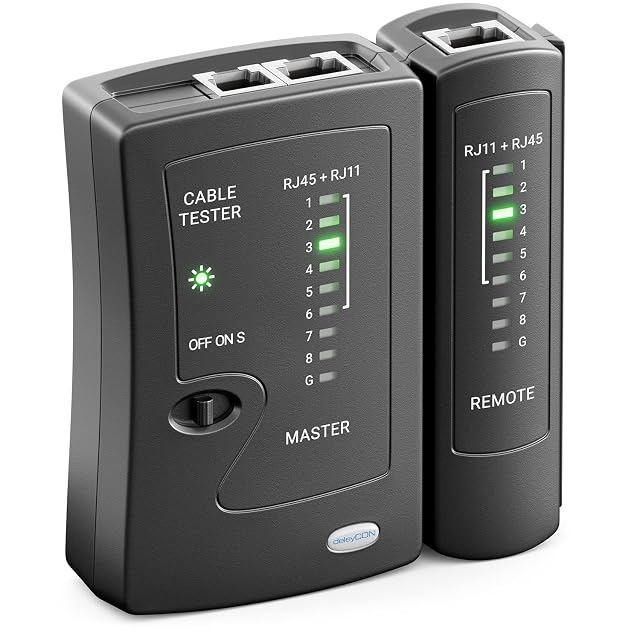
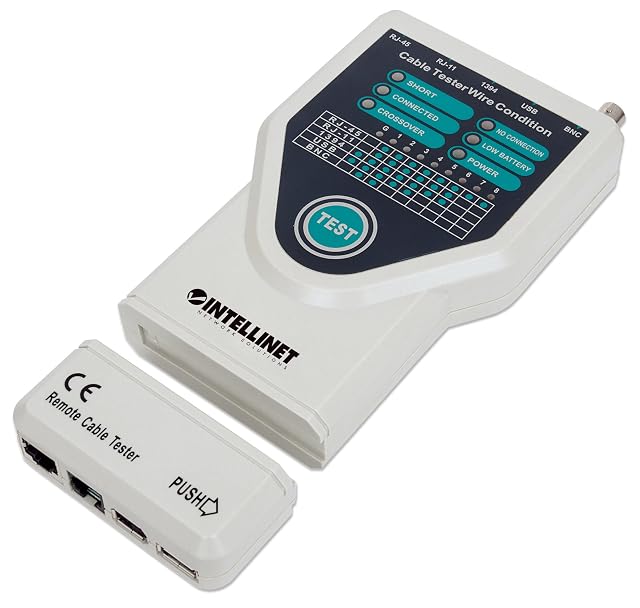
Neither of these has a screen and neither measures a distance — they light a lamp per conductor and tell you whether the wiring is right. The deleyCON MK5196 covers RJ11, RJ12 and RJ45, names ISDN and Cat 6 to Cat 8, and supplies a remote unit with its own row of lights. The INTELLINET 780094 reaches further across connector types — USB, FireWire and coaxial as well — and lists no remote unit anywhere.
deleyCON MK5196, continuity tester for RJ11, RJ12, RJ45 and ISDN wiring
Continuity tester in two pieces, with a remote carrying lights for the eight conductors; no screen and no distance measurement
Continuity tester with lights for the eight conductors and one for the shield; no screen and no distance measurement
Connector types accepted
RJ11, RJ12 and RJ45, with ISDN and LAN wiring at Cat 6, Cat 7 and Cat 8 named
Six kinds named in the title — RJ45, 10Base, RJ11, USB, FireWire and BNC — under a badge that says five in one; both counts recorded as printed
Wire map detection
Yes — a light per conductor on the remote, with swapped conductors named among the faults
Yes — a light per conductor plus the shield, with wrong pin assignment named among the faults
Split pair detection
Not published — the four faults named are continuity, a short, a swapped conductor and a cable defect
Not published — the three faults named are a short, a wrong pin assignment and no connection
Length reporting
Not published — no distance, no screen, no measurement
Not published — no distance and no measurement
Tone and probe function
Not published — the unit checks a lead it is already attached to and does not find one
Not published — the contents are the tester, a case, a coaxial adapter and a manual
Remote units supplied
One, with its own display of lights
Not published — none in the title, the bullets or the contents list, where every other unit in this group states one
PoE detection
Not published — power over the network cable is not named in either direction
Not published — power over the network cable is not named in either direction
Power source
Not published — no cell type, no count, no note about cells being supplied
Not published — no cell type, no count, no note about cells being supplied
A tick means one listing published something the other did not, or published
a better figure. It does not mean the product is better, and the column is not
a score out of anything: a maker who says less loses lines here without losing
a comparison. The two verdicts below are where the page is settled.
Which one, for whom
Buy the deleyCON MK5196, continuity tester for RJ11, RJ12, RJ45 and ISDN wiring
The MK5196 is the one that solves the practical problem: it supplies the remote unit, so a cable already run through a wall can be tested by one person with the far end unattended. It names Cat 6, Cat 7 and Cat 8 wiring and ISDN, and it examines four named faults. It stops at telephone and network connectors, and — like its rival — its page never says what it runs on.
Buy the INTELLINET NETWORK SOLUTIONS 780094, five-in-one tester covering network, telephone, USB, FireWire and coaxial leads
The 780094 covers more shapes of connector: USB A and B, six-pin FireWire and coaxial through a supplied adapter, on top of network and telephone. It adds a light for the shield, which the deleyCON does not, and it ships in a case. What it never mentions is a remote unit, and on a continuity tester that is the piece that makes a wall-to-wall run testable at all. Its own title counts six connector types under a badge that says five.
The questions that come up before an order
What is the remote unit for?
A continuity tester needs both ends of the cable. The remote is a small module you plug into the far socket so the main unit can light one lamp per conductor on its own. Without one, both ends of the run have to reach the same instrument — which is fine for patch leads on a bench and no use at all for a cable already buried in a wall.
Neither page says what powers the tester. Does that matter?
It matters on the day it arrives. Testers of this kind normally take a 9 V cell, which is often not in the box; both of these listings simply do not say, so neither the type nor whether it is supplied can be read from the page. This site records that silence rather than assuming the usual answer.
continuity tester · RJ11, RJ12 and RJ45 · ISDN and Cat 6 to Cat 8 named · four named faults · lights for eight conductors on the remote · no power source stated
A continuity tester that names the four faults it looks for one by one, and never says what it runs on.
Best for: A house with both telephone and network wiring in the walls, where a single tester should cover the older sockets as well as RJ45.
continuity tester · RJ45, RJ11, USB A and B, six-pin FireWire and coaxial · lights for eight conductors and the shield · three faults named · case and coaxial adapter supplied · no remote listed
A tester that reaches beyond network leads to USB, FireWire and coaxial, and whose contents list holds a case and an adapter and no remote unit.
Best for: A bench or a workshop drawer of assorted leads, where the network cables are only part of what needs checking and everything is within reach.