A different connector at each end, and both loss figures printed
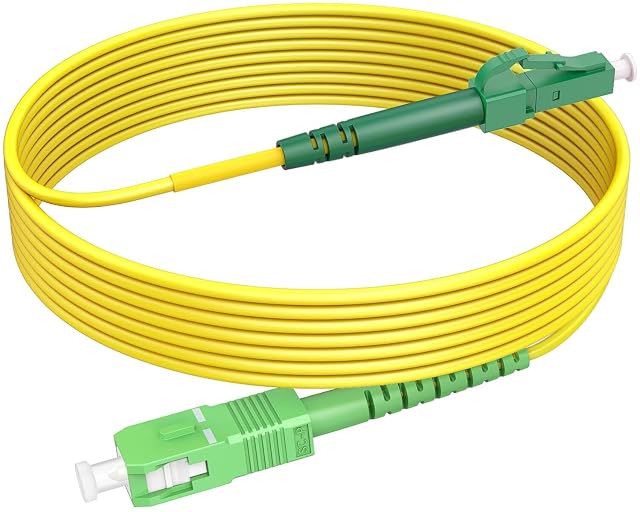
RamboCables 5 m simplex OS2 LC/APC to SC/APC, 9/125 µm, 2.0 mm jacket
The only lead in this hub that changes connector between its ends, which is what two pieces of equipment that disagree actually need — with both loss figures printed and the polish named against the reflection figure.
Specifications
- Fibre type
- Single-mode — stated in the first bullet as sm os2, with the central core and its 9/125 micron coating named and a cable diameter of 2.0 mm given alongside
- Fibre grade
- OS2 — stated in the first and third bullets. No G.65x fibre standard is named anywhere on the page
- Connector types at each end
- LC/APC at one end and SC/APC at the other — stated in the title and in the first and third bullets. It is the only lead on this shelf with a different connector at each end
- Simplex or duplex
- Simplex — stated in the title and in the first bullet, which describes a single strand of glass thinner than a copper cable and less susceptible to interference
- Polarity arrangement
- Not published on the listing, and a simplex lead has no pair to cross
- Length
- 5 m — stated in the title and in the first bullet. The second says individual lengths of any fibre lead are available on request
- Jacket rating
- LSZH — stated in the fourth bullet as a flame-retardant Low Smoke Zero Halogen sheath, with a cable diameter of 2.0 mm given in the first
- Polish type
- APC — carried by both connector designations. The third bullet quotes an insertion loss of 0.3 dB or less and a return loss of 50 dB or better, with APC named in brackets beside the return loss figure, and states that the lead meets industry standards for reflectivity and insertion loss
- Armouring
- Not published on the listing — no armour is named. The fourth bullet supplies dust caps on every fibre and an operating range of -10 °C to 60 °C instead, and the fifth cites more than fifteen years of manufacturing experience
- Amazon reference
- B0BN3B3VT6 (same reference on 5 Amazon marketplaces)
- EAN
- 0785366001341
On the listing
A 5 m simplex single-mode fibre patch cable in OS2, with an SC/APC connector at one end and an LC/APC connector at the other, a central core with a 9/125 micron coating and a cable diameter of 2.0 mm; a stated compatibility with fibre-to-the-home services from the major German operators, with custom lengths available on request; conformity to industry standards for reflectivity and insertion loss, quoted as an insertion loss of 0.3 dB or less and a return loss of 50 dB or better with APC named beside it; a tested, flame-retardant Low Smoke Zero Halogen sheath, with dust caps on every fibre and an operating range of -10 °C to 60 °C; and more than fifteen years of manufacturing experience claimed by the maker.
LC/APC at one end, SC/APC at the other
Six leads on this shelf have the same connector at both ends. This one does not, and that is the whole reason it exists.
Provider equipment often terminates in SC — the larger square connector with a push-pull body. Routers, transceivers and SFP cages mostly take LC, which is half the size. When those two meet, the usual answer is an adapter: a small plastic barrel with a face at each end, sitting in the middle of the run, adding a pair of connections to a link that had one.
A lead with one of each end removes it. One object, two connections, no barrel on the floor behind the cabinet.
The catch is that it is directional in a way an ordinary lead is not — a spare is a spare only if the next job has the same two ends the other way round.
Insertion loss, return loss, and the polish named beside them
The third bullet prints both figures and then does something the other listings do not: it puts APC in brackets next to the return loss.
That is not decoration. Return loss measures light reflected back towards the transmitter, and the angled face is the reason the number is as good as it is — the reflection leaves the core sideways instead of travelling home. Naming the polish beside the figure says where the figure comes from.
Insertion loss, the light lost passing straight through, is quoted at 0.3 dB or less, matching three other leads in this hub. Return loss at 50 dB or better sits between the 30 dB of the two multimode leads and the 60 dB of the cheapest single-mode one.
Five metres, two millimetres thick
The first bullet gives the cable diameter as 2.0 mm, which is the thinner of the two diameters published on this shelf.
That is a genuine consideration on a 5 m run. A thinner lead goes round a tighter corner, disappears more easily behind a skirting board and is less obtrusive across a room. It is also less substantial under a chair leg, and the page names no armouring of any kind.
The operating range, -10 °C to 60 °C, is the narrower of the two published here. Indoors it never signifies. In a garage, a loft or an outbuilding it is the figure to read twice.
Before ordering
Check which connector is on which piece of equipment, because this lead is the answer to a specific mismatch and the wrong way round is no use at all. Confirm both faces are angled — APC to APC — since a flat face will not mate with either end of this. And measure the route: 5 m of 2.0 mm cable with no armour wants a path that is not across a doorway.
Availability
Priced at roughly 12 € on the German and French Amazon stores the day this page was checked.
In the British, Italian and Spanish Amazon catalogues with no live offer against it: the reference exists, nobody is filling it.
The American Amazon store returned nothing at all, so the buy button there opens a search in that country rather than a page that would not load.
Every figure in this section is what Keepa held on the day this page was last updated. Stock and prices move without warning.
Prices quoted in this text were read on 10 September 2026. The live price is at the top of the page.