The slowest link in the chain decides it, and it is rarely the drive · review
Verbatim SnapBack UltraSlim 2 TB, the one link rate in gigabits review
A two-terabyte portable drive that publishes its link rate in gigabits per second, its weight and all three of its measurements, and that never gives a figure in megabytes per second for either direction.
The bottom line The one page on this shelf that publishes a link rate in gigabits, and the one that publishes no rate in megabytes at all. Physically it is the best described drive here; what it produces through that fast link is left entirely open.
On the listing
A two-terabyte external solid-state drive on USB 3.2 Gen 2×2 with magnetic attachment, sold for 4K work; a magnetic hold onto a telephone for filming, photographing and storing; recording of high-quality 4K video directly onto the drive at up to sixty frames a second; up to 20 Gbps over the doubled-lane arrangement for moving large video files, projects and high-resolution photographs; a body of 42 grams measuring 7.0 × 5.7 × 0.5 cm, offered to people making video; and a box containing the drive, a curved lead of 6.5 cm for reaching a telephone, a straight lead of 20 cm, a quick guide and a backup application.
Twenty gigabits, and nothing in megabytes
The third bullet publishes the link rate. No other page on this shelf does, and it is the quantity the standard actually defines: what the connection is specified to carry when both ends agree. What it does not describe is the drive. A rate in megabytes per second would say what the flash and the bridge chip inside produce through that link, and this page carries none — not for reading, not for writing.
Two leads, and how short they are
Six and a half centimetres, curved, and twenty centimetres, straight. Both lengths are printed, which almost no rival here manages. They are also the lengths of a drive designed to sit against a telephone rather than to reach a laptop on a desk, and a buyer planning to use it that way is a buyer planning to buy a third lead.
Forty-two grams, on a magnet
The weight and all three measurements are published, and on this product they are the specification that matters most. A drive held to the back of a telephone by magnets is carried by that attachment through everything the telephone does, and how heavy it is decides whether that holds. It is the only page in this lot where the size of the object is fully described.
Frames are not a data rate
The second bullet gives sixty frames a second for 4K recording. That is a property of the video being made, not of the drive receiving it, and the amount of data behind a given frame rate depends on the format. It is a reasonable claim about what the drive is for and it does not stand in for a figure in megabytes per second.
Before ordering
Ask what the drive reads and writes at, and check that the computer end supports the doubled-lane arrangement. The link is published, the object is measured, and what crosses between them is not stated.
Availability
Priced from 227 € to 276 € across the German, French, Italian and Spanish Amazon stores the day this page was checked.
It is stocked on the American and British Amazon stores as well, in that country’s own currency. The range above leaves those out: it counts euro stores and no others.
Every figure in this section is what Keepa held on the day this page was last updated. Stock and prices move without warning.
Prices quoted in this text were read on 10 September 2026. The live price is at the top of the page.
Where it holds up, and where it stops
Strengths
The link rate is published in gigabits per second, which is the quantity the standard defines and the one that says what the connection allows
Weight, all three measurements and both lead lengths are printed, so the physical object is fully described
The doubled-lane arrangement is named rather than left at the family, and it is what separates this drive from the rest of the shelf
Compromises
No figure in megabytes per second in either direction, so nothing says what the drive itself produces through that link
Both leads are very short, which suits a telephone and not a computer sitting on a desk
None of the three endurance quantities, and no rating of any kind for a drive meant to hang off a moving telephone
Specifications
Capacity
2 TB — printed in the title and repeated in the first bullet and the box list, in the maker’s unit and reported here in that unit without conversion
Interface standard
USB 3.2 Gen 2×2 — printed in the title and named again in the third bullet, which is the doubled-lane arrangement of that family rather than the single-lane one
Stated link rate
Up to 20 Gbps — stated in the third bullet beside the interface designation. It is the rate the link is specified to carry, and it is the only figure in gigabits per second published on this shelf
Connector type
Not published on the listing as a socket on the drive — the box list counts two leads, one of them a short curved one for reaching a telephone, and both are described by the symmetrical connector shape without naming the end that meets the drive
Stated sequential read figure
Not published on the listing — no figure in megabytes per second appears anywhere in the title or in the five bullets, on a page that does publish the rate of the link
Stated sequential write figure
Not published on the listing — the second bullet describes recording video directly onto the drive at up to sixty frames a second, which is a frame rate rather than a data rate
Stated ingress or drop rating
Not published on the listing — no ingress code, no drop height and no shell material is named, on a drive designed to hang off the back of a telephone
Dimensions
7.0 × 5.7 × 0.5 cm — stated in the fourth bullet alongside the weight, which makes this one of the two portable drives here whose size is published
Weight
42 g — stated in the fourth bullet, given as the figure behind the claim that the drive is a mobile companion
Cable supplied
Two leads — the box list counts a curved one of 6.5 cm for a telephone and a straight one of 20 cm, both with their lengths stated, alongside a quick guide and a backup application
TBW rating
Not published on the listing — no total in terabytes written appears anywhere on the page
Stated MTBF
Not published on the listing — no figure in hours appears in the title or in the five bullets
Warranty length
Not published on the listing — no term of any length appears, on a page that does state the length of both supplied leads
Amazon reference
B0FYQ3SP8S (same reference on 6 Amazon marketplaces)
EAN
0023942323372
The questions that come up before an order
Why is a link rate in gigabits not the same as a drive’s speed?
Because it describes the road and not the vehicle. Twenty gigabits per second is what the connection is specified to carry once both ends support the same arrangement; what crosses it depends on the flash and the bridge chip inside the drive, and on how long the fast region lasts during a large transfer. A page publishing the link and not the drive has given the ceiling and not the result.
What does a doubled-lane arrangement need at the computer end?
A socket that supports the same arrangement. It is less common than the single-lane version, particularly on laptops a few years old, and where it is absent the connection falls back to the slower one and everything still works. The rate on the box is the best case, and the socket at the other end decides whether that case applies.
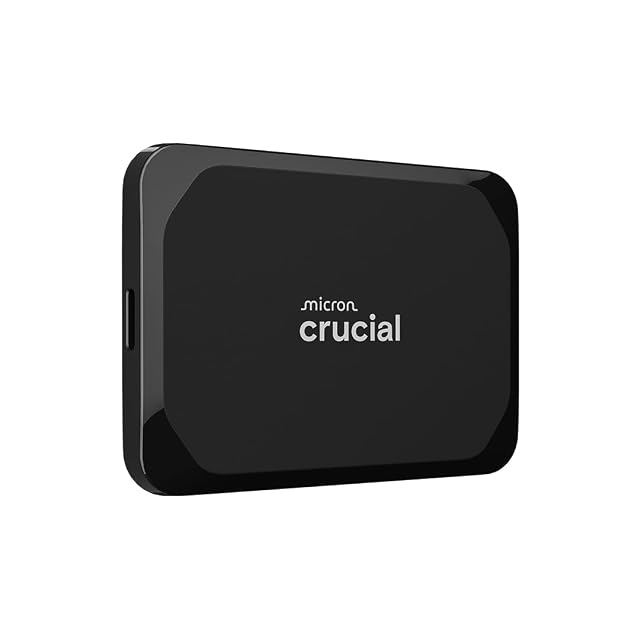
1 TB · USB-C 3.2, generation not published · up to 1050 MB/s read · drop resistance to 2 m · one lead named, no length · no write figure · no TBW, no MTBF, no warranty
A one-terabyte portable drive that publishes a drop height and a single reading figure, names a lead without measuring it, and stops its interface designation one word short of a generation.
Best for: A laptop bag where a drive gets knocked about, and where the published drop height and the named backup arrangements matter more than a second rate.
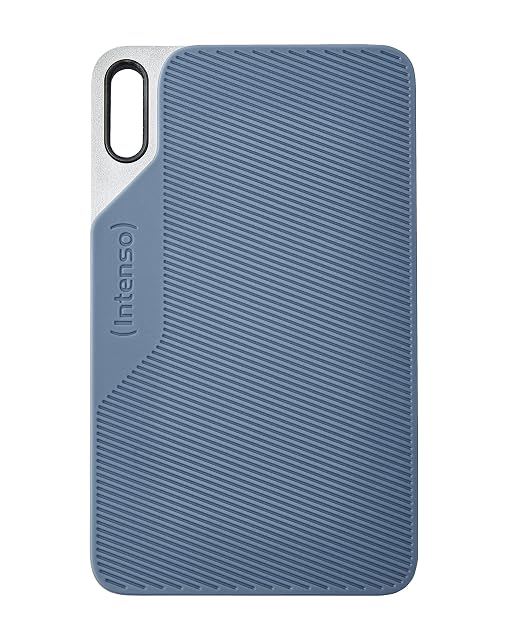
1 TB · USB 3.2 Gen 1×1 · up to 500 MB/s as a transfer rate · two leads in the box · rubberised surface, no rating · no dimensions, no weight · no TBW, no MTBF, no warranty
A one-terabyte portable drive that counts two supplied leads and names the interface generation, and that never states the socket on the drive, a rate in gigabits or a single endurance quantity.
Best for: A household backup that moves between a computer and a console, where two supplied leads and a stated interface matter more than a full sheet of figures.
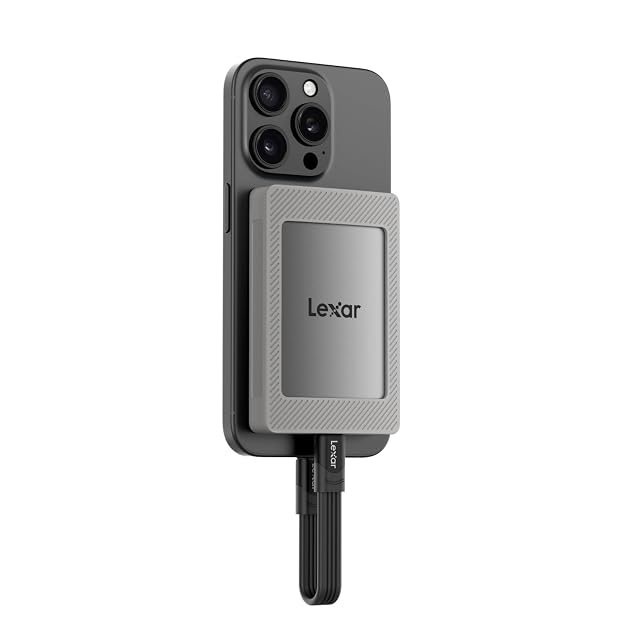
2 TB · USB 3.2 Gen 2 · up to 1050 MB/s read · up to 1000 MB/s write · magnetic case and ring supplied · two leads in the box · encryption at 256 bits · no dimensions, no weight · no TBW, no MTBF, no warranty
A two-terabyte portable drive supplied with a magnetic case and ring, whose first bullet states outright what the magnets will not do, and whose page publishes both rates and no endurance quantity.
Best for: A recent telephone used for filming, where the magnetic case is the point and the drive will spend its life attached rather than in a bag.