The slowest link in the chain decides it, and it is rarely the drive · review
SSK SD301 1 TB, two plugs on the body and no cable at all review
A one-terabyte drive built as a stick with a plug at each end, publishing both sequential figures and attributing them to the maker’s own internal testing, with a fourth bullet that names a different interface family entirely.
The bottom line A sensible design described in confusing terms: two plugs on the body, both rates published with their conditions, and one bullet naming an interface family the rest of the page contradicts. Nothing about size, weight or endurance is on the page.
On the listing
A one-terabyte external solid-state drive with a symmetrical connector and the older rectangular plug on the same body, quoted at up to 550 MB/s; a dual arrangement described as convenient for moving files between a telephone or tablet and a computer; reading of up to 550 MB/s and writing of up to 500 MB/s on USB 3.2 Gen 2, attributed to the maker’s own internal testing and qualified by host machines and conditions; plug-and-play use with no software to install; a zinc alloy shell called resistant to falls and abrasion, with caps protecting both plugs, and a description of the product as a Thunderbolt drive; and compatibility with computers, televisions, car head units, telephones, tablets and laptops, backwards compatible with the two older generations.
Two plugs, and no lead in the chain
A symmetrical connector at one end, the older rectangular plug at the other. On any portable drive the result is set by the slowest part of the chain, and this design removes one part of it. There is no cable to lose, no cable to buy and no cable to be the limiting piece. What replaces it is the shape of the machine: a stick standing out of a laptop is easier to knock than a drive lying on a desk.
Both rates, and where they came from
The second bullet publishes reading and writing, says the figures come from the maker’s own internal testing and warns that the host machine and the conditions change them. That last clause is unusual and it is the honest part: a portable drive is measured through somebody else’s socket, and the socket has as much say as the drive does.
One bullet on another interface
The fourth bullet calls this a Thunderbolt drive. The title, the first bullet and the second all describe a USB drive, and the two are different families with different costs and different ceilings. The symmetrical connector can carry either, which is exactly why the shape cannot settle the question. Both mentions are reported here and neither is corrected.
A shell described, not rated
Zinc alloy, resistant to falls and abrasion, with caps over both plugs. There is no drop height and no ingress code, so it is a material and a design rather than a specification. The caps are the practical part: two exposed plugs in a pocket are two things to bend.
Before ordering
Ask which interface family the drive is built for, and ask for its length and weight. The rates and the plugs are settled by the page, and nothing else is.
Availability
Priced from 132 € to 147 € across the German, French, Italian and Spanish Amazon stores the day this page was checked.
It is stocked on the British Amazon store as well, in that country’s own currency. The range above leaves those out: it counts euro stores and no others.
In the American Amazon catalogue with no live offer against it: the reference exists, nobody is filling it.
Every figure in this section is what Keepa held on the day this page was last updated. Stock and prices move without warning.
Prices quoted in this text were read on 10 September 2026. The live price is at the top of the page.
Where it holds up, and where it stops
Strengths
Two plugs on the body remove the lead from the chain entirely, which is one fewer part to lose and one fewer part to limit the result
Both sequential figures are published and the maker says where they came from and that conditions change them
Compatibility is described by machine — telephones, tablets, televisions, car head units — rather than by operating system
Compromises
The fourth bullet names a different interface family from the rest of the page, and nothing reconciles the two
No measurement and no weight, on a product sold on being small enough to carry anywhere
None of the three endurance quantities, and no rating behind the claim of a tough shell
Specifications
Capacity
1 TB — printed in the title, in the maker’s unit and reported here in that unit without conversion
Interface standard
USB 3.2 Gen 2 — named in the second bullet, with the first bullet describing the older rectangular plug as a 3.2 socket. The fourth bullet separately calls the drive a Thunderbolt drive, which is a different interface family, and nothing on the page resolves the two
Stated link rate
Not published on the listing as a figure in gigabits per second — the page quotes rates in megabytes per second only, and the generation named in the second bullet is left to imply the rest
Connector type
Two plugs on the body itself — a symmetrical connector at one end and the older rectangular plug at the other, both named in the first bullet and described there as a dual arrangement with a protective cap over each
Stated sequential read figure
Up to 550 MB/s — stated in the second bullet as a reading speed, with the maker attributing the figure to its own internal testing and warning that host machines and conditions change the result
Stated sequential write figure
Up to 500 MB/s — stated in the second bullet beside the read figure, under the same attribution
Stated ingress or drop rating
Not published on the listing — the fourth bullet names a zinc alloy shell described as resistant to falls and abrasion, with no drop height, no ingress code and no standard named
Dimensions
Not published on the listing — no measurement appears, on a product whose whole design argument is that it is small enough to carry loose
Weight
Not published on the listing — no figure in grams appears in the title or in the five bullets
Cable supplied
Not published on the listing — no lead is counted anywhere, and none is needed in the ordinary case: the two plugs are on the body and the drive goes straight into a socket
TBW rating
Not published on the listing — no total in terabytes written appears anywhere on the page
Stated MTBF
Not published on the listing — no figure in hours appears, and the fourth bullet offers shock resistance and heat dissipation as descriptions instead
Warranty length
Not published on the listing — no term of any length appears in the title or in the five bullets
Amazon reference
B0C36F3J6V (same reference on 6 Amazon marketplaces)
EAN
5907190004649
The questions that come up before an order
What does a drive with plugs on its body give up?
Cooling and, usually, sustained speed. A lead lets a drive sit on a desk with air around it; a stick held in a socket sits against a warm machine and has less room for the flash and the bridge chip inside. In exchange there is nothing to forget and nothing between the drive and the socket to slow it down. For moving a few files it is the better arrangement; for a long backup a cased drive on a lead is usually happier.
Can one product be on two different interface families?
A socket of the symmetrical shape can carry either, so the shape does not settle it — but a drive is built for one or the other, and the two are not interchangeable in what they cost or what they reach. This page names one family in four places and the other in one, and the site reports both rather than deciding which the maker meant.
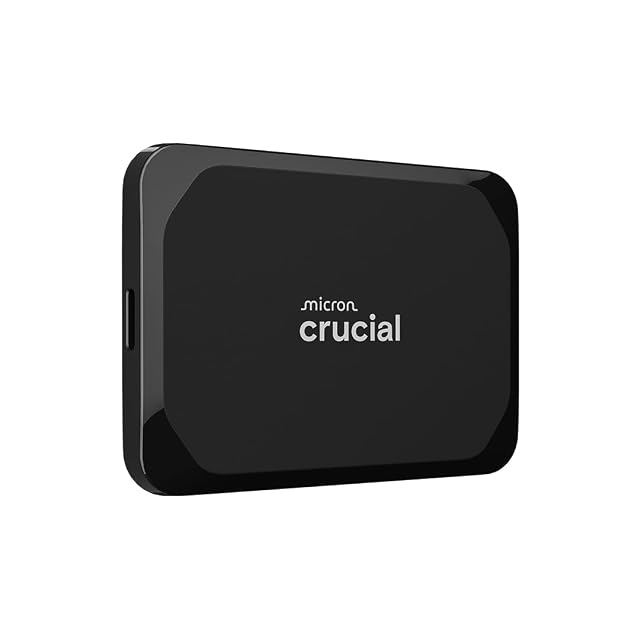
1 TB · USB-C 3.2, generation not published · up to 1050 MB/s read · drop resistance to 2 m · one lead named, no length · no write figure · no TBW, no MTBF, no warranty
A one-terabyte portable drive that publishes a drop height and a single reading figure, names a lead without measuring it, and stops its interface designation one word short of a generation.
Best for: A laptop bag where a drive gets knocked about, and where the published drop height and the named backup arrangements matter more than a second rate.
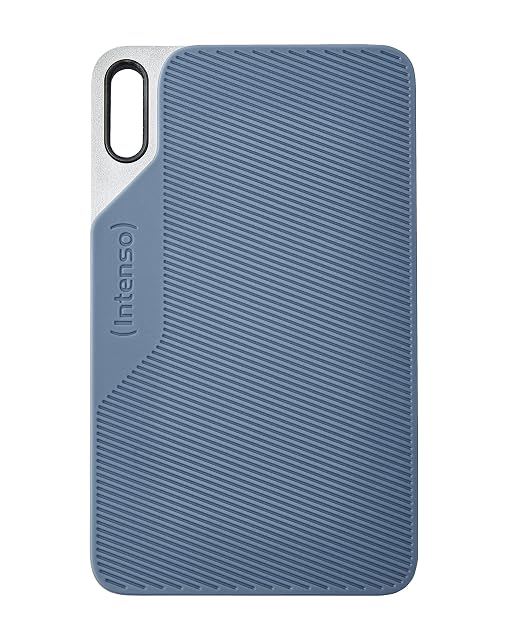
1 TB · USB 3.2 Gen 1×1 · up to 500 MB/s as a transfer rate · two leads in the box · rubberised surface, no rating · no dimensions, no weight · no TBW, no MTBF, no warranty
A one-terabyte portable drive that counts two supplied leads and names the interface generation, and that never states the socket on the drive, a rate in gigabits or a single endurance quantity.
Best for: A household backup that moves between a computer and a console, where two supplied leads and a stated interface matter more than a full sheet of figures.
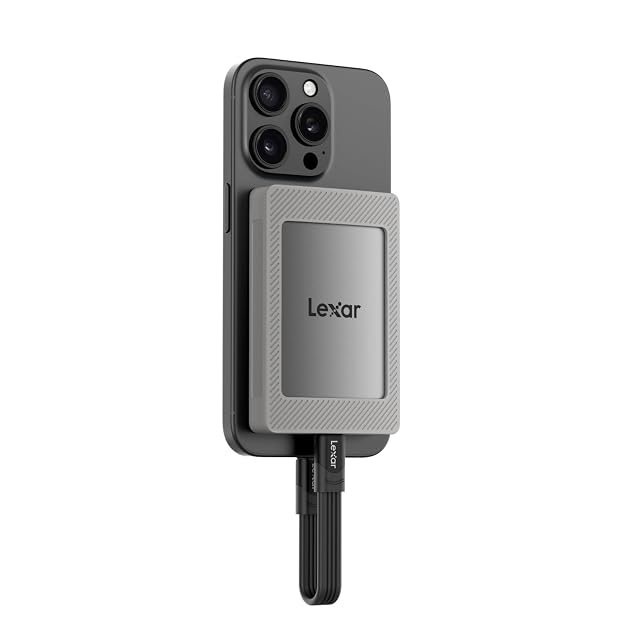
2 TB · USB 3.2 Gen 2 · up to 1050 MB/s read · up to 1000 MB/s write · magnetic case and ring supplied · two leads in the box · encryption at 256 bits · no dimensions, no weight · no TBW, no MTBF, no warranty
A two-terabyte portable drive supplied with a magnetic case and ring, whose first bullet states outright what the magnets will not do, and whose page publishes both rates and no endurance quantity.
Best for: A recent telephone used for filming, where the magnetic case is the point and the drive will spend its life attached rather than in a bag.