The one listing that publishes its own usable capacity
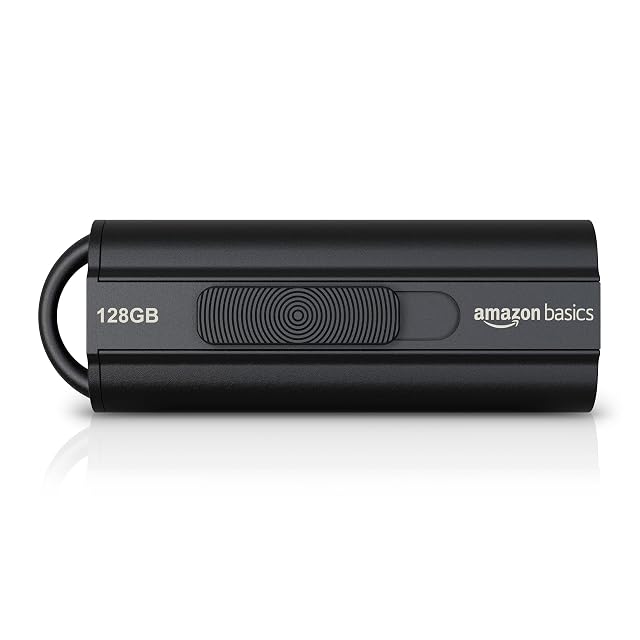
Amazon Basics 128 GB, USB 3.1 stated, telescopic body, 130 read and 30 write stated, 115 GB usable published
The only drive in this hub whose maker prints the usable figure alongside the label figure — and the only one that prints its headline number in two different units within a single page.
Specifications
- Capacity
- 128 GB — stated in the title, with the fifth bullet adding that the available storage is more than 115 GB and naming differing measurement standards as the reason the two figures differ. Both numbers are the maker’s own and both are reported here as printed; neither is calculated by this page
- USB generation
- USB 3.1 — stated in the title. The first bullet is more specific: a USB 3.1 Gen 1 or USB 3.0 port is required on the host machine to reach the stated read and write speeds, with backward compatibility to USB 2.0 hosts at a lower rate
- Stated link rate
- Not published on the listing — no class rate in gigabits per second appears. The first bullet claims the drive is 15 times faster than USB 2.0 drives, which is a comparison rather than a rate
- Stated read figure
- 130, printed in two units on the same page. The title gives up to 130 Mbit/s; the first bullet gives up to 130 MB/s. The two units differ by a factor of eight and the listing never reconciles them, so both are reported here exactly as written and neither is converted
- Stated write figure
- Up to 30 MB/s — stated in the first bullet, in the same sentence as the reading figure. The bullet attributes both to internal tests under controlled conditions and adds that actual speeds vary with the device, the transfer size, the file types and other factors
- Connector type
- Not published on the listing as a plug shape — the first bullet names the host ports required, USB 3.1 Gen 1 or USB 3.0, which is a class and not a connector, and no Type-A or Type-C designation appears in the title or the bullets
- Body design
- A telescopic design — stated in the third bullet, which names the retracting body as what protects the drive from damage when it is not in use. There is no separate cap to lose. No material, no dimensions and no weight are given
- Keyring provision
- Not published on the listing — no loop or eyelet is named in any of the five bullets
- Stated ingress rating
- Not published on the listing — no IP code and no water or dust figure appears
- Warranty length
- Not published on the listing — no period is stated. The fifth bullet closes on a note about checking the storage requirements of devices such as games consoles before use
- Amazon reference
- B0B6148YKN (same reference on 6 Amazon marketplaces)
- EAN
- 0840095889711
On the listing
A 128 GB flash drive in black, described in the title as USB 3.1 with a reading speed of up to 130 Mbit/s; a first bullet calling it 15 times faster than USB 2.0 drives, requiring a USB 3.1 Gen 1 or USB 3.0 port on the host machine for the stated read and write speeds, backward compatible with USB 2.0 hosts at lower speed, with reading up to 130MB/s and writing up to 30MB/s based on internal tests under controlled conditions and a note that actual speeds vary by device, transfer size, file type and other factors; storage for Full HD and 4K films, high-resolution photographs and other data; a portable telescopic design protecting the drive when not in use; plug-and-play with no installation; and a closing note that the storage capacity displayed by an operating system may be lower than the capacity on the label because of differing measurement standards, with the available capacity given as more than 115 GB.
One hundred and thirty, in two units
The title says Mbit/s. The first bullet says MB/s. The number in front of them is the same.
Those units are eight times apart. A megabit is an eighth of a megabyte, so 130 Mbit/s and 130 MB/s are two entirely different claims about the same drive, printed on the same page, in the same week.
This page reports both as they are written. It does not convert one into the other and it does not pick the one that flatters, because neither choice would be a fact — it would be a guess about which line the maker meant.
What can be said without guessing is that the writing figure sits beside the reading figure in the same bullet and in the same unit, at up to 30 MB/s. The pair of them describes the ratio this whole family lives with: files come off a flash drive several times faster than they go onto it.
The condition attached to the numbers
The first bullet does something four listings on this shelf never do: it names the port required.
A USB 3.1 Gen 1 or USB 3.0 socket on the host machine, it says, is what the stated read and write speeds depend on, and an older USB 2.0 host will work at a lower rate.
That is the rule this hub keeps returning to. The chain runs memory, controller, plug, cable where there is one, and host socket, and the slowest of them settles the result. A quick drive in a slow port is a slow drive, and the drive’s own figure says nothing about it.
The bullet also attributes its numbers to internal tests under controlled conditions and lists what varies them in practice: the device, the size of the transfer, the file types. That attribution is the maker’s and it is reported as the maker’s.
More than a hundred and fifteen gigabytes
The fifth bullet is the most useful sentence on this page, and it is the last one.
It says the capacity an operating system displays can be lower than the capacity on the label because of differing measurement standards, and it gives the available figure as more than 115 GB.
No other listing in this hub does that. Six of the seven print the label figure and stop, leaving the buyer to meet the smaller number on the day the drive arrives. Publishing both is a small act of good faith, and the closing advice — check what a games console needs before ordering — is aimed at exactly the buyer who would otherwise be caught out.
Both numbers here are Amazon Basics’ own. This page reports what the maker published, in the units the maker used.
The telescopic body, and the plug that is never named
The third bullet describes a retracting design that shields the drive when it is not in use. That is the cap problem solved by removing the cap, and it is a genuine practical difference from the two capped drives on this shelf.
What is not on the page is the plug shape. Type-A and Type-C are never mentioned; only the class of host port is. On a drive sold on being backward compatible with USB 2.0 machines, the assumption is easy to make and this page will not make it for you.
Before ordering
Read the unit letters on the speed claim before the digits. Expect the machine to display something near the 115 GB the maker itself publishes rather than the 128 on the label. And confirm the connector shape with the seller if the drive is going into anything other than a standard desktop socket.
Availability
Priced from 18 € to 28 € across the German, French, Italian and Spanish Amazon stores the day this page was checked.
It is stocked on the American and British Amazon stores as well, in that country’s own currency. The range above leaves those out: it counts euro stores and no others.
Every figure in this section is what Keepa held on the day this page was last updated. Stock and prices move without warning.
Prices quoted in this text were read on 10 September 2026. The live price is at the top of the page.