The per-port budget and the total budget are two different numbers · review
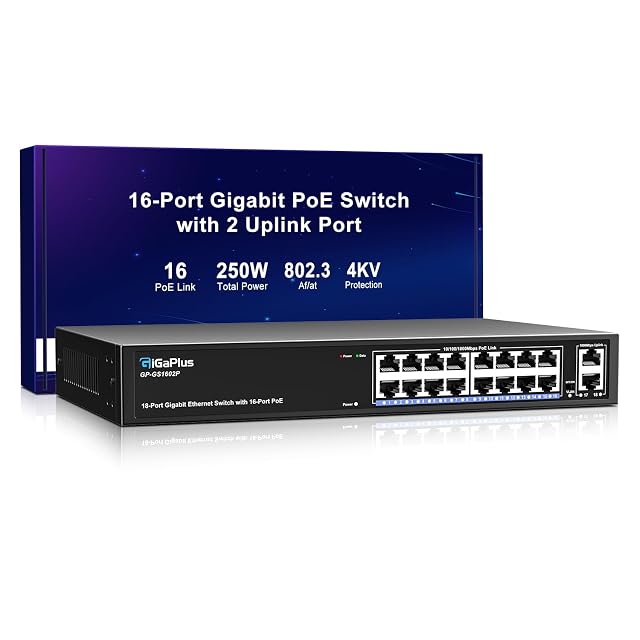
MokerLink POE-G162G, eighteen-socket rack-mounted switch with sixteen powered sockets review
A rack-mounted eighteen-socket switch with sixteen powered sockets, an internal power supply and fans, which numbers its uplinks and isolates the powered sockets from each other.
The bottom line A straightforward rack switch that publishes what an installer needs: both power figures, the numbered uplinks and the supply arrangement. The fans put it firmly in a cupboard, which is where a unit of this size belongs anyway.
On the listing
Eighteen gigabit Ethernet sockets: sixteen gigabit PoE+ and two gigabit uplinks, all supporting 10/100/1000 Mbps, with the uplinks named for routers, recorders and servers; a maximum output of 250 W with an internal supply, support for IEEE 802.3af and 802.3at and up to 30 W at each socket, and a note that passive 24 V PoE is not supported; unmanaged plug and play with power detection, automatic recognition of devices and compatibility with unpowered ones; traffic on sockets 1 to 16 isolated and communicating only with sockets 17 and 18, reducing congestion and improving security; and a compact metal case with indicator lights and industrial fans.
The two power figures
30 W at a socket, 250 W across the unit. The first is set by the class the switch names and belongs to one socket at a time. The second is what all sixteen powered sockets share, and it is the number a camera list has to fit under. They describe different things and neither is derived from the other.
Isolation with an address
The fourth bullet does something the rest of this shelf does not: it names the sockets. Traffic from 1 to 16 reaches 17 and 18 and nowhere else. That is a wiring instruction rather than a feature description, and it means the recorder and the router have a defined home before installation day.
Fans, and where that puts it
Industrial fans are named in the fifth bullet. They are what makes 250 W practical in a rack case, and they are why this unit belongs behind a door.
The supply
Internal, stated. One fewer brick to mount, one fewer lead to dress, and a mains cable that goes straight into the unit.
Before ordering
Confirm the depth of the rack space and whether the mounting ears are attached or supplied loose. The page names rack mounting without listing what comes with it.
Availability
Priced at roughly 110 € on the German, French, Italian and Spanish Amazon stores the day this page was checked.
It is stocked on the American and British Amazon stores as well, in that country’s own currency. The range above leaves those out: it counts euro stores and no others.
Every figure in this section is what Keepa held on the day this page was last updated. Stock and prices move without warning.
Prices quoted in this text were read on 10 September 2026. The live price is at the top of the page.
Where it holds up, and where it stops
Strengths
The uplinks are numbered, 17 and 18, so the wiring diagram can be written before the unit is unpacked
An internal power supply is stated, which means one fewer brick to find room for behind a rack
Both power figures and the exclusion of passive 24 V PoE are published, so a camera list can be checked against the switch on paper
Compromises
It has fans, so this belongs in a rack or a cupboard rather than in a room where anyone works
The title counts sixteen sockets plus two uplinks and the first bullet counts eighteen, which is the same unit described two ways and needs reading twice
No SFP cage, so a fibre run has to reach a different switch
Specifications
PoE standard supported
IEEE 802.3af and 802.3at — stated in the title and in the second bullet, which adds that passive 24 V PoE is not supported
Per-port power budget
Up to 30 W at one socket — stated in the second bullet as the maximum any single socket reaches
Total power budget
250 W for the unit — stated in the title and in the second bullet as the maximum output, with an internal supply named as making installation easier. It is what the sixteen powered sockets share
Powered port count
Sixteen — stated in the first bullet as sixteen gigabit PoE+ sockets
Port count
Eighteen — stated in the first bullet as eighteen gigabit Ethernet sockets, made up of the sixteen powered ones and two uplinks; the title counts the same unit as sixteen sockets plus two uplinks
Port speed
10/100/1000 Mbps on all sockets — stated in the first bullet; no BASE-T designation is printed behind the figures
Managed or unmanaged
Unmanaged — stated in the title in that word and in the third bullet as plug and play with no configuration; the fourth bullet describes traffic on the powered sockets 1 to 16 as isolated, reaching only the uplinks
Uplink type
Two gigabit copper uplinks, numbered 17 and 18 — stated in the first bullet and named again in the fourth, for routers, recorders and servers; no SFP cage appears anywhere
Cooling
Fan-cooled — stated in the fifth bullet, which names industrial fans as the means of shedding heat, alongside a robust metal case and indicator lights
Amazon reference
B08QHY7JYG (same reference on 6 Amazon marketplaces)
EAN
0786118199873
The questions that come up before an order
Why does it matter that the uplinks are numbered?
Because on an unmanaged switch the isolation is fixed, and knowing which sockets are outside it decides the wiring. Here the powered sockets 1 to 16 reach only sockets 17 and 18. The recorder and the router go in those two, and a diagram can be drawn before anything is mounted.
What does an internal power supply change?
It removes the external brick and its lead, which on a rack is one less object to mount and one less connection to work loose. It also means the mains cable goes straight into the unit. Against that, a failed internal supply is a failed switch rather than a replaceable adapter.
802.3af and 802.3at · 250 W total, no per-socket figure · sixteen powered of eighteen · two gigabit uplinks · one-key VLAN mode · unmanaged
An eighteen-socket switch with sixteen powered sockets and a 250 W shared budget, which never states what one socket can deliver and contradicts itself about how it mounts.
Best for: A building with a dozen or more cameras where the total draw is known and the switch will live in a cupboard, and where the per-socket question can be settled with the seller first.
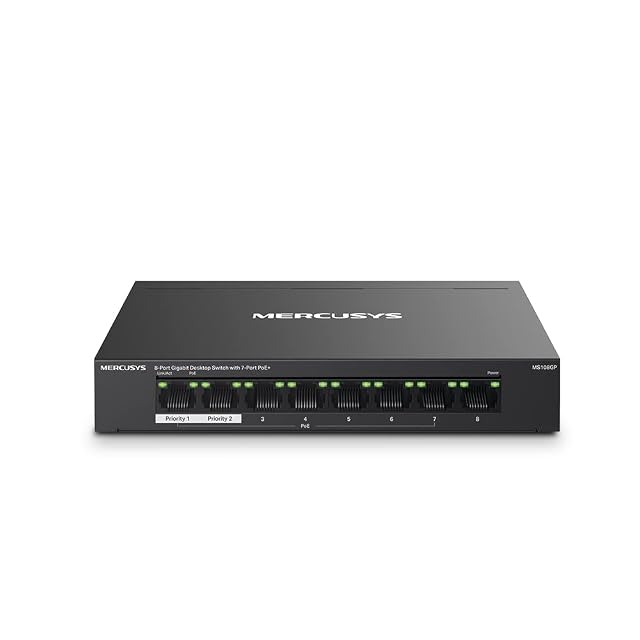
802.3af and 802.3at · up to 30 W per socket · 65 W total · seven powered of eight · gigabit · fanless · metal case
A gigabit switch that powers seven of its eight sockets and states both halves of the power question: 30 W at one socket and 65 W for all of them together.
Best for: A small installation of three or four cameras or access points that draw modestly, where the switch has to be silent and sit in the open.
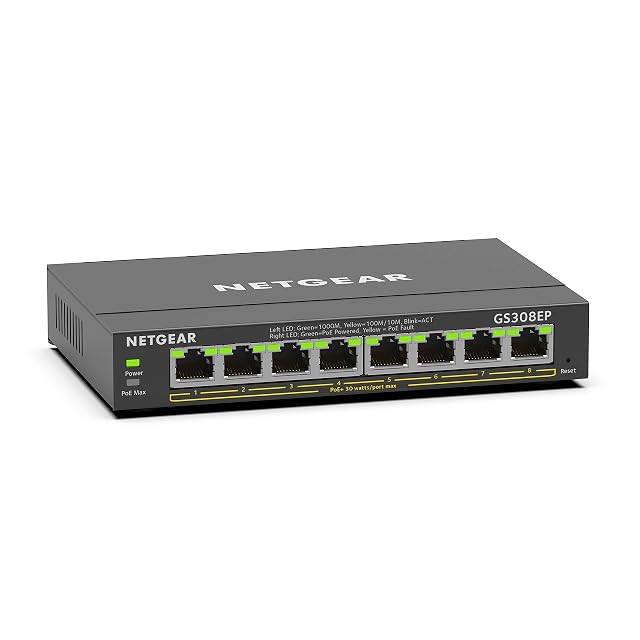
PoE+ named, no IEEE class printed · 62 W total · eight powered sockets · managed, with VLANs and QoS · per-socket power control · fanless metal case
A managed eight-socket switch with per-socket power control and a 62 W shared budget, whose sockets are called PoE+ without any IEEE class being printed.
Best for: An office or a small business that wants VLANs and the ability to restart a powered device remotely, on devices that draw modestly.