The per-port budget and the total budget are two different numbers · review
MERCUSYS MS108GP, eight-socket gigabit switch with seven powered sockets review
A gigabit switch that powers seven of its eight sockets and states both halves of the power question: 30 W at one socket and 65 W for all of them together.
The bottom line A well-labelled first PoE switch, silent and clear about the two power figures. The shared 65 W is modest, so it suits several small devices rather than two hungry ones, and the unpowered eighth socket is the line to plan around.
On the listing
Eight RJ45 sockets at 10/100/1000 Mbit/s; seven PoE+ sockets carrying data and power on one cable; up to 30 W at each PoE socket and 65 W for all of them together; an extended mode raising PoE reach to 250 m; a one-click isolation mode separating traffic for stability and security; conformity with powered devices meeting IEEE 802.3af and 802.3at; a robust metal case for heat dissipation; and plug and play working.
Two numbers, two questions
30 W, and 65 W. The first is what one socket can deliver, decided by the class the switch names. The second is what all seven powered sockets draw on together. They are not versions of the same figure, and the arithmetic that matters runs the other way from the way the page reads: add up what the devices ask for, then compare that sum with the 65 W.
Seven of eight
The count is stated, which is more than several listings on this shelf manage. What is not stated is what the eighth socket is for. It carries no power, no bullet calls it an uplink, and its speed is the same as the rest.
The isolation mode
One click separates the traffic on the sockets. It is a fixed behaviour rather than a page of settings, and the listing describes it as being about stability and security. Useful on a run of cameras; not a substitute for a managed switch.
Before ordering
Write down what each device draws and add the figures up. If the total approaches 65 W, this is the wrong size of switch, however comfortable each socket looks on its own.
Availability
Priced from 30 € to 38 € across the German, French, Italian and Spanish Amazon stores the day this page was checked.
It is stocked on the British Amazon store as well, in that country’s own currency. The range above leaves those out: it counts euro stores and no others.
In the American Amazon catalogue with no live offer against it: the reference exists, nobody is filling it.
Every figure in this section is what Keepa held on the day this page was last updated. Stock and prices move without warning.
Prices quoted in this text were read on 10 September 2026. The live price is at the top of the page.
Where it holds up, and where it stops
Strengths
States the per-socket ceiling and the shared total as two separate figures, which is the distinction most buyers of a first PoE switch have to learn the hard way
Names both PoE standards and says the powered devices must conform to them, so the compatibility question has a written answer
Fanless with seven powered sockets, which is unusual on this shelf and matters where the unit lives in a room rather than a cupboard
Compromises
The eighth socket carries no power and is not described as an uplink either, so what it is for has to be worked out
Neither the word managed nor unmanaged appears, and the isolation mode is a fixed behaviour rather than something to configure
At 65 W shared, three devices drawing the full 30 W cannot all be run, and nothing on the page draws attention to that
Specifications
PoE standard supported
IEEE 802.3af and 802.3at — stated in the title and confirmed in the sixth bullet, which says the unit works with powered devices conforming to those two standards
Per-port power budget
Up to 30 W at one PoE socket — stated in the title and in the third bullet. It is the ceiling one socket can reach, and it is not available at seven sockets at the same time
Total power budget
65 W for all PoE sockets together — stated in the title and in the third bullet. This is the figure the seven powered sockets share between them, and it is the one to compare against the sum of what the connected devices ask for
Powered port count
Seven — stated in the title and in the second bullet as seven PoE+ sockets, out of eight in total
Port count
Eight — stated in the title and in the first bullet as eight RJ45 sockets
Port speed
10/100/1000 Mbit/s on all eight sockets — stated in the first bullet; no BASE-T designation is printed behind the figures
Managed or unmanaged
Not published on the listing as either word — the title and the eighth bullet say plug and play, and the fifth bullet names a one-click isolation mode that separates traffic, described as a built-in mode rather than a settings page
Uplink type
Not published on the listing — with seven of the eight sockets powered, the eighth is the only one left, and no bullet designates it as an uplink or gives it a type of its own
Cooling
Fanless — stated in the title, with the seventh bullet naming a robust metal case as the means of shedding heat
Amazon reference
B0C3D21DKJ (same reference on 6 Amazon marketplaces)
EAN
6957939001209
The questions that come up before an order
Why are 30 W and 65 W both printed?
Because they answer different questions. The 30 W is the ceiling one socket can deliver, set by the standard the switch names. The 65 W is what all the powered sockets share. Adding up what the connected devices actually ask for and comparing that sum against the total is the check that matters; the per-socket figure never applies to every socket at once.
What does the extended range of 250 m cost?
The listing states the extended mode as raising the PoE reach to 250 m, and does not say what happens to the data rate in that mode. On several switches the two are traded against each other. This page names the distance and leaves the trade unstated, so it is a question for the seller.
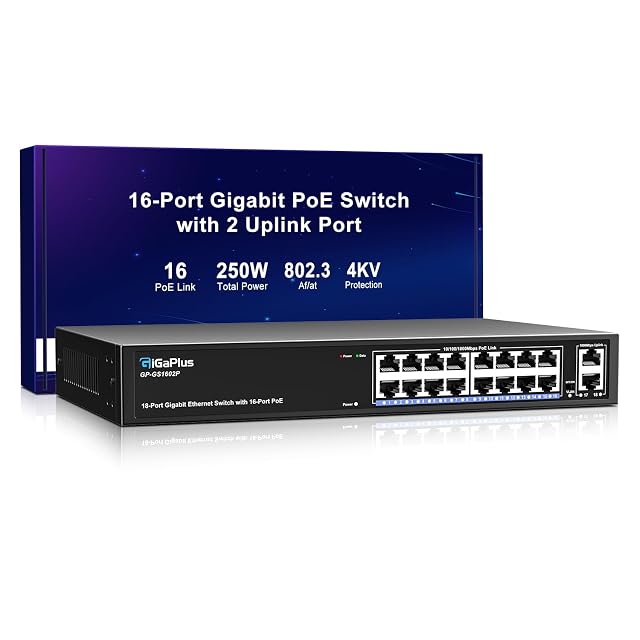
802.3af and 802.3at · 250 W total, no per-socket figure · sixteen powered of eighteen · two gigabit uplinks · one-key VLAN mode · unmanaged
An eighteen-socket switch with sixteen powered sockets and a 250 W shared budget, which never states what one socket can deliver and contradicts itself about how it mounts.
Best for: A building with a dozen or more cameras where the total draw is known and the switch will live in a cupboard, and where the per-socket question can be settled with the seller first.
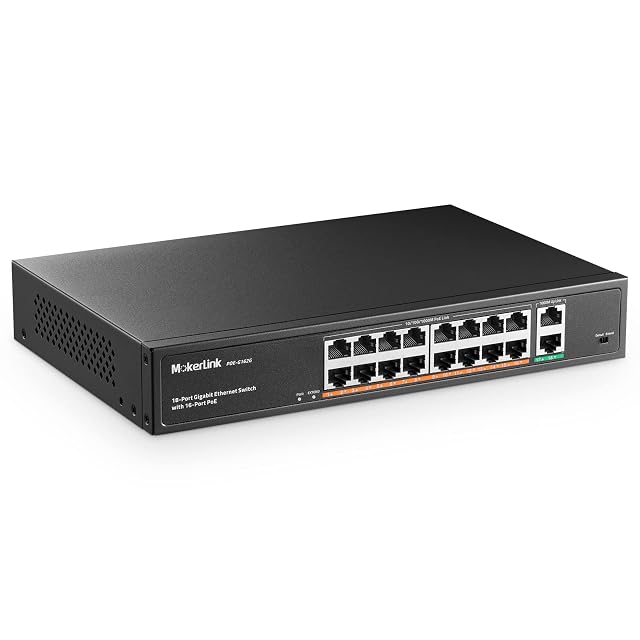
802.3af and 802.3at · up to 30 W per socket · 250 W total · sixteen powered of eighteen · uplinks numbered 17 and 18 · internal supply · fan-cooled
A rack-mounted eighteen-socket switch with sixteen powered sockets, an internal power supply and fans, which numbers its uplinks and isolates the powered sockets from each other.
Best for: A rack in a cupboard or a small server room carrying a camera installation, where fans are inaudible and an internal supply saves space.
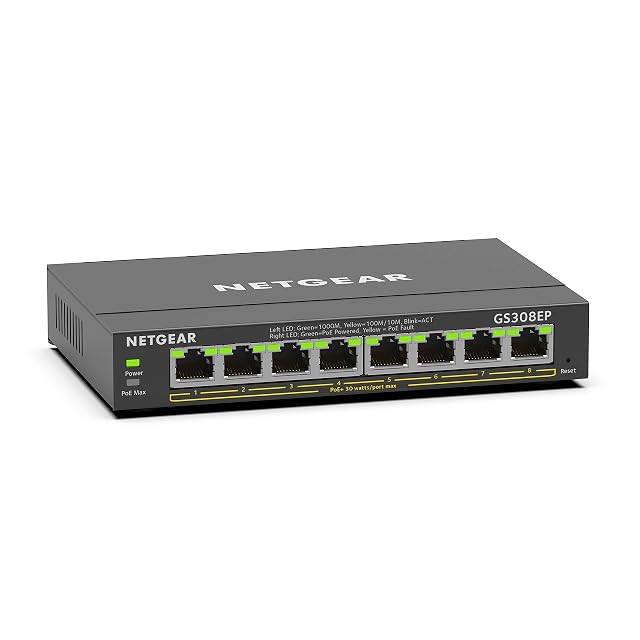
PoE+ named, no IEEE class printed · 62 W total · eight powered sockets · managed, with VLANs and QoS · per-socket power control · fanless metal case
A managed eight-socket switch with per-socket power control and a 62 W shared budget, whose sockets are called PoE+ without any IEEE class being printed.
Best for: An office or a small business that wants VLANs and the ability to restart a powered device remotely, on devices that draw modestly.