The per-port budget and the total budget are two different numbers · review
NETGEAR GS308EP, eight-socket managed switch with all sockets powered review
A managed eight-socket switch with per-socket power control and a 62 W shared budget, whose sockets are called PoE+ without any IEEE class being printed.
The bottom line The management is real and well described, and per-socket power control is the feature installers keep. The blank where the PoE class should be is the one line that would decide compatibility, and it is not on the page.
On the listing
Eight Ethernet sockets at 1.0 Gbps with automatic negotiation and compatibility with existing Cat5e and Cat6 cable; eight PoE+ sockets with a total budget of 62 W, uninterrupted PoE and per-socket power control for managed energy management; an easy smart managed interface for configuring VLANs, prioritising traffic with QoS, monitoring sockets and managing network security for small businesses; a compact metal case for desk or wall mounting; and a fanless design with IEEE 802.3az energy-efficient Ethernet.
Where a PoE class should be
A class. The sockets are called PoE+ four times over and no 802.3 figure is attached to them. The one that is printed, 802.3az, governs how little the switch draws when idle and has nothing to do with what it can deliver. A camera datasheet quotes a class; this page does not, so the two cannot be compared without asking.
What 62 W means across eight sockets
It is the whole budget, shared. There is no per-socket ceiling on this page to multiply out, and multiplying one out would be the wrong operation in any case: the total is the constraint, and the sum of what the connected devices ask for is what has to fit under it.
Why the management is worth paying for here
Per-socket power control and uninterrupted PoE are the two features that change a working day. The first restarts a hung camera from a browser. The second keeps the telephones alive while the switch reloads its own software. Both are named plainly in the second bullet.
Before ordering
Ask the seller which PoE class the sockets conform to, and match it against what the cameras or access points require. That single answer decides whether this switch fits the installation.
Availability
Priced from 78 € to 100 € across the German, French, Italian and Spanish Amazon stores the day this page was checked.
It is stocked on the British Amazon store as well, in that country’s own currency. The range above leaves those out: it counts euro stores and no others.
The American Amazon store returned nothing at all, so the buy button there opens a search in that country rather than a page that would not load.
Every figure in this section is what Keepa held on the day this page was last updated. Stock and prices move without warning.
Prices quoted in this text were read on 10 September 2026. The live price is at the top of the page.
Where it holds up, and where it stops
Strengths
Per-socket power control means a device that has stopped responding can be restarted from a browser rather than from a ladder
VLANs, QoS, socket monitoring and security are named individually, so what the management interface actually offers is written down
Fanless with all eight sockets powered, which is the combination that lets a managed PoE switch live in an office
Compromises
No IEEE class is printed for the PoE sockets, so whether a device specified for 802.3at will settle on this switch cannot be read from the page
No per-socket ceiling is given either, which leaves the shared 62 W as the only power figure on the listing
At 62 W across eight sockets, the total is the lowest per socket of any eight-socket unit here once it is shared out
Specifications
PoE standard supported
Not published on the listing as an IEEE number — the sockets are called PoE+ in the title and in the second bullet, and the only 802.3 figure printed anywhere on the page is 802.3az, which is the energy-efficiency standard rather than a PoE class
Per-port power budget
Not published on the listing — the second bullet gives the total and names per-socket PoE control as a management feature, without ever stating a ceiling for one socket
Total power budget
62 W for the unit — stated in the title and in the second bullet as the total budget shared by the eight powered sockets
Powered port count
Eight — stated in the second bullet as eight PoE+ sockets
Port count
Eight — stated in the first bullet as eight Ethernet sockets at 1.0 Gbps
Port speed
1.0 Gbps per socket with automatic negotiation — stated in the first bullet, which also names Cat5e and Cat6 as the cable grades the sockets work with
Managed or unmanaged
Managed — stated in the title and described in the third bullet as a software interface for configuring VLANs, prioritising traffic with QoS, monitoring sockets and managing network security; the second bullet adds uninterrupted PoE and per-socket power control
Uplink type
Not published on the listing — all eight sockets are counted together and carry power, and none is set aside as an uplink or given a type of its own
Cooling
Fanless — stated in the title as a fanless metal case and repeated in the fifth bullet, with IEEE 802.3az energy-efficient Ethernet named as lowering consumption
Amazon reference
B08LZJ2H9S (same reference on 5 Amazon marketplaces)
EAN
0606449153040
The questions that come up before an order
Why does the PoE class matter more than the word PoE+?
Because the classes set different ceilings, and a device specified for the higher one will not settle on a source offering the lower. PoE+ is a marketing name commonly used for one of them, but it is the IEEE number that a device datasheet quotes. This page names the marketing word throughout and prints no class, so the check cannot be made from the listing.
What is uninterrupted PoE?
A feature that keeps power flowing to connected devices while the switch itself restarts its software, so cameras and telephones do not drop out during a configuration change or an update. The second bullet names it alongside per-socket power control, and the two together are the practical reason to choose a managed unit for a powered installation.
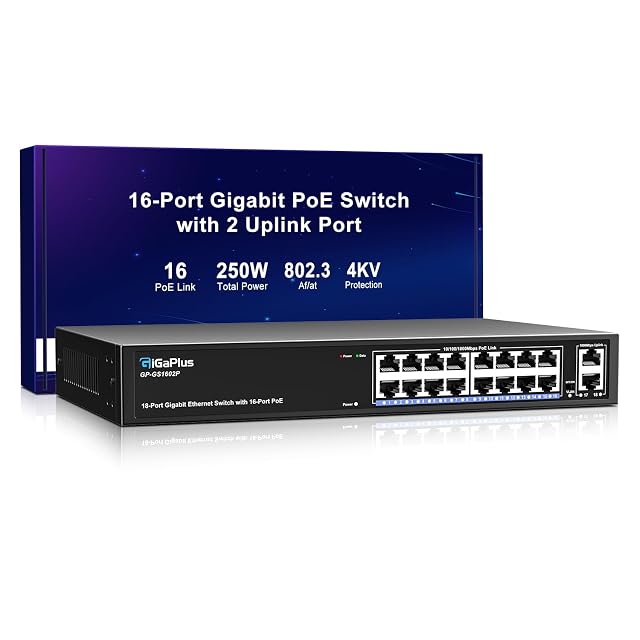
802.3af and 802.3at · 250 W total, no per-socket figure · sixteen powered of eighteen · two gigabit uplinks · one-key VLAN mode · unmanaged
An eighteen-socket switch with sixteen powered sockets and a 250 W shared budget, which never states what one socket can deliver and contradicts itself about how it mounts.
Best for: A building with a dozen or more cameras where the total draw is known and the switch will live in a cupboard, and where the per-socket question can be settled with the seller first.
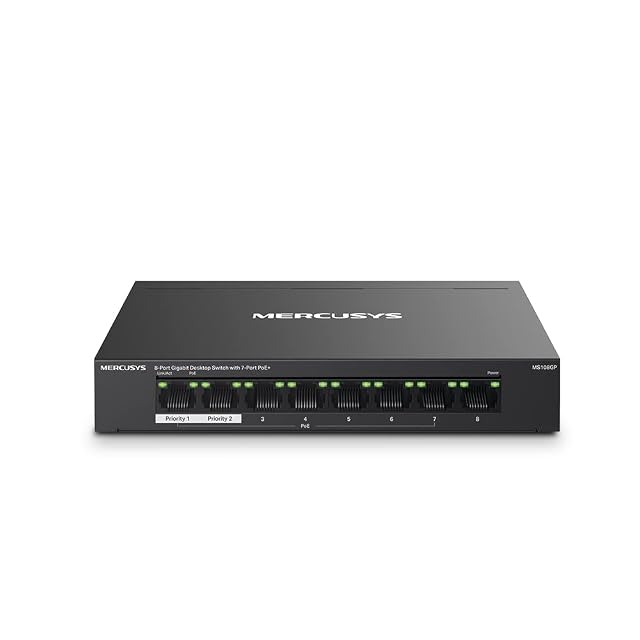
802.3af and 802.3at · up to 30 W per socket · 65 W total · seven powered of eight · gigabit · fanless · metal case
A gigabit switch that powers seven of its eight sockets and states both halves of the power question: 30 W at one socket and 65 W for all of them together.
Best for: A small installation of three or four cameras or access points that draw modestly, where the switch has to be silent and sit in the open.
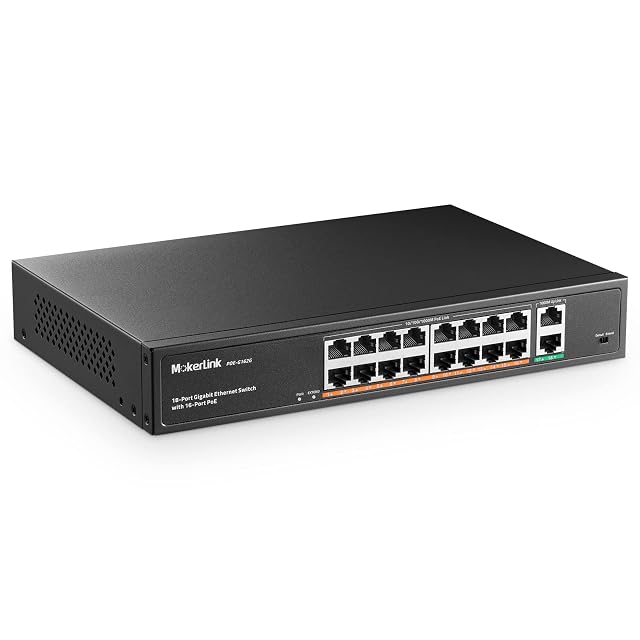
802.3af and 802.3at · up to 30 W per socket · 250 W total · sixteen powered of eighteen · uplinks numbered 17 and 18 · internal supply · fan-cooled
A rack-mounted eighteen-socket switch with sixteen powered sockets, an internal power supply and fans, which numbers its uplinks and isolates the powered sockets from each other.
Best for: A rack in a cupboard or a small server room carrying a camera installation, where fans are inaudible and an internal supply saves space.