The slot, the lanes and the controller settle it before the port speed does · review
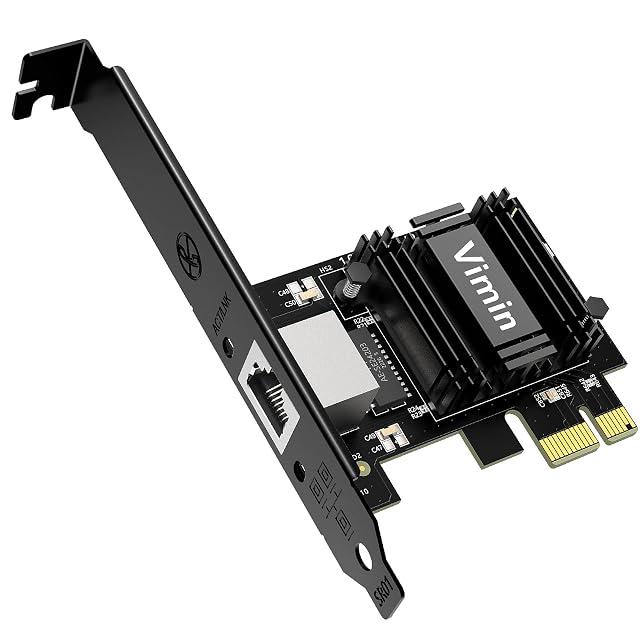
TP-Link TX201, single-port 2.5-gigabit PCIe card with both brackets review
A single-socket 2.5-gigabit card that names its Ethernet standard, its brackets and its operating systems, and never says which PCIe generation or how many lanes it wants.
The bottom line The Ethernet half of this page is stated properly, standard and all, and the PCIe half is not stated at all. On a board whose slots are already known that is a small gap; on an unfamiliar machine it is the whole question.
On the listing
A 2.5-gigabit PCIe network card carrying no wireless; 2.5G Base-T technology with a ceiling of 2.5 Gbps, described as two and a half times a typical gigabit adapter; backwards compatibility across 2.5 Gbps, 1 Gbps and 100 Mbps Base-T with automatic negotiation between higher and lower rates; a Quality of Service feature named for gaming; Wake-on-LAN for switching a machine on or off remotely; a low-profile bracket supplied alongside the standard one for mini-tower cases; and operating system support given as Windows 11/10/8.1/8/7, Windows Server and Linux.
The slot the card never describes
Every other card on this shelf prints something about the connector it wants — a generation, a lane figure, or at least a list of the slots it fits. This page prints none of the three. The word PCIe appears four times and never once carries a number.
Two lists of Windows Server
The title runs 2022, 2019, 2016, 2012 R2, 2012 and 2008 R2. The sixth bullet stops at 2016. Both are reported here because both are published; nothing on the page says which of them was written later, and the gap is exactly the range of machines old enough for the question to matter.
The bracket that comes with it
A low-profile bracket in addition to the standard one. Named in the fifth bullet, with the case it is for. It is a small line and it decides whether the card can be fitted at all in a slim machine, which is why it belongs beside the speed rather than under it.
Before ordering
Look up the free slot in the published table of the motherboard. This page will not tell you what the card wants, so the board has to tell you what it offers.
Availability
Priced from 18 € to 22 € across the German, French, Italian and Spanish Amazon stores the day this page was checked.
It is stocked on the American and British Amazon stores as well, in that country’s own currency. The range above leaves those out: it counts euro stores and no others.
Every figure in this section is what Keepa held on the day this page was last updated. Stock and prices move without warning.
Prices quoted in this text were read on 10 September 2026. The live price is at the top of the page.
Where it holds up, and where it stops
Strengths
Names the Ethernet standard as 2.5G Base-T rather than printing a figure in gigabits and stopping there, so the socket can be matched against a switch
Says in the title that the card carries no wireless, which is the mistake a buyer makes once when a network card and a Wi-Fi card sit side by side in the same list
Both bracket heights are in the box, and the fifth bullet says which case the second one is for
Compromises
Neither a PCIe generation nor a lane count is printed, so the one question a card has to answer before it is ordered is left to the motherboard manual alone
The controller is never named, and driver support follows the chip rather than the brand on the box
The two lists of Windows Server versions on the same page do not match, and nothing says which one is current
Specifications
PCIe generation
Not published on the listing — the word PCIe appears in the title and in three bullets, and no generation number follows it anywhere on the page
Lane count
Not published on the listing — neither a lane figure for the card nor a list of the connectors it fits appears, which is the one thing two rival listings on this shelf both print
Port speed standard
2.5GBASE-T — stated in the first bullet as 2.5G Base-T technology with a ceiling of 2.5 Gbps, and in the second as backwards compatible Base-T connectivity at 2.5 Gbps, 1 Gbps and 100 Mbps, negotiated automatically between the higher and lower rates
Port count
One — the second bullet speaks of the 2.5G Ethernet port in the singular, and no figure is printed in the title or in any of the six bullets
Controller family
Not published on the listing — no chip, no chip maker and no part number is named, on a shelf where three of the seven cards put the controller in the title
Bracket heights supplied
Two — the fifth bullet states that a low-profile bracket is supplied in addition to the standard one, and names mini-tower cases as the reason
Cooling arrangement
Not published on the listing — no heatsink, no fan and no word about heat appears anywhere on the page
Stated operating system support
Published twice and not identically. The title names Windows 11/10/8.1/8/7, Windows Server 2022/2019/2016/2012R2/2012/2008 R2 and Linux; the sixth bullet stops the server list at 2016 and names Windows 11/10/8.1/8/7, Windows Server 2022/2019/2016 and Linux
Amazon reference
B0BHW6BX7Y (same reference on 6 Amazon marketplaces)
EAN
4897098687833
The questions that come up before an order
What does 2.5G Base-T describe that a figure in gigabits does not?
It names the standard the socket follows over twisted-pair copper, which is what makes it comparable with the socket at the other end of the run. A switch port published as 2.5GBASE-T and a card published the same way agree on channel width, cable grade and negotiation. A bare figure agrees with nothing.
Why does a missing lane count matter on a card that fits any slot?
Because fitting and being wired are two different things. A connector can be physically long and wired for fewer lanes than it looks, which is common on consumer boards and invisible from the outside. Without a published lane count for the card, the only way to settle it is the slot table of the motherboard.
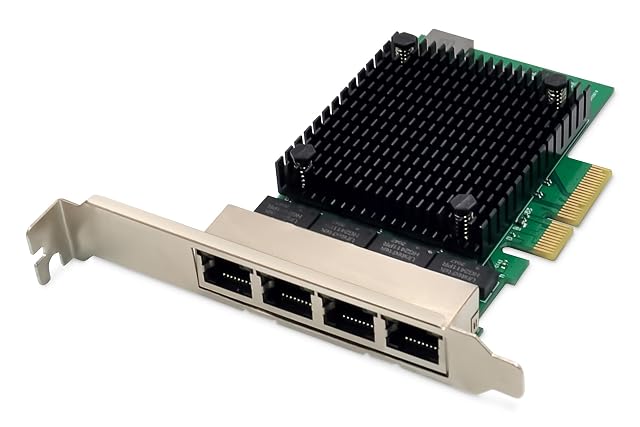
four RJ45 sockets · 2.5G base-T with 10M BASE-Te and 100/1000M · bus width stated up to 10 Gbps · two lanes in one bullet, ×4 in the next · no controller named
A four-socket 2.5-gigabit card whose page publishes a bus width and then gives its lane count two different values in consecutive bullets.
Best for: A router, firewall or small server build where four separate 2.5-gigabit sockets are the reason for the slot, and where the driver situation can be checked on the hardware itself.
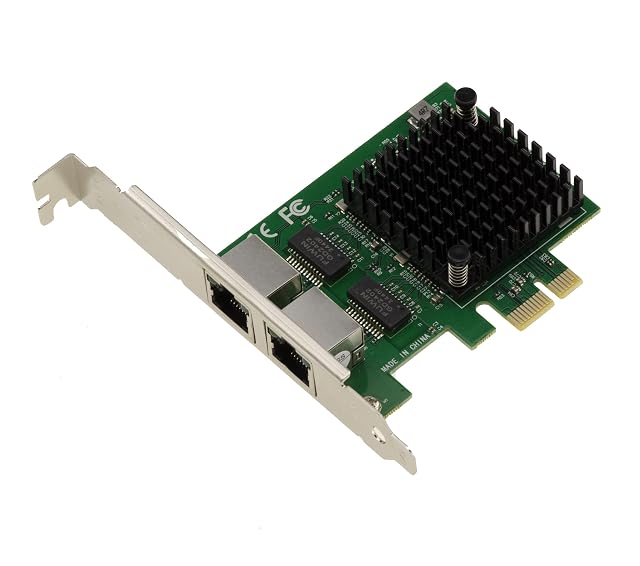
two RJ45 sockets · 2500/1000/100/10 BASE-T · PCIe 3.1 ×1 · dual Intel I226 SRKTU with an ASM bridge · high and low brackets · jumbo frames to 9.5 KB
The only card on this shelf that publishes a PCIe generation and a lane count, and it puts two 2.5-gigabit sockets behind a single lane and says so.
Best for: A small server or a workshop machine that needs two separate 2.5-gigabit sockets from one slot, where the ×1 requirement is a fit rather than a compromise.
2500/1000/100 Mbit/s · Realtek RTL8125B named · fits ×1, ×4, ×8 and ×16 connectors · two brackets · port count printed both ways
A 2.5-gigabit card that names its controller and lists every connector it fits, and whose own page counts its Ethernet socket once in the singular and once in the plural.
Best for: A machine where the driver situation has to be settled in advance, since the controller is named and its support can be checked before anything is ordered.