A dual-socket ten-gigabit copper card that publishes its slot, its cable grades and its distances, and states in as many words the two intermediate rates it does not support.
The bottom line A card written for someone who plans an installation rather than an upgrade: slot, lanes, controller, cable grade and distance, all published. The name on the packing list and the missing second bracket are the two things to settle with the seller first.
On the listing
A ten-gigabit PCI-E network card with dual copper RJ45 ports, sold under the Intel X540-T2 name and built on the original Intel X540 controller with intelligent offloads named; compatibility given as Windows Server 2003, 2008 and 2012, Windows 7 and 8, Linux and ESX or ESXi 6 and 7, with Windows 11 possible after a manual setup for which the seller asks to be contacted; support for 100M, 1G and 10G with 2.5G and 5G explicitly excluded; dual copper RJ45 ports for Category 6A to 100 m and Category 6 to 55 m, named for data centre work; PCI Express 2.1 at 5.0 GT/s on an ×8 lane arrangement suitable for ×8 and ×16 connectors; a profile bracket with an additional low-profile bracket for small cases; a line stating that hot swapping is not supported; and a contents list naming the card as X540-10G-2T with one low-profile bracket, thirty days of free returns, a three-year warranty and lifetime technical support.
Ten gigabit, and the two rates it refuses
Supports 100M, 1G and 10G; does not support 2.5G or 5G. That sentence is worth the whole page. Ten-gigabit copper cards are bought for buildings that are half upgraded, and a card that cannot meet a 2.5-gigabit switch in the middle drops to a gigabit instead. Most listings never raise the subject. This one raises it in the same breath as the rates it does support.
Cat 6A to 100 m, Cat 6 to 55 m
The two distances belong to the standard, not to the card, and printing them turns a specification into a plan. A run already in a wall has a grade and a length, and those two figures say whether it can carry ten gigabits or not. They say nothing about whether the run was installed properly, which is a separate question and a separate instrument.
A second model number in the contents
The title sells an X540-T2. The contents line packs an X540-10G-2T and adds that it compares to the Intel part. Both names are printed here because both are on the page, and nothing is transferred from one to the other.
Hot swapping, ruled out
One short bullet, with an exclamation mark. It means the machine goes off before the card comes out, which is ordinary for a desktop and worth knowing in a rack.
Before ordering
Count the brackets you will actually need, then ask which ones ship. One bullet says two and the contents line says one, and a full-height machine needs the one that is missing from the shorter list.
Availability
Priced from 53 € to 63 € across the German, French, Italian and Spanish Amazon stores the day this page was checked.
It is stocked on the British Amazon store as well, in that country’s own currency. The range above leaves those out: it counts euro stores and no others.
The American Amazon store returned nothing at all, so the buy button there opens a search in that country rather than a page that would not load.
Every figure in this section is what Keepa held on the day this page was last updated. Stock and prices move without warning.
Prices quoted in this text were read on 10 September 2026. The live price is at the top of the page.
Where it holds up, and where it stops
Strengths
States which rates are not supported, 2.5G and 5G, on a shelf where every other page lists only what works
Publishes the cable grade with the distance attached: Cat 6A to 100 m, Cat 6 to 55 m, which is how a run in a building is planned
Lists the contents of the box, which two thirds of the pages here never do
Compromises
The card is sold under one name in the title and packed under another in the contents line, and nothing on the page explains the difference
The fourth bullet promises two brackets and the sixth packs one, so what arrives has to be confirmed
Nothing about cooling on a ten-gigabit copper card, which is the kind that runs warm enough for the question to be asked
Specifications
PCIe generation
PCI Express 2.1 — stated in the third bullet, printed with an asterisk and followed by a signalling figure of 5.0 GT/s
Lane count
Eight — stated in the third bullet as an ×8 lane arrangement suitable for both ×8 and ×16 connectors, and repeated in the contents line as a PCI-E ×8 card. It is the only card here that names a lane count for itself and pairs it with the connectors that accept it
Port speed standard
10GBASE-T over copper — the third bullet states support for 100M, 1G and 10G and states in the same sentence that 2.5G and 5G are not supported, which is unusual enough to be the most useful line on the page
Port count
Two — stated in the title as dual copper RJ45 and in the third bullet as dual copper RJ45 ports
Controller family
Intel X540 — stated in the title and in the first bullet, described as the original Intel X540 controller chip with intelligent offloads named
Bracket heights supplied
Stated twice and not identically. The fourth bullet names a profile bracket and an additional low-profile bracket; the sixth, which lists the contents of the box, names one card and one low-profile bracket and stops there
Cooling arrangement
Not published on the listing — no heatsink, no fan and no reference to temperature appears in the title or in any of the six bullets, on the only ten-gigabit copper card in this group
Stated operating system support
Windows Server 2003, 2008 and 2012, Windows 7 and 8, Linux and ESX or ESXi 6 and 7 — stated in the second bullet, which adds that the card can be used with Windows 11 but has to be set up by hand, and asks buyers intending that to make contact first
Amazon reference
B01ISV7TYM (same reference on 5 Amazon marketplaces)
EAN
0603149411074
The questions that come up before an order
Why does it matter that 2.5G and 5G are unsupported?
Because a ten-gigabit card that will not negotiate the two rates in between falls straight back to one gigabit when the other end cannot manage ten. On a network with 2.5-gigabit switches that is the difference between most of the speed and a tenth of it, and this page says so outright rather than leaving it to be found.
What do the two distances, 100 m and 55 m, describe?
The reach of ten-gigabit copper on two grades of cable: Cat 6A to a hundred metres and Cat 6 to fifty-five. They come from the standard rather than from this card, and the page prints them because they decide whether an existing run in a building can carry the card at all. Neither figure is a certification of the run.
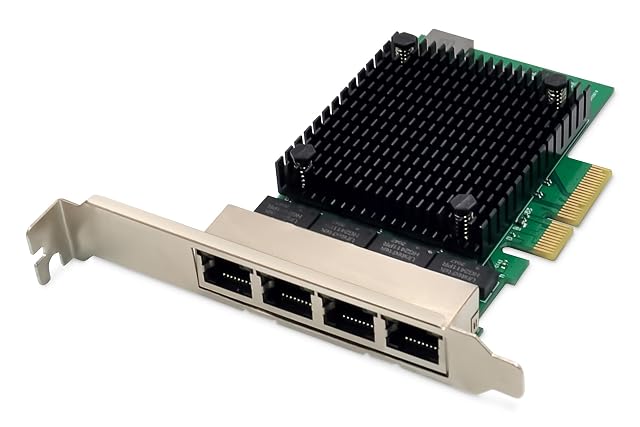
four RJ45 sockets · 2.5G base-T with 10M BASE-Te and 100/1000M · bus width stated up to 10 Gbps · two lanes in one bullet, ×4 in the next · no controller named
A four-socket 2.5-gigabit card whose page publishes a bus width and then gives its lane count two different values in consecutive bullets.
Best for: A router, firewall or small server build where four separate 2.5-gigabit sockets are the reason for the slot, and where the driver situation can be checked on the hardware itself.
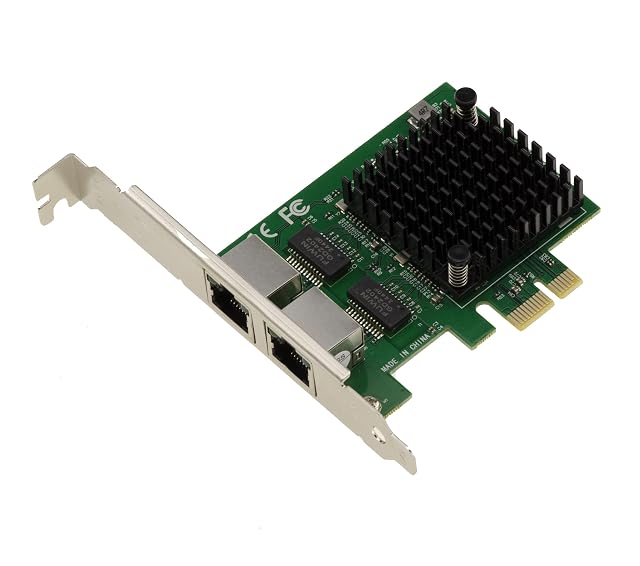
two RJ45 sockets · 2500/1000/100/10 BASE-T · PCIe 3.1 ×1 · dual Intel I226 SRKTU with an ASM bridge · high and low brackets · jumbo frames to 9.5 KB
The only card on this shelf that publishes a PCIe generation and a lane count, and it puts two 2.5-gigabit sockets behind a single lane and says so.
Best for: A small server or a workshop machine that needs two separate 2.5-gigabit sockets from one slot, where the ×1 requirement is a fit rather than a compromise.
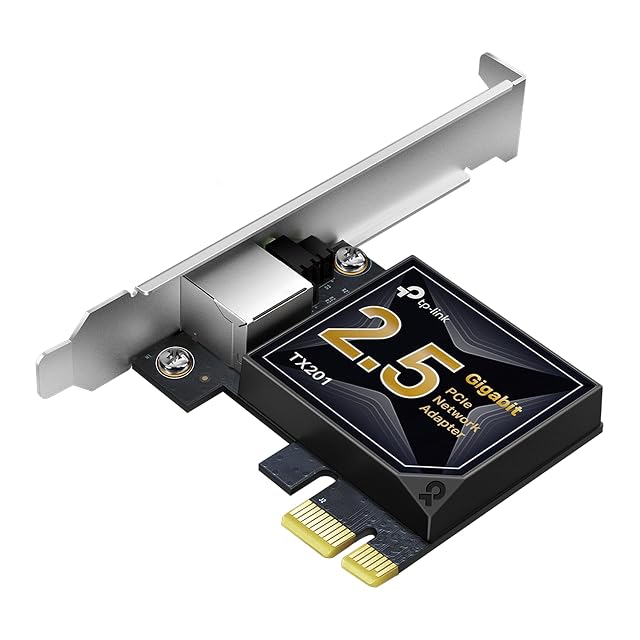
one 2.5GBASE-T socket · 2.5G / 1G / 100M · no PCIe generation printed · no lane count printed · two brackets · Wake-on-LAN and QoS named
A single-socket 2.5-gigabit card that names its Ethernet standard, its brackets and its operating systems, and never says which PCIe generation or how many lanes it wants.
Best for: A desktop machine whose motherboard socket has been outgrown, where the case may be a small one and where the buyer already knows what the free slot is wired for.