The slot, the lanes and the controller settle it before the port speed does · review
YuanLey 2.5-gigabit PCI Express card with a heatsink and three network features named review
A 2.5-gigabit card that states a heatsink rather than an adjective and names three network features by name, on a page whose title counts one bracket and whose bullets count two.
The bottom line The most complete feature list on this shelf, with a heatsink stated as a part and three network capabilities named individually. The disagreement about the brackets is the one line to confirm, and it is a cheap question to ask.
On the listing
A 2.5G PCIe card given as a 2.5-gigabit PCI Express Ethernet adapter at 2500 Mbps on a Realtek RTL8125B, with a low-profile bracket named in the title; an upgrade described as two and a half times conventional gigabit Ethernet, named for gaming, 4K streaming, large file transfers and low-latency work; compatibility given as Windows 11/10/8.1/8/7, Linux and macOS, plug and play under Windows 10 and a driver installation elsewhere; standard and low-profile brackets in the third bullet, with support for PCIe ×1, ×4, ×8 and ×16; an integrated heatsink credited with heat dissipation and connection stability, alongside Wake-on-LAN, PXE boot and VLAN tagging; and lifetime technical support with a stated response within 24 hours.
A heatsink, stated
An integrated heatsink. Two words, and they do more work than a paragraph about thermal performance would. A part can be seen in a photograph and a quality cannot, and on a shelf where one rival claims excellent heat dissipation with nothing attached to it, the difference between the two pages is exactly this line.
Wake-on-LAN, PXE and VLAN tagging
Three capabilities, named one by one in the fourth bullet rather than gathered under a word like advanced. Each answers a different question: starting a machine remotely, starting it from the network, and letting it carry tagged traffic. None of the three is unusual on a card of this kind, and printing them is what separates a specification from a description.
Two brackets in the box, one in the title
The title mentions the low-profile bracket. The third bullet mentions both. Both statements are reported here, and neither is chosen, because a bracket is the part that decides whether a card can be fitted at all and guessing at it is how a slim machine ends up with a card that will not screw down.
Before ordering
Confirm that the standard bracket is in the box if the machine is a full-height one. The title and the bullets do not agree, and a card fitted with the wrong bracket is a card that sits loose in its slot.
Availability
Priced from 18 € to 20 € across the German, French, Italian and Spanish Amazon stores the day this page was checked.
It is stocked on the American and British Amazon stores as well, in that country’s own currency. The range above leaves those out: it counts euro stores and no others.
Every figure in this section is what Keepa held on the day this page was last updated. Stock and prices move without warning.
Prices quoted in this text were read on 10 September 2026. The live price is at the top of the page.
Where it holds up, and where it stops
Strengths
States an integrated heatsink as a part rather than describing heat dissipation as a quality, which is what allows the claim to be checked against the photograph
Names Wake-on-LAN, PXE boot and VLAN tagging individually, and PXE boot in particular is what lets a machine start from the network rather than from its own disc
Says which version of Windows needs nothing installed and which need a driver, instead of calling the whole range compatible
Compromises
The title counts one bracket and the third bullet counts two, so what arrives in the box has to be confirmed
No BASE-T designation behind the 2.5 gigabits, which is the form that lines up against a switch port and a cable grade
No PCIe generation, so the list of supported connectors is the only thing said about the slot
Specifications
PCIe generation
Not published on the listing — the third bullet names the connectors the card supports and stops there, and no generation number appears in the title or in any of the five bullets
Lane count
Not published on the listing as a figure for the card — the third bullet says it supports PCIe ×1, ×4, ×8 and ×16, which describes the connectors it will sit in rather than the lanes it asks for
Port speed standard
2.5 Gbit/s over RJ45 — stated in the title as a 2.5-gigabit PCI Express Ethernet adapter at 2500 Mbps and in the first bullet as a 2.5 Gbit/s card; no BASE-T designation is printed anywhere on the page
Port count
One — the title names a single RJ45 LAN controller card, and no bullet prints a figure or returns to the subject
Controller family
Realtek RTL8125B — stated in the title and named again in the fourth bullet, which credits it with the speed and the latency of the card
Bracket heights supplied
Stated twice and not identically. The title names a low-profile bracket alone; the third bullet names standard and low-profile brackets together, with desktop machines, small machines and servers given as what they cover
Cooling arrangement
An integrated heatsink — stated in the fourth bullet, given as what improves heat dissipation and keeps the network connection stable. It is the only cooling part named on this shelf alongside one other card
Stated operating system support
Windows 11/10/8.1/8/7, Linux and macOS — stated in the second bullet, which adds plug and play under Windows 10 and a simple driver installation for the others
Amazon reference
B0F13BQ7MG (same reference on 6 Amazon marketplaces)
EAN
0790885828706
The questions that come up before an order
What is PXE boot for on a network card?
It lets the machine fetch its start-up image over the network instead of from a disc inside it, which is how thin clients, workshop machines and freshly wiped computers are set up. It has to be supported by the card as well as by the motherboard, and this page names it directly rather than leaving it to be discovered.
Does VLAN tagging on the card replace a managed switch?
No. Tagging on the card lets one machine take part in tagged traffic; the switch still decides which tags go where. The two work together, and the card is the end of the chain rather than the middle of it. This listing publishes the capability, which is what a buyer with a tagged network needs to know beforehand.
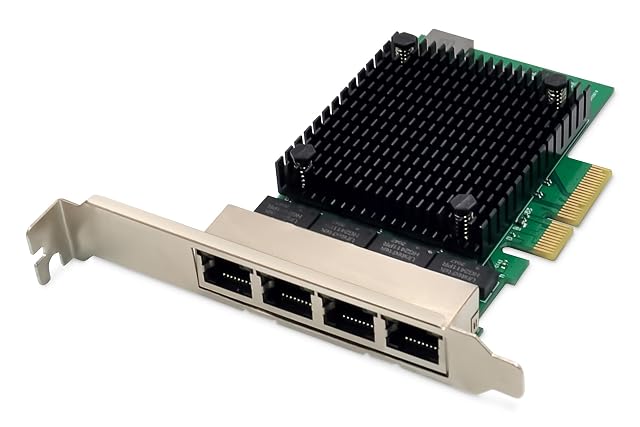
four RJ45 sockets · 2.5G base-T with 10M BASE-Te and 100/1000M · bus width stated up to 10 Gbps · two lanes in one bullet, ×4 in the next · no controller named
A four-socket 2.5-gigabit card whose page publishes a bus width and then gives its lane count two different values in consecutive bullets.
Best for: A router, firewall or small server build where four separate 2.5-gigabit sockets are the reason for the slot, and where the driver situation can be checked on the hardware itself.
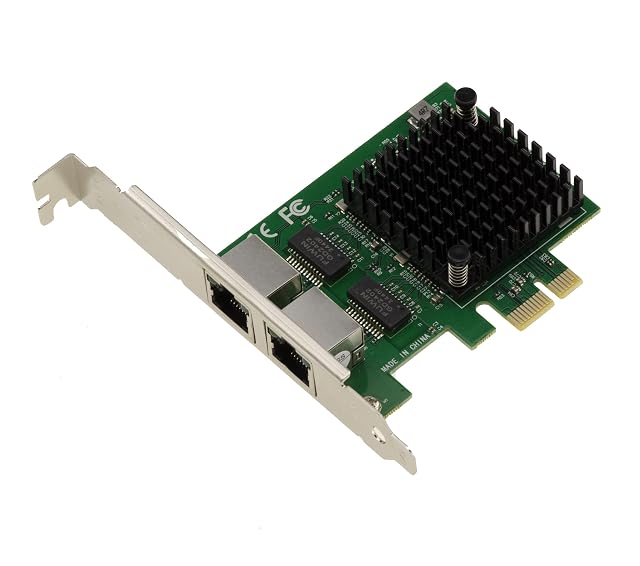
two RJ45 sockets · 2500/1000/100/10 BASE-T · PCIe 3.1 ×1 · dual Intel I226 SRKTU with an ASM bridge · high and low brackets · jumbo frames to 9.5 KB
The only card on this shelf that publishes a PCIe generation and a lane count, and it puts two 2.5-gigabit sockets behind a single lane and says so.
Best for: A small server or a workshop machine that needs two separate 2.5-gigabit sockets from one slot, where the ×1 requirement is a fit rather than a compromise.
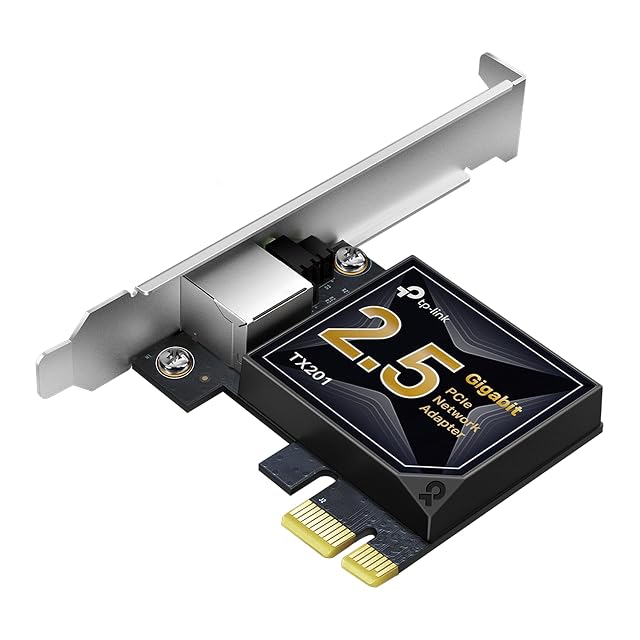
one 2.5GBASE-T socket · 2.5G / 1G / 100M · no PCIe generation printed · no lane count printed · two brackets · Wake-on-LAN and QoS named
A single-socket 2.5-gigabit card that names its Ethernet standard, its brackets and its operating systems, and never says which PCIe generation or how many lanes it wants.
Best for: A desktop machine whose motherboard socket has been outgrown, where the case may be a small one and where the buyer already knows what the free slot is wired for.