The slot, the lanes and the controller settle it before the port speed does · review
VIMIN 2.5G Base-T PCIe card built on a Realtek RTL8125B review
A 2.5-gigabit card that names its controller and lists every connector it fits, and whose own page counts its Ethernet socket once in the singular and once in the plural.
The bottom line A card that answers the driver question in its title and then loses count of its own socket. The controller is the reason to consider it; the singular and the plural three lines apart are the reason to look at the photograph before ordering.
On the listing
A 2.5G Base-T PCIe card built on a Realtek RTL8125B, given in the title as 2500/1000/100 Mbit/s for Windows and Linux; a ceiling of 2.5 Gbps described as two and a half times a conventional gigabit adapter; support for 2.5 Gbps, 1 Gbps and 100 Mbps with automatic negotiation between connections of different speed; flat and standard brackets, given as the reason the card suits several kinds of machine; operating system support named as Windows 11, 8.1, 8 and 7 and Linux; and a fifth bullet turning a PCIe connector of ×1, ×4, ×8 or ×16 into 2.5-gigabit RJ45 Ethernet, with a note in brackets that it works only with PCIe and not with PCI.
One port, or ports
The title says one. The fifth bullet says sockets, plural. Nothing else on the page counts anything, so there is no third statement to break the tie. Both are printed here, because both are published, and the photograph is the only place left to look.
The controller, named
Realtek RTL8125B, in the title. That single line answers more than the speed does: it says which driver the machine needs, whether the operating system already has one, and what two other cards on this shelf share with it. Three of the seven pages here name the chip; four do not.
Windows 10 missing from the list
Eleven, 8.1, 8 and 7. The gap in the middle is the version most desktop machines are still running. Nothing on the page excludes it and nothing includes it, and a list that skips its own most common member is worth one question to the seller.
Before ordering
Ask the seller how many RJ45 sockets the card carries. It is one question, the page gives two answers, and the rest of the listing is straightforward enough to be worth the message.
Availability
Priced from 18 € to 22 € across the German, French, Italian and Spanish Amazon stores the day this page was checked.
It is stocked on the American and British Amazon stores as well, in that country’s own currency. The range above leaves those out: it counts euro stores and no others.
Every figure in this section is what Keepa held on the day this page was last updated. Stock and prices move without warning.
Prices quoted in this text were read on 10 September 2026. The live price is at the top of the page.
Where it holds up, and where it stops
Strengths
Names the controller in the title, which is where driver support is actually decided and where three of the seven cards here put it
Lists the four connector sizes the card goes into, and says outright that an older PCI slot is not one of them
Prints the three Ethernet rates as figures in the title, so the fallback behaviour is readable before the bullets are opened
Compromises
The socket is counted in the singular in the title and in the plural in the fifth bullet, on a page where nothing else disagrees with itself
Windows 10 is missing from a list that names Windows 11, 8.1, 8 and 7, which reads as an omission rather than an exclusion and is neither confirmed nor denied
No lane count for the card itself, so the list of connectors it fits says what it goes into and not what it wants
Specifications
PCIe generation
Not published on the listing — the fifth bullet lists the connectors the card fits and never gives the generation those connectors belong to
Lane count
Not published on the listing as a figure for the card — the fifth bullet names the slots it goes into, ×1, ×4, ×8 and ×16, and adds that it works only in a PCIe connector and not in an older PCI one. That is a list of what accepts the card, not a statement of how many lanes it uses
Port speed standard
2.5G Base-T — stated in the title, which also gives the three rates as 2500/1000/100 Mbit/s; the second bullet repeats them as 2.5 Gbps, 1 Gbps and 100 Mbps with automatic negotiation between connections of different speed
Port count
Not published on the listing as a settled figure — the title turns the connector into one 2.5G Ethernet port, in the singular, while the fifth bullet turns it into 2.5-gigabit RJ45 Ethernet sockets, in the plural. Both forms are on the same page and nothing resolves them
Controller family
Realtek RTL8125B — stated in the title and named again in the first bullet as the 2.5G Ethernet card of the range
Bracket heights supplied
Two — the third bullet names a flat bracket and a standard one, given as the reason the card suits several kinds of machine
Cooling arrangement
Not published on the listing — no heatsink, no fan and no mention of heat appears in the title or in any of the five bullets
Stated operating system support
Windows 11, 8.1, 8 and 7, and Linux — stated in the fourth bullet. Windows 10 is absent from that list, while the title says only Windows and Linux without versions
Amazon reference
B0CFPQQ58P (same reference on 6 Amazon marketplaces)
EAN
0790885573958
The questions that come up before an order
Why is a named controller worth more than a named brand?
Because the driver follows the chip. Operating systems ship support for controller families, not for the labels on cards, and two cards from different sellers carrying the same chip behave the same way. A page that names the chip lets the question be settled before the order; a page that does not leaves it until the machine is open.
Does a card that fits a ×1, ×4, ×8 and ×16 connector work the same in all four?
It fits all four, which is what the bullet says. What it carries depends on how many lanes the connector is actually wired for, and that is published by the maker of the motherboard rather than by the maker of the card. This listing gives the fit and not the requirement.
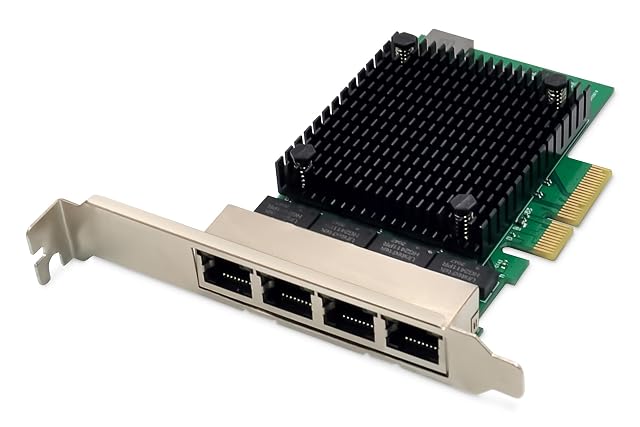
four RJ45 sockets · 2.5G base-T with 10M BASE-Te and 100/1000M · bus width stated up to 10 Gbps · two lanes in one bullet, ×4 in the next · no controller named
A four-socket 2.5-gigabit card whose page publishes a bus width and then gives its lane count two different values in consecutive bullets.
Best for: A router, firewall or small server build where four separate 2.5-gigabit sockets are the reason for the slot, and where the driver situation can be checked on the hardware itself.
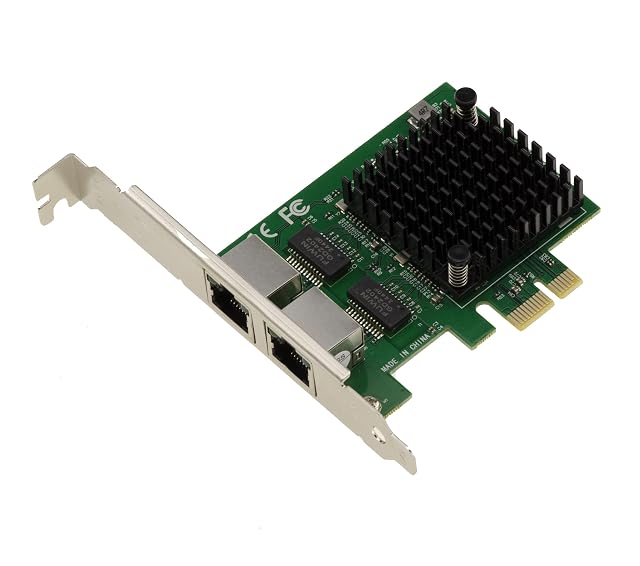
two RJ45 sockets · 2500/1000/100/10 BASE-T · PCIe 3.1 ×1 · dual Intel I226 SRKTU with an ASM bridge · high and low brackets · jumbo frames to 9.5 KB
The only card on this shelf that publishes a PCIe generation and a lane count, and it puts two 2.5-gigabit sockets behind a single lane and says so.
Best for: A small server or a workshop machine that needs two separate 2.5-gigabit sockets from one slot, where the ×1 requirement is a fit rather than a compromise.
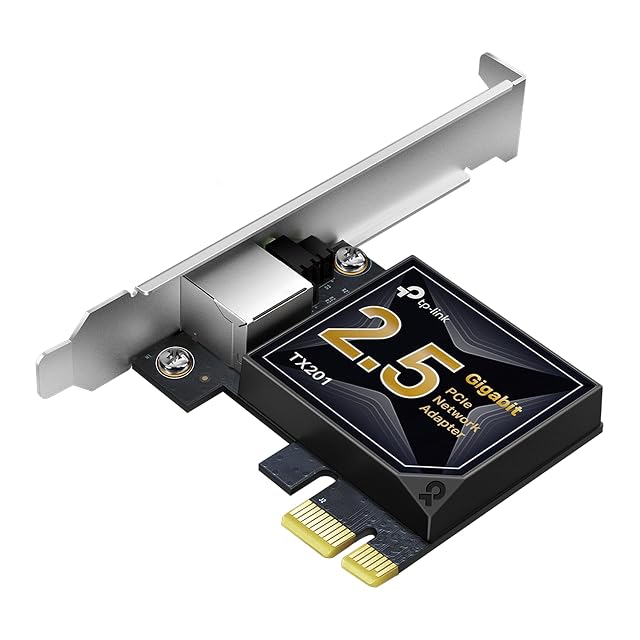
one 2.5GBASE-T socket · 2.5G / 1G / 100M · no PCIe generation printed · no lane count printed · two brackets · Wake-on-LAN and QoS named
A single-socket 2.5-gigabit card that names its Ethernet standard, its brackets and its operating systems, and never says which PCIe generation or how many lanes it wants.
Best for: A desktop machine whose motherboard socket has been outgrown, where the case may be a small one and where the buyer already knows what the free slot is wired for.