Form factor code, PCIe generation and lane count, before any speed figure · review
Samsung SSD 990 1 TB, a random write figure and a three-year term review
A one-terabyte Gen 4 drive that publishes a random write figure in IOPS and a three-year term, and that never prints the length code an M.2 slot will physically test.
The bottom line The one page here that publishes a random figure with its direction, paired with a shorter term than most and no card size at all. Strong on how the drive behaves, silent on whether it will physically fit.
On the listing
A one-terabyte internal M.2 solid-state drive on PCIe 4.0 with four lanes, offered for desktop machines, laptops and handheld consoles at up to 7150 MB/s sequential reading; reading of up to 7150 MB/s, writing of up to 6450 MB/s and 1,100,000 IOPS of random writing; installation without tools by fitting the drive into a free slot and fastening it, with a management application handling firmware updates and optimisation; an efficient ratio of speed to power for longer battery life, compatibility with both PCIe 4.0 and 3.0, and a limited three-year maker’s warranty; and a box containing the drive itself.
A million random writes, and no random reads
1,100,000 IOPS, given for writing. That is the measurement closest to what a machine actually asks of a drive, and publishing it is unusual here. Its counterpart — the same measurement for reading — is absent, which leaves the more common direction of the two unquantified. One half of a pair is still more than none of it, and it is worth reading as half.
M.2, without its length
The form is named and the code is not. Length is what a slot enforces: the card has to reach a standoff to be fastened, and boards differ in which lengths they provide for. A buyer replacing a known stick will not care; a buyer fitting an empty slot in a small machine has to find the answer elsewhere, because it is not on this page.
Three years, alone
The term arrives at the end of a bullet about power efficiency, which is an odd place for it and does not make it less real. It stands without a written total and without a population statistic, so it is the whole of what this maker publishes about endurance. Three separate quantities exist for this, and one of them is here.
Efficiency as a ratio
The fourth bullet gives speed per watt rather than a figure in watts. In a laptop or a handheld that is the quantity that matters, because two drives reaching similar rates can draw very different amounts of power to get there. It is a comparison rather than a value, and it points at a real constraint.
Before ordering
Measure the slot and ask for the card length. Everything about how this drive behaves is published, including a figure most rivals leave out; the one thing that decides whether it can be fitted is not.
Availability
Priced from 172 € to 220 € across the German, French, Italian and Spanish Amazon stores the day this page was checked.
It is stocked on the American and British Amazon stores as well, in that country’s own currency. The range above leaves those out: it counts euro stores and no others.
Every figure in this section is what Keepa held on the day this page was last updated. Stock and prices move without warning.
Prices quoted in this text were read on 10 September 2026. The live price is at the top of the page.
Where it holds up, and where it stops
Strengths
A random figure is published with its unit and its direction, which is rarer on this shelf than a sequential pair
Compatibility with both the current and the previous PCIe generation is stated, so an older board is covered explicitly rather than by implication
Firmware updates are given a named route instead of being left to a search
Compromises
The length code is never printed, and naming M.2 alone does not say which standoff the stick reaches
The random figure covers writing only, so the reading half of the same measurement is absent
A three-year term is published with neither a written total nor a population statistic beside it
Specifications
Capacity
1 TB — printed in the title, in the first bullet and in the box list of the fifth, always in the maker’s unit and reported here in that unit
Form factor code
Not published on the listing — the title and the first bullet name the M.2 form, and no length code follows it in any of the five bullets
PCIe generation
PCIe 4.0 — printed in the title and repeated in the box list, with the fourth bullet adding that the drive is compatible with both PCIe 4.0 and 3.0
Lane count
Four — the title writes PCIe 4.0 x4, which is the full interface designation rather than a generation alone
Stated sequential read figure
Up to 7150 MB/s — stated in the first bullet as a sequential reading speed, repeated in the second and again in the box list of the fifth
Stated sequential write figure
Up to 6450 MB/s — stated in the second bullet beside the read figure, which is the only bullet that quantifies writing
Stated random IOPS
1,100,000 IOPS, random write — stated in the second bullet. The figure covers writing only, and no random reading figure appears anywhere beside it
TBW rating
Not published on the listing — no total in terabytes written appears, on a page that does publish a term in years
Stated MTBF
Not published on the listing — no figure in hours appears in the title or in the five bullets
Warranty length
Three years, limited, from the maker — stated at the end of the fourth bullet, after a sentence about power efficiency and slot compatibility
DRAM cache
Not published on the listing — no memory chip on the drive and no host memory arrangement is named, on a page that does name a management application and a firmware route
Heatsink
Not published on the listing — no heatsink is named, and the third bullet describes fitting the drive into a free slot and fastening it with no thermal part mentioned
Amazon reference
B0H3C6XHGK (same reference on 6 Amazon marketplaces)
EAN
8806099020699
The questions that come up before an order
Why is a random figure more useful than a sequential one?
Because most of what a computer asks a drive to do is scattered rather than continuous. Starting an application, opening a project, loading a level: each reads small pieces from many places at once. The sequential pair describes one long file moving in one direction, which happens far less often than the marketing suggests. A figure in IOPS describes the other case, and this page publishes one.
Is M.2 a size?
No, it is a connector and a family of card sizes. The size is the code that follows, such as 2280, where the last two digits give the length in millimetres and the first two the width. A slot has standoff positions for particular lengths, and a card that does not reach one cannot be screwed down. Naming the family alone leaves the question open, and this page names only the family.
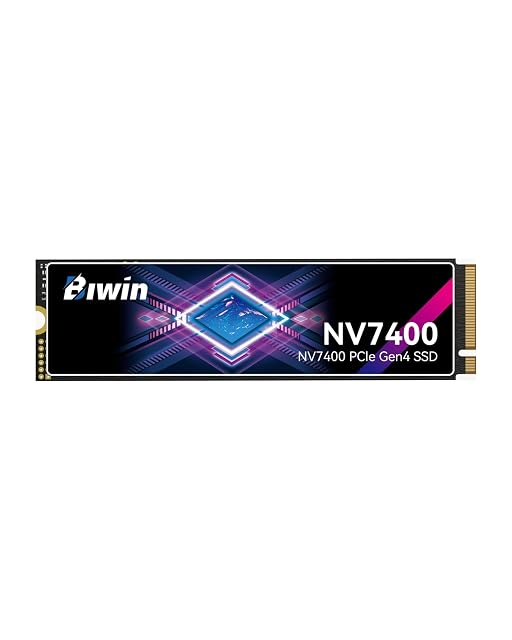
1 TB · M.2, length not published · PCIe Gen 4 ×4 · NVMe 2.0 · up to 7400 MB/s read · up to 1000K IOPS · 1.5 million hours MTBF · five-year limited warranty · no TBW · graphene thermal pad
A one-terabyte Gen 4 drive that publishes a population statistic and a warranty term in the same sentence, keeps them apart from any written total, and never states a sequential write figure.
Best for: A Gen 4 slot in a machine that runs warm, where a named thermal material and a published population statistic count for more than a complete pair of sequential figures.
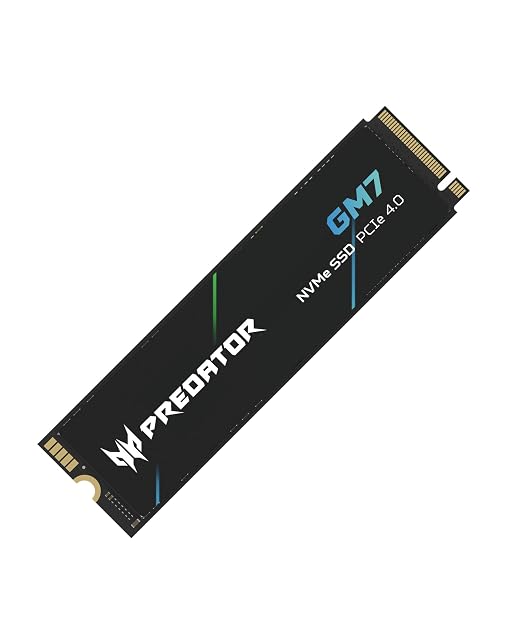
1 TB · M.2 2280 · PCIe 4.0 · NVMe 2.0 · up to 7400 MB/s read · up to 6500 MB/s write · 1.5 million hours MTBF · SLC caching named · no TBW, no warranty
A one-terabyte Gen 4 drive that publishes a population statistic in hours, both sequential figures and backwards compatibility with the previous generation, and that names no warranty term at all.
Best for: A Gen 4 board, or an older one of the previous generation, where the length code and the stated compatibility matter and the buyer will chase the term separately.
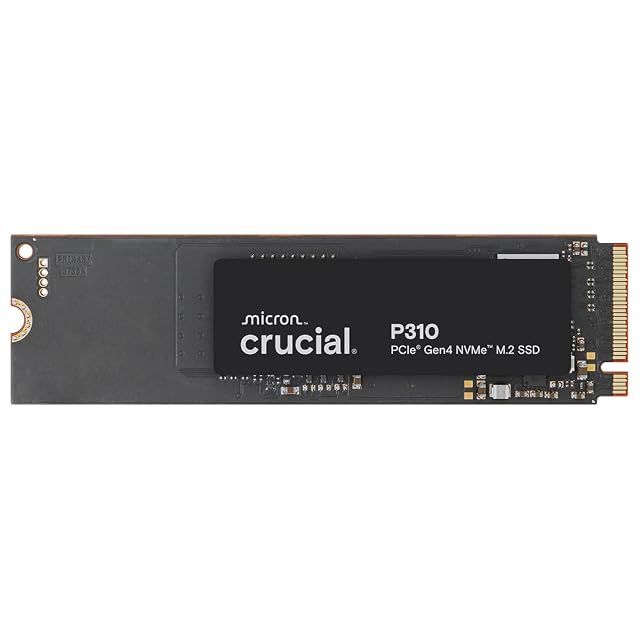
1 TB · M.2 2280 · PCIe Gen 4 · up to 7100 MB/s read · five-year limited warranty · three percentage claims against unnamed drives · no write figure, no TBW, no MTBF
A one-terabyte Gen 4 drive with a five-year term and a single sequential figure, whose remaining bullets compare it in percentages against drives the page never names.
Best for: A laptop or a handheld where a long term and a stated efficiency claim matter, and where receiving large files is not the daily job.