Form factor code, PCIe generation and lane count, before any speed figure · review
SanDisk WD_Black SN7100 1 TB, two rates and no slot dimension review
A one-terabyte Gen 4 drive that publishes both sequential figures and the memory type, never names a form factor or a lane count, and ends its title in the middle of a phrase.
The bottom line A fast pair of figures and a named memory type, on a page that never says what shape the drive is. For a buyer replacing a known stick that is no obstacle; for anyone measuring a slot for the first time, the page answers nothing.
On the listing
A one-terabyte NVMe solid-state drive on PCIe Gen4, sold as high-performance storage for gaming and quoted at up to 7250 MB/s reading, with a title that ends after the words powered by; reading of up to 7250 MB/s and writing of up to 6900 MB/s for short loading times; up to one terabyte of room for game libraries, updates and extra content, stated twice in identical bullets; PCIe Gen4 and next-generation three-level cell stacked flash for reliable performance and durability; and a dashboard application for monitoring condition and performance, with a game mode available on Windows only.
Two rates, and no slot
The generation is here, the lane count is not. The memory type is here, the card size is not. A buyer who already owns a machine with an occupied M.2 slot can order this drive with confidence; a buyer measuring an empty slot for the first time learns nothing from this page about whether the stick will reach the standoff.
A title that stops mid-phrase
The words powered by, and then nothing. The rest of the title is complete and specific, which makes the break stranger rather than less. It is reported here as it appears; nothing on the page says what the phrase was going to name, and the site does not finish a seller’s sentence.
The same bullet twice
Bullets two and three carry the same claim about capacity in the same words. On a five-line list that is a fifth of the space, and the lines it displaces are the ones that would have carried a written total, a term or a card size.
What the memory type sets
Three-level cells store three bits each, which is what makes a terabyte affordable and what makes sustained writing slower than the opening burst. Naming the memory is genuinely useful — most listings here do not — and it points at the figure the page then does not give: what the drive writes at once the fast region is full.
Before ordering
Measure the slot and ask for the card size and lane count. The rates are published, the memory is named, and the two questions that decide whether the drive fits are both open.
Availability
Priced from 159 € to 192 € across the German, French, Italian and Spanish Amazon stores the day this page was checked.
It is stocked on the American and British Amazon stores as well, in that country’s own currency. The range above leaves those out: it counts euro stores and no others.
Every figure in this section is what Keepa held on the day this page was last updated. Stock and prices move without warning.
Prices quoted in this text were read on 10 September 2026. The live price is at the top of the page.
Where it holds up, and where it stops
Strengths
Both sequential figures are published, with the write side given its own number rather than left to follow from the generation
The memory type is named — three-level cells in a stacked arrangement — which is the part of a specification that governs what happens once the fast buffer empties
A monitoring application is named and its platform limit stated outright, so the software side is not oversold
Compromises
Neither a form factor nor a lane count is published, so nothing on the page says which slot the drive physically fits
The title stops in the middle of a phrase and never names what it was about to name
The second and third bullets are identical, which spends one line of a five-line list on a repetition
Specifications
Capacity
1 TB — printed in the title and repeated in the second and third bullets, which are the same sentence twice. It is reported here in the maker’s unit
Form factor code
Not published on the listing — neither a length code nor the M.2 form itself appears in the title or in the five bullets, on a drive sold for desktop machines, laptops and handheld consoles alike
PCIe generation
PCIe Gen4 — printed in the title and named again in the fourth bullet, where it sits beside the memory type
Lane count
Not published on the listing — the generation is given twice and never followed by a lane figure, so half of the interface designation is missing
Stated sequential read figure
Up to 7250 MB/s — printed in the title and repeated in the first bullet as a reading speed
Stated sequential write figure
Up to 6900 MB/s — stated in the first bullet beside the read figure, which is the only place on the page where writing is quantified
Stated random IOPS
Not published on the listing — no figure in IOPS appears in the title or in the five bullets
TBW rating
Not published on the listing — no total in terabytes written appears, and the fourth bullet offers durability as an adjective where a volume would go
Stated MTBF
Not published on the listing — no figure in hours appears anywhere on the page
Warranty length
Not published on the listing — no term of any length appears in the title or in the five bullets
DRAM cache
Not published on the listing — no memory chip on the drive and no host memory arrangement is named. The fourth bullet names the flash that stores files, which answers a different question
Heatsink
Not published on the listing — no heatsink and no thermal part is named, and the title puts energy efficiency where a cooling arrangement would be
Amazon reference
B0DN7CYYSD (same reference on 6 Amazon marketplaces)
EAN
0718037893204
The questions that come up before an order
Why does a form factor matter more than a speed figure?
Because a slot refuses the wrong card outright. Speed is a matter of degree — a faster drive in a slower slot simply runs slower, and nothing is broken — but a stick whose mounting hole misses the standoff cannot be fitted at all. A page publishing two rates and no dimension has answered the soft question and skipped the hard one.
What does the memory type say about a long copy?
It sets what the drive sustains once the fast buffer is full. Cells holding three bits each are written more slowly than the same cells used one bit at a time, and the quick opening of a transfer comes from treating part of the memory in that simpler way. When that region runs out, the rate falls to what the three-bit cells accept. No figure for that state is published here, and few listings publish one anywhere.
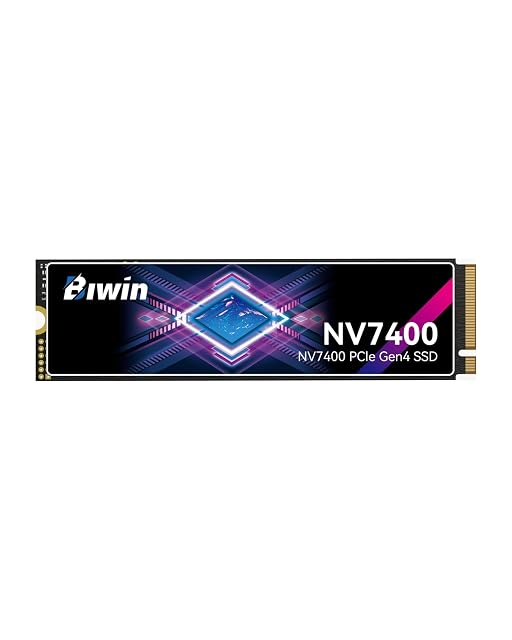
1 TB · M.2, length not published · PCIe Gen 4 ×4 · NVMe 2.0 · up to 7400 MB/s read · up to 1000K IOPS · 1.5 million hours MTBF · five-year limited warranty · no TBW · graphene thermal pad
A one-terabyte Gen 4 drive that publishes a population statistic and a warranty term in the same sentence, keeps them apart from any written total, and never states a sequential write figure.
Best for: A Gen 4 slot in a machine that runs warm, where a named thermal material and a published population statistic count for more than a complete pair of sequential figures.
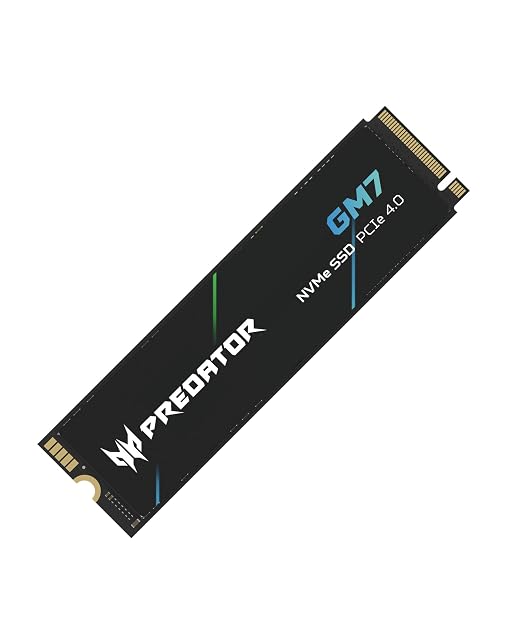
1 TB · M.2 2280 · PCIe 4.0 · NVMe 2.0 · up to 7400 MB/s read · up to 6500 MB/s write · 1.5 million hours MTBF · SLC caching named · no TBW, no warranty
A one-terabyte Gen 4 drive that publishes a population statistic in hours, both sequential figures and backwards compatibility with the previous generation, and that names no warranty term at all.
Best for: A Gen 4 board, or an older one of the previous generation, where the length code and the stated compatibility matter and the buyer will chase the term separately.
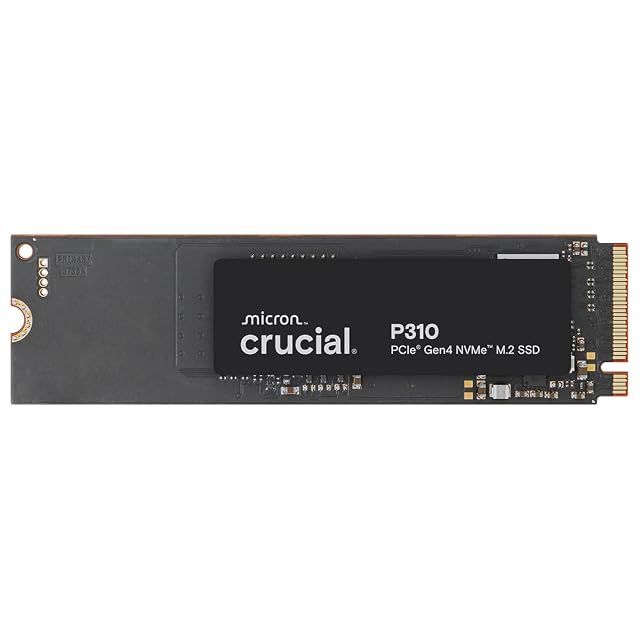
1 TB · M.2 2280 · PCIe Gen 4 · up to 7100 MB/s read · five-year limited warranty · three percentage claims against unnamed drives · no write figure, no TBW, no MTBF
A one-terabyte Gen 4 drive with a five-year term and a single sequential figure, whose remaining bullets compare it in percentages against drives the page never names.
Best for: A laptop or a handheld where a long term and a stated efficiency claim matter, and where receiving large files is not the daily job.