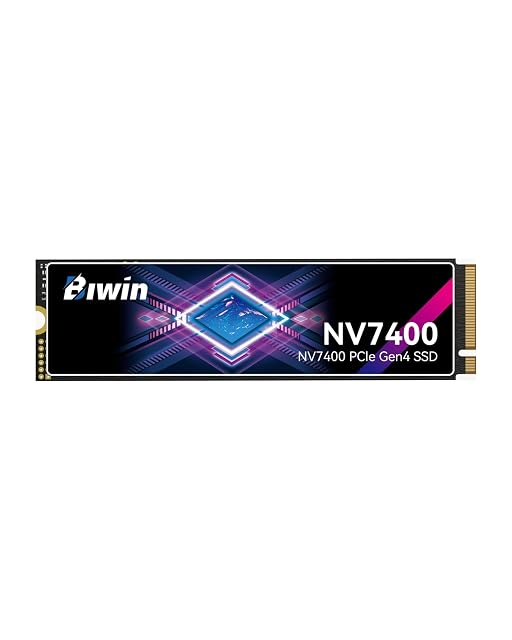
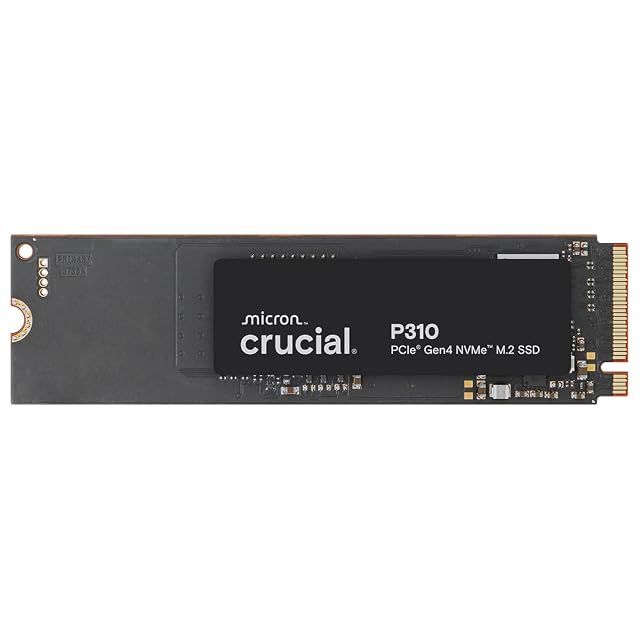
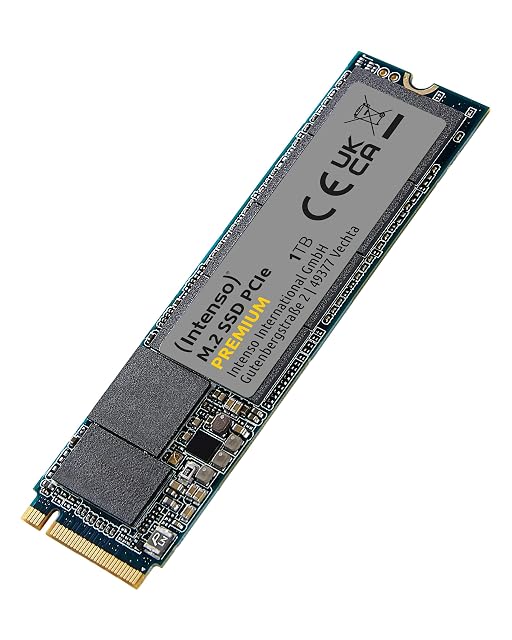
Form factor code, PCIe generation and lane count, before any speed figure · review
Acer Predator GM7 1 TB, a population statistic and no term of years review
A one-terabyte Gen 4 drive that publishes a population statistic in hours, both sequential figures and backwards compatibility with the previous generation, and that names no warranty term at all.
The bottom line One endurance quantity published and two absent, with a full pair of sequential figures and an unusually explicit statement about older boards. The reliability bullet runs further than any other on the page, and it is the one place a term of years would belong.
On the listing
A one-terabyte M.2 solid-state drive on PCIe 4.0 with NVMe 2.0, quoted at reading of up to 7400 MB/s and writing of up to 6500 MB/s and offered for gaming, video editing and file transfer; selected three-level cell flash with single-level cell caching for long-term stability and a mean time between failures of 1.5 million hours, with larger capacities said to extend the working life; an M.2 2280 format described as backwards compatible with systems of the previous generation, with a recent controller said to draw less power and produce less heat; integrated thermal throttling and power management for automatic temperature control under heavy load; and official compatibility with a games console, subject to that console’s own requirements.
A million and a half hours, and no years
The second bullet is the reliability bullet, and it carries one number. A population statistic in hours describes a fleet, not a unit, and it obliges the maker to nothing. The two quantities that do carry obligations — a total in terabytes written and a term in years — are both missing, on a page whose fullest bullet is about durability. That is a specific gap rather than a general silence.
Both sequential figures, and the buffer that produces them
Reading and writing are both quantified, which several rivals here manage only in one direction. The same bullet that gives the population statistic also names the write buffer: part of the flash used one bit per cell, which accepts data quickly and empties afterwards. That is the mechanism behind the opening of a large copy, and the page is unusually direct about it while publishing no figure for what follows.
Backwards into an older slot
The third bullet says plainly that the drive runs in a system of the previous generation. It is an ordinary property of the interface and listings rarely state it, which leaves buyers of older boards guessing. Stated, it turns a possible return into a settled question, and it is the most practically useful line on the page.
Throttling, and what it admits
Naming automatic temperature control is naming a response to heat rather than a defence against it. The drive slows itself and keeps the data safe. Under a graphics card, in a laptop, or during a copy that runs for twenty minutes, that response is what a buyer will actually meet, and a page that says so is more informative than one claiming excellent cooling.
Before ordering
Ask for the term and the written total. The fit, the compatibility and both rates are settled here; what the maker will replace, and after how much writing, is not addressed on the page at all.
Availability
Priced at roughly 160 € on the German, French and Italian Amazon stores the day this page was checked.
It is stocked on the American and British Amazon stores as well, in that country’s own currency. The range above leaves those out: it counts euro stores and no others.
The Spanish Amazon price runs past 1.6× the cheapest store. A gap that size normally marks a reshipper and not a seller in the country, so that listing stays out of the range above.
Every figure in this section is what Keepa held on the day this page was last updated. Stock and prices move without warning.
Prices quoted in this text were read on 10 September 2026. The live price is at the top of the page.
Where it holds up, and where it stops
Strengths
Backwards compatibility with the previous PCIe generation is stated outright, which decides whether an older board can take the drive at all
The length code and the protocol revision are both published, which is the pair a board manual asks for
A population statistic is given with its unit, so it can be lined up against a rival publishing the same quantity
Compromises
No warranty term anywhere, on a page that spends a full bullet on long-term stability
No written total in terabytes, so the endurance claim has a statistic and no volume behind it
Thermal throttling is named as a feature, and throttling is what a drive does once heat has already become a problem
Specifications
Capacity
1 TB — printed in the title, in the maker’s unit and reported here in that unit. The second bullet refers separately to larger capacities in the range, which are not this drive
Form factor code
M.2 2280 — stated in the third bullet, which calls it a compact format and adds that the drive is backwards compatible with systems of the previous generation
PCIe generation
PCIe 4.0 — printed in the title and in the first bullet, with the third bullet stating that the drive also runs in a PCIe 3.0 system
Lane count
Not published on the listing — the generation is named three times across the title and bullets and never once followed by a lane figure
Stated sequential read figure
Up to 7400 MB/s — printed in the title and repeated in the first bullet as a reading performance figure
Stated sequential write figure
Up to 6500 MB/s — stated in the first bullet beside the read figure, which makes this one of the pages here that quantifies both directions
Stated random IOPS
Not published on the listing — no figure in IOPS appears, on a page that publishes both sequential figures and a population statistic
TBW rating
Not published on the listing — no total in terabytes written appears; the second bullet offers an extended working life in words, with no quantity attached to it
Stated MTBF
1.5 million hours — stated in the second bullet, beside the memory type and the write buffer. It is a statistic across a population, and the maker owes nothing under it
Warranty length
Not published on the listing — no term of any length appears, on a page whose second bullet is entirely about long-term stability and reliability
DRAM cache
Not published on the listing as memory on the drive — the second bullet names SLC caching, which treats part of the flash one bit at a time as a write buffer and is a different thing from a memory chip on the board
Heatsink
Not published on the listing — the fourth bullet names thermal throttling and power management, which slow the drive to hold its temperature down rather than carry heat away from it
Amazon reference
B0C3ZJ8T6F (same reference on 6 Amazon marketplaces)
EAN
0887184017440
The questions that come up before an order
Does thermal throttling protect a drive or slow it down?
Both, and that is the design. When the controller reaches a temperature it will not exceed, it reduces its own rate until it cools. The drive keeps working and the data stays intact; the transfer simply takes longer. A page naming throttling is describing what happens under sustained load rather than promising it will not happen.
Is an SLC cache the same as a DRAM cache?
No. An SLC cache is part of the drive’s own flash used one bit per cell, which accepts writing quickly and empties into the slower three-bit region afterwards. A DRAM cache is a separate memory chip holding the map of where data sits. A drive can carry either, both or neither, and this page names only the first.
1 TB · M.2, length not published · PCIe Gen 4 ×4 · NVMe 2.0 · up to 7400 MB/s read · up to 1000K IOPS · 1.5 million hours MTBF · five-year limited warranty · no TBW · graphene thermal pad
A one-terabyte Gen 4 drive that publishes a population statistic and a warranty term in the same sentence, keeps them apart from any written total, and never states a sequential write figure.
Best for: A Gen 4 slot in a machine that runs warm, where a named thermal material and a published population statistic count for more than a complete pair of sequential figures.
1 TB · M.2 2280 · PCIe Gen 4 · up to 7100 MB/s read · five-year limited warranty · three percentage claims against unnamed drives · no write figure, no TBW, no MTBF
A one-terabyte Gen 4 drive with a five-year term and a single sequential figure, whose remaining bullets compare it in percentages against drives the page never names.
Best for: A laptop or a handheld where a long term and a stated efficiency claim matter, and where receiving large files is not the daily job.
1 TB · M.2 2280 · PCI Express Gen 3 ×4 · NVMe 1.3 · up to 2100 MB/s read · up to 1700 MB/s write · no TBW, no MTBF, no warranty term
A one-terabyte drive on the older PCIe generation whose title and bullets publish the interface, the length code and both sequential figures, and whose page carries none of the three endurance quantities.
Best for: A board with a slot of the older generation, where the sequential pair is the requirement and the buyer does not need an endurance total on paper before ordering.