Form factor code, PCIe generation and lane count, before any speed figure · review
Intenso M.2 SSD PCIe Premium 1 TB, a Gen 3 drive with both sequential figures review
A one-terabyte drive on the older PCIe generation whose title and bullets publish the interface, the length code and both sequential figures, and whose page carries none of the three endurance quantities.
The bottom line A plainly specified drive on the older generation: interface, lanes, length and both sequential figures, all printed and all easy to check. The whole endurance side is absent — no written total, no population statistic, no term — so how far the maker stands behind it cannot be read here at all.
On the listing
A one-terabyte M.2 solid-state drive on PCI Express Gen 3 with four lanes and the NVMe 1.3 protocol; first-rate performance claimed for the interface; sequential reading of up to 2100 MB/s and sequential writing of up to 1700 MB/s; up to four times the speed of SATA drives; a compact M.2 2280 form said to suit desktop machines and slimmer ones such as ultrabooks; and a box containing the drive itself at one terabyte.
Gen 3, four lanes and the length code
Four values decide whether this drive can be fitted at all, and all four are on the page: the generation, the lane count, the M.2 form and the 2280 length. That last one is the only one a slot enforces physically. A stick whose mounting hole misses the standoff cannot be screwed down, whatever its rate, and several rivals on this shelf name the form and never the length.
Two peaks, and the buffer under them
Up to 2100 MB/s reading, up to 1700 MB/s writing. The second bullet names both as sequential, which is the right word: these are the rates a single long file moves at, measured with the fast write buffer empty. Nothing on the page says what the drive settles to once that buffer fills, and a large copy always finds out. A sustained figure is the more useful of the two numbers wherever a maker publishes one, and this maker does not.
Four times what
The third bullet compares the drive to SATA drives as a class. No model is named, no capacity, no test. A ceiling of roughly half a gigabyte per second applies to every drive on that interface, so the comparison has a real basis, and it still has no rival behind it to check against.
The three endurance quantities, and none of them here
A written total in terabytes, a population statistic in hours, a term in years. They answer three different questions — how much writing the drive is rated for, how often units fail across a fleet, and what the maker will replace — and this page carries none of the three. That is worth knowing before a drive is bought for a machine that writes heavily, and it is the half of the specification the sequential pair cannot substitute for.
Before ordering
Ask for the written total and the term. The interface and the length are settled by the page; the endurance side has to come from the maker’s own material, and on a drive at this price it is the part that decides value rather than speed.
Availability
Priced from 135 € to 151 € across the German, French, Italian and Spanish Amazon stores the day this page was checked.
It is stocked on the American and British Amazon stores as well, in that country’s own currency. The range above leaves those out: it counts euro stores and no others.
Every figure in this section is what Keepa held on the day this page was last updated. Stock and prices move without warning.
Prices quoted in this text were read on 10 September 2026. The live price is at the top of the page.
Where it holds up, and where it stops
Strengths
Both sequential figures are published, which lets the drive be placed against a rival on the write side and not only on the read side
The length code is printed rather than implied, so the stick can be checked against the standoff positions of a board before it is ordered
The protocol revision is named beside the interface, which is the pair a board manual asks for
Compromises
None of the three endurance quantities appears, so the page says nothing about writing rated, failures across a population or a term to claim under
No figure in IOPS, which is the measurement closest to how a drive behaves when a machine is simply being used
The comparison against SATA drives names no drive, so the multiple has nothing behind it
Specifications
Capacity
1 TB — printed in the title and repeated in the box list of the fifth bullet, in the maker’s unit and reported here in that unit without conversion
Form factor code
M.2 2280 — given in the fourth bullet, which pairs the code with a claim that the drive suits slim machines as well as desktops
PCIe generation
PCI Express Gen 3 — printed in the title and named again in the first bullet, both times beside the NVMe 1.3 protocol revision
Lane count
Four — the title writes Gen.3x4 and the first bullet repeats the same pairing
Stated sequential read figure
Up to 2100 MB/s — printed in the title and given again in the second bullet, where it is named as a sequential read rather than left as a headline
Stated sequential write figure
Up to 1700 MB/s — stated in the second bullet beside the read figure. Both are peaks, and no sustained rate follows either of them
Stated random IOPS
Not published on the listing — no figure in IOPS appears in the title or in the five bullets, on a page that does take the trouble to publish both sequential figures
TBW rating
Not published on the listing — no total in terabytes written appears, and the first bullet offers a claim of first-rate performance where a written volume would sit
Stated MTBF
Not published on the listing — no figure in hours appears in the title or in any of the five bullets
Warranty length
Not published on the listing — no term of any length appears, so the page states what the drive does and never what the maker will stand behind
DRAM cache
Not published on the listing — no memory chip on the drive is claimed and no host memory arrangement is named, so neither of the two possible answers is given
Heatsink
Not published on the listing — no heatsink, no thermal pad and no temperature behaviour is named, on a drive the fourth bullet recommends for slim machines
Amazon reference
B09F4LLK1R (same reference on 6 Amazon marketplaces)
EAN
4034303031207
The questions that come up before an order
Does a drive of this generation make sense in a newer board?
It works, at its own generation. A PCIe link negotiates down to the lower of the two ends, so a Gen 3 drive in a Gen 4 slot runs as a Gen 3 drive and nothing is faulty about that. The reverse is equally true and more common. What a slot will not tolerate is the wrong physical length, which is why the code in the fourth bullet matters more than the generation in the title.
Why do the two sequential figures not describe a long copy?
They describe its opening. A drive absorbs writing into a fast buffer first, and while that buffer has room the transfer runs near the published rate. Once it fills, writing settles to whatever the underlying memory sustains. This page publishes no sustained figure, and very few listings do; the peak pair is an honest label for the first part of a transfer and not for the rest of it.
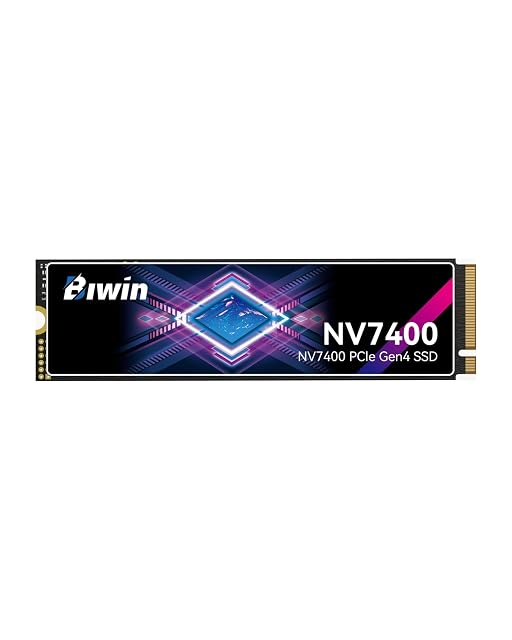
1 TB · M.2, length not published · PCIe Gen 4 ×4 · NVMe 2.0 · up to 7400 MB/s read · up to 1000K IOPS · 1.5 million hours MTBF · five-year limited warranty · no TBW · graphene thermal pad
A one-terabyte Gen 4 drive that publishes a population statistic and a warranty term in the same sentence, keeps them apart from any written total, and never states a sequential write figure.
Best for: A Gen 4 slot in a machine that runs warm, where a named thermal material and a published population statistic count for more than a complete pair of sequential figures.
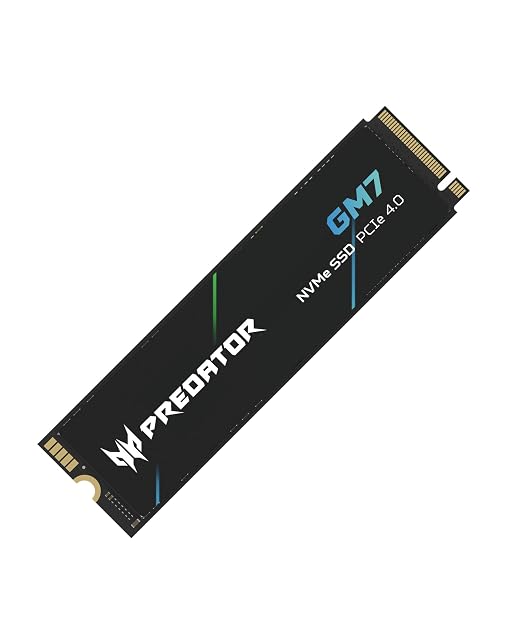
1 TB · M.2 2280 · PCIe 4.0 · NVMe 2.0 · up to 7400 MB/s read · up to 6500 MB/s write · 1.5 million hours MTBF · SLC caching named · no TBW, no warranty
A one-terabyte Gen 4 drive that publishes a population statistic in hours, both sequential figures and backwards compatibility with the previous generation, and that names no warranty term at all.
Best for: A Gen 4 board, or an older one of the previous generation, where the length code and the stated compatibility matter and the buyer will chase the term separately.
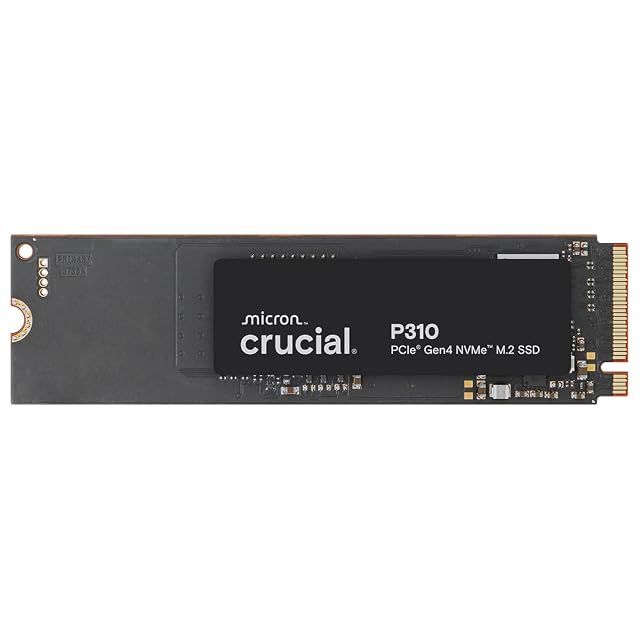
1 TB · M.2 2280 · PCIe Gen 4 · up to 7100 MB/s read · five-year limited warranty · three percentage claims against unnamed drives · no write figure, no TBW, no MTBF
A one-terabyte Gen 4 drive with a five-year term and a single sequential figure, whose remaining bullets compare it in percentages against drives the page never names.
Best for: A laptop or a handheld where a long term and a stated efficiency claim matter, and where receiving large files is not the daily job.