Form factor code, PCIe generation and lane count, before any speed figure · review
BIWIN Black Opal NV7400 1 TB, an MTBF and a term with no written total review
A one-terabyte Gen 4 drive that publishes a population statistic and a warranty term in the same sentence, keeps them apart from any written total, and never states a sequential write figure.
The bottom line Two endurance quantities out of three, published properly and kept apart, on a page that then declines to give a sequential write figure or an M.2 length. Strong where most listings here are silent, silent where most are ordinary.
On the listing
A one-terabyte M.2 solid-state drive on PCIe Gen 4 with four lanes and NVMe 2.0; a transfer speed of up to 7400 MB/s and random reading and writing of up to 1000K IOPS; flash memory of the latest generation, with capacities of up to 4 TB available across the range; a temperature control algorithm and a graphene thermal pad said to prevent slowdowns and data loss under heavy load; Host Memory Buffer for stable operation at high workloads, a smart cache said to optimise retrieval and compression said to improve efficiency; and a limited five-year warranty with a mean time between failures of up to 1.5 million hours.
An MTBF and a term, side by side and separate
Up to 1.5 million hours, and five years. They appear in the same sentence, which is where most confusion between them starts, and they answer different questions. The hours describe how often drives fail across a population under conditions the maker sets. The years are a commercial promise with conditions of their own. Neither is a lifespan, and neither substitutes for the third quantity — a total in terabytes written — which this page does not carry.
A reading figure without its writing figure
The first bullet gives one transfer rate and one random figure. The rate is named as reading in the title. Nothing on the page says how fast a long file is written, which is the direction a buyer notices when a large project is copied onto a new drive. The random figure covers both directions at once, so it does not fill the gap either.
The M.2 length the page never gives
M.2 is a connector and a family of card sizes, not a size. The code that matters is the one giving width and length in millimetres, and it decides whether the stick reaches a standoff and can be screwed down. This page names the form three times and the length never, on a drive it recommends for laptops as well as desktop machines.
A thermal pad is not a heatsink
The third bullet names a graphene pad and an algorithm. A pad conducts heat from the controller into whatever it touches; an algorithm slows the drive when heat builds. Neither is a block of fins standing above the drive, and a slot under a graphics card behaves differently with each. The distinction matters where clearance is tight, and the page is specific enough to make it.
Before ordering
Get the length code and the written total. The page settles the generation, the lanes and two of the three endurance quantities; the physical fit and the writing budget are the two questions left.
Availability
Priced at roughly 150 € on the German, French and Italian Amazon stores the day this page was checked.
It is stocked on the American and British Amazon stores as well, in that country’s own currency. The range above leaves those out: it counts euro stores and no others.
In the Spanish Amazon catalogue with no live offer against it: the reference exists, nobody is filling it.
Every figure in this section is what Keepa held on the day this page was last updated. Stock and prices move without warning.
Prices quoted in this text were read on 10 September 2026. The live price is at the top of the page.
Where it holds up, and where it stops
Strengths
Two of the three endurance quantities are published in one sentence and left standing as two separate claims
The random figure is given in IOPS, which describes daily behaviour more closely than a sequential peak does
The thermal arrangement is named as a specific material rather than described as good cooling
Compromises
No sequential write figure at all, so only half of the pair every rival here prints is available
The M.2 length code is never given, and length is the one dimension a slot physically refuses
No written total in terabytes, which is the quantity that normally bounds a five-year term
Specifications
Capacity
1 TB — printed in the title, in the maker’s unit and reported here in that unit. The second bullet separately names capacities of up to 4 TB, which is the ceiling of the range and not a figure for this drive
Form factor code
Not published on the listing — the title names the M.2 form and stops, so nothing on the page says whether the stick is 2280 or one of the shorter lengths a laptop slot expects
PCIe generation
PCIe Gen 4 — printed in the title and named again in the first bullet, with the NVMe 2.0 revision given alongside it in the title
Lane count
Four — the first bullet writes Gen 4x4, which is the only place on the page the lanes are counted
Stated sequential read figure
Up to 7400 MB/s — printed in the title as a reading speed and given again in the first bullet as a transfer speed
Stated sequential write figure
Not published on the listing — the first bullet sets the 7400 MB/s transfer figure beside a random figure in IOPS and never gives a sequential rate for writing
Stated random IOPS
Up to 1000K IOPS — stated in the first bullet as a random reading and writing figure, given as a single value covering both directions rather than one for each
TBW rating
Not published on the listing — no total in terabytes written appears, on a page whose fifth bullet takes the trouble to publish both of the other two endurance quantities
Stated MTBF
Up to 1.5 million hours — stated in the fifth bullet. It is a statistic describing failures across a population under defined conditions, and it is neither the five-year term printed in the same sentence nor a lifespan
Warranty length
Five years, limited — stated in the fifth bullet. It is a commercial term with its own conditions, published alongside the population statistic without either being folded into the other
DRAM cache
Not published on the listing as memory on the drive — the fourth bullet names Host Memory Buffer, which borrows a slice of the computer’s own memory instead, and no separate on-board cache is claimed
Heatsink
Not published on the listing as a heatsink — the third bullet names a graphene thermal pad and a temperature control algorithm, which spread and manage heat rather than adding a finned block above the drive
Amazon reference
B0DM1R7KHZ (same reference on 6 Amazon marketplaces)
EAN
0887184019017
The questions that come up before an order
Is 1.5 million hours a length of time this drive will run?
No. A figure of that kind describes failures across a population of drives under defined conditions, and it says something about how often units in a fleet fail rather than how long any one of them lasts. Dividing it into years produces a number nobody promised. It sits here beside a five-year term, and the term is the part that carries an obligation.
What does a host memory buffer replace?
The memory a drive would otherwise carry itself. A controller needs somewhere to hold the map between the addresses a computer asks for and the places data actually sits. Carrying that memory on the board costs money; borrowing a slice of the computer’s memory is the cheaper arrangement and is common on drives at this price. The page names the borrowing, which is more than most listings say in either direction.
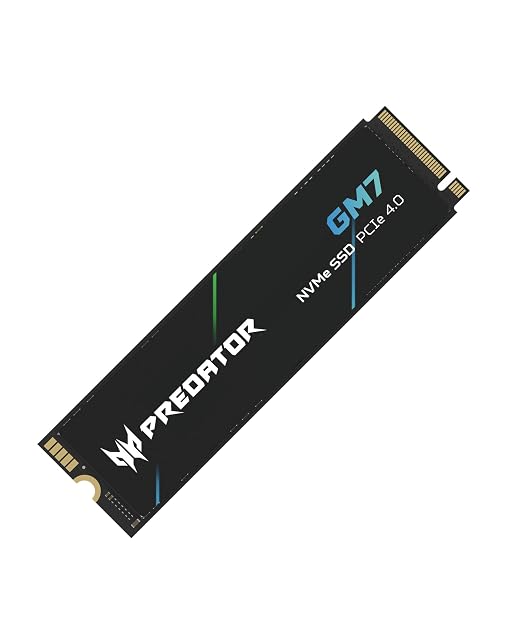
1 TB · M.2 2280 · PCIe 4.0 · NVMe 2.0 · up to 7400 MB/s read · up to 6500 MB/s write · 1.5 million hours MTBF · SLC caching named · no TBW, no warranty
A one-terabyte Gen 4 drive that publishes a population statistic in hours, both sequential figures and backwards compatibility with the previous generation, and that names no warranty term at all.
Best for: A Gen 4 board, or an older one of the previous generation, where the length code and the stated compatibility matter and the buyer will chase the term separately.
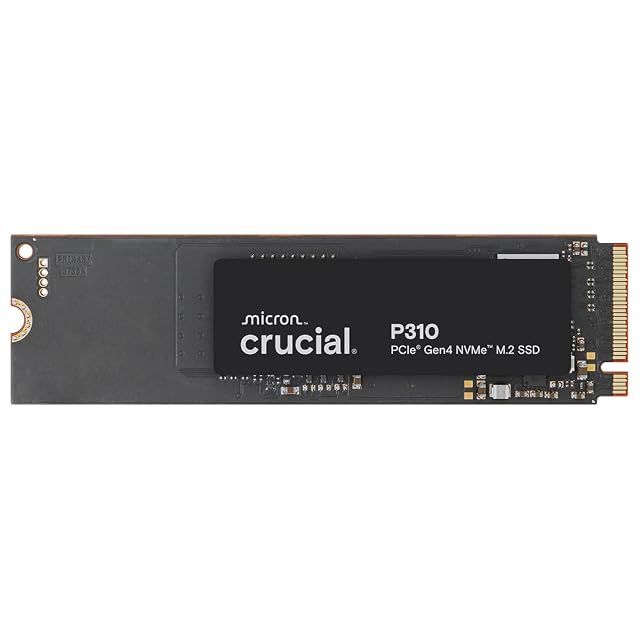
1 TB · M.2 2280 · PCIe Gen 4 · up to 7100 MB/s read · five-year limited warranty · three percentage claims against unnamed drives · no write figure, no TBW, no MTBF
A one-terabyte Gen 4 drive with a five-year term and a single sequential figure, whose remaining bullets compare it in percentages against drives the page never names.
Best for: A laptop or a handheld where a long term and a stated efficiency claim matter, and where receiving large files is not the daily job.
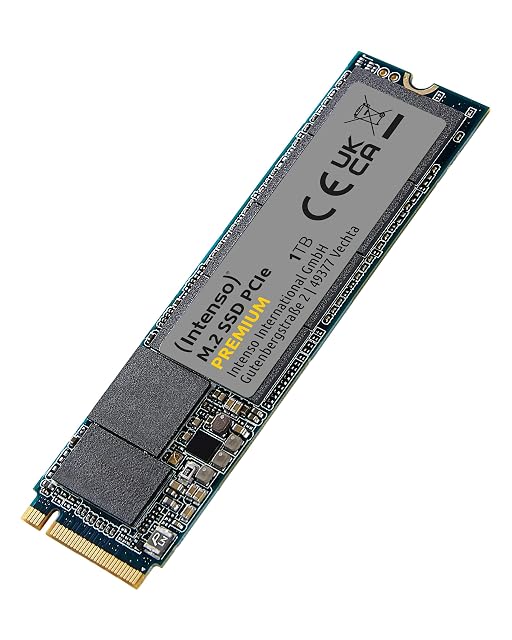
1 TB · M.2 2280 · PCI Express Gen 3 ×4 · NVMe 1.3 · up to 2100 MB/s read · up to 1700 MB/s write · no TBW, no MTBF, no warranty term
A one-terabyte drive on the older PCIe generation whose title and bullets publish the interface, the length code and both sequential figures, and whose page carries none of the three endurance quantities.
Best for: A board with a slot of the older generation, where the sequential pair is the requirement and the buyer does not need an endurance total on paper before ordering.