Two things on this page appear nowhere else on this shelf, and both are in the small print rather than the title.
The first is in the description: “You can quickly test cables using scan mode, or step mode to check connection one contact at a time.” Every other continuity tester here runs its sequence and shows the result. A step mode stops at each contact, which is what lets a fault be pinned to a pin rather than reported as a pattern of lights to interpret. No other listing on this shelf offers it.
The second is the second bullet, which is not about network leads at all: “Cable state testing (2-wire): Line DC detecting, anode and cathode determination, Ringing signal detecting open, short and cross circuit testing”. Direct current on the line, which polarity is which, and the ring signal — that is telephone work, and the only unit on this shelf that reaches it. Two published testers here name ISDN wiring; neither detects a ring.
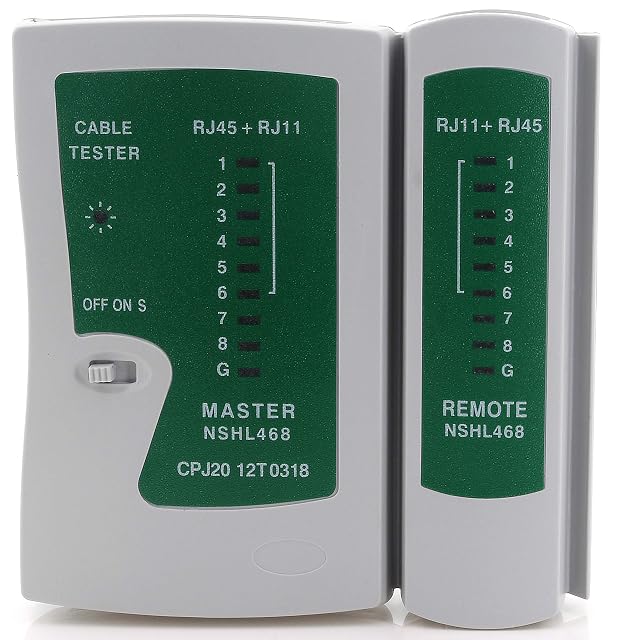
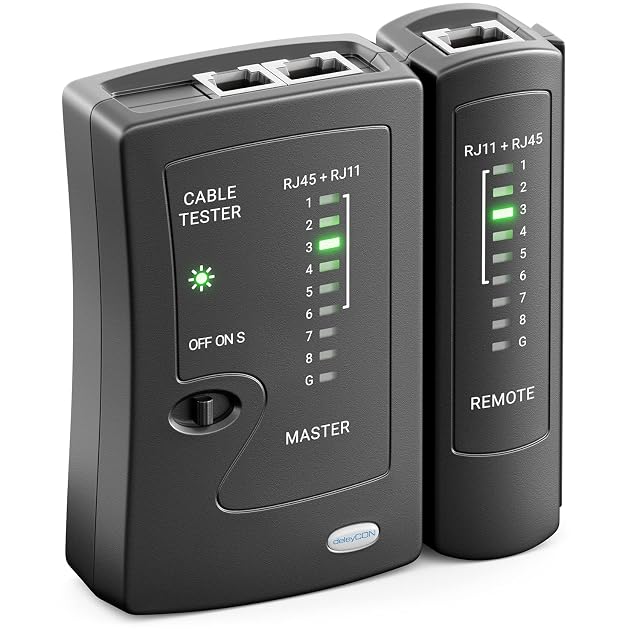
The ordinary half of the page is ordinary. The first bullet gives automatic testing for continuity, open circuits, shorted pairs and crossed pairs with a visible LED display. The third and fourth give RJ11 telephone and RJ45 network leads, and Cat 5, Cat 5e, Cat 6 and Cat 7 with RJ11 6P and RJ45 8P connectors. The description adds a detachable remote unit for testing runs already installed in a building, which is the part that makes a tester useful beyond the bench.
The fifth bullet is clear and unwelcome in equal measure: a DC 9 V cell is required and not included. One American tester on this shelf supplies the cell; this one states plainly that it does not, which is better than the several pages here that never mention a cell at all.
What is absent is the length measurement — no distance, no screen, no meters — and any tone and probe. Split pairs are not addressed, as they are not on any of the fifteen listings on this shelf.
One oddity in the record: the product dimensions are given as 10 by 10 by 3 mm (0.12 in). A centimeter cube with a three-millimeter side holds no tester, no RJ45 socket and no 9 V cell. The figure is a record defect rather than a product.
At $9.99 this is nine cents dearer than the cheapest tester here, the NOYAFA NF466, and it buys a step mode, a detachable remote and the telephone functions.
Prices quoted in this text were read on October 26, 2026. The live price is at the top of the page.