The bottom line The most thorough of the simple testers here, because it counts nine paths rather than eight and scans the shield. The nine-volt block it needs, and does not include, is the thing to remember at the checkout.
On the listing
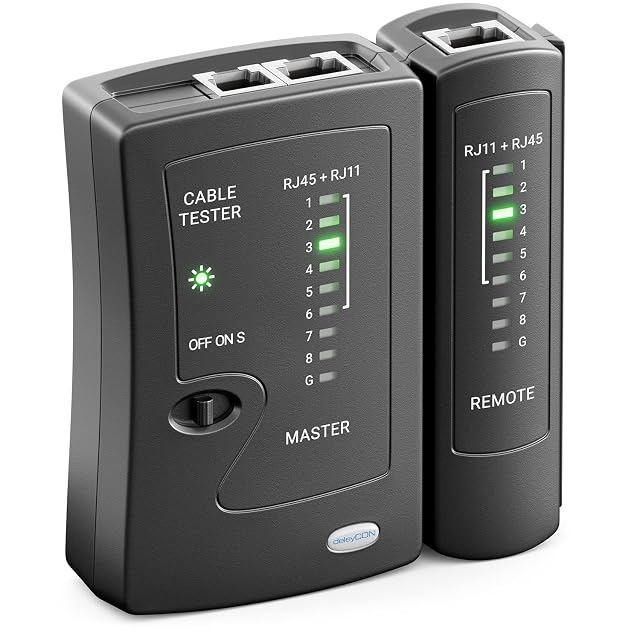
A network cable tester for RJ45, RJ12 and RJ11, named for ISDN, LAN, network and patch leads; a test of the correct pin occupancy with a master unit and a remote unit; a separate light for pins 1 to 8 and one for ground; shielding, with every individual conductor scanned automatically; a scan speed settable low or high; and a contents list giving the LAN tester with a plastic case, with a 9 V block cell that is not supplied.
A light for the ground wire
Pins 1 to 8, and ground. Nine indicators. On a shielded lead the screen is a ninth path and it fails silently: everything else passes, the lead works, and the shielding does nothing. Two other testers on this shelf mention the shield, and this one gives it an indicator alongside the pins.
Scan speed, high or low
Set by the user, which is unusual at this level and is the same idea another unit here publishes in different words. High to sort a pile, low to look properly at the one that failed.
Nine volts, not supplied
The block cell is the least convenient of the three power arrangements in this group. It lasts a long time in a tester and it is the one nobody has spare. The bullet is honest that it is not in the box, which is the right time to find out.
Before ordering
Put a nine-volt cell in the same basket. Everything else needed is in the case.
Availability
Priced at roughly 14 € on the German, French, Italian and Spanish Amazon stores the day this page was checked.
It is stocked on the British Amazon store as well, in that country’s own currency. The range above leaves those out: it counts euro stores and no others.
The American Amazon store returned nothing at all, so the buy button there opens a search in that country rather than a page that would not load.
Every figure in this section is what Keepa held on the day this page was last updated. Stock and prices move without warning.
Prices quoted in this text were read on 10 September 2026. The live price is at the top of the page.
Where it holds up, and where it stops
Strengths
Ground gets an indicator of its own, so a shielded lead whose drain is not connected shows as a fault rather than passing
The shielding of each conductor is described as scanned automatically, which is one step past checking eight conductors and nothing else
A plastic case is in the box, which is what keeps a two-piece tester as a pair rather than as two things in different drawers
Compromises
A 9 V block cell, which is the one cell least likely to be in a drawer, and it is not supplied
Nothing about split pairs, on a page that otherwise describes its indicators conductor by conductor
No tone and probe, so the unit checks what it is plugged into and cannot find it among others
Specifications
Tester type
A continuity tester in two pieces — the second bullet names a master unit and a remote unit and describes the test as checking the pin occupancy of the lead. No screen and no distance measurement appears anywhere on the page
Connector types accepted
RJ45, RJ12 and RJ11 — stated in the title and in the first bullet, with ISDN, LAN, network and patch leads named in the title as what the unit is for
Wire map detection
Yes — the third bullet gives a separate light for pins 1 to 8 and one for ground, which is nine indicators rather than the eight the rest of this group offers
Split pair detection
Not published on the listing — the test is described as pin occupancy, which is the order conductors arrive in, and a pair that is continuous but wrongly twisted is not addressed anywhere
Length reporting
Not published on the listing — no distance, no screen and no measurement appears in the title or in any of the six bullets
Tone and probe function
Not published on the listing — no tone generator and no probe is named, and the contents list holds the tester and a plastic case and nothing else
Remote units supplied
One — stated in the second bullet as the remote half of a master and remote arrangement
PoE detection
Not published on the listing — power over the network cable is not named in either direction anywhere on the page
Power source
One 9 V block cell, not supplied — stated in the sixth bullet, which also gives the contents of the box as the tester and a plastic case
Amazon reference
B07NRKRX3X (same reference on 5 Amazon marketplaces)
EAN
4251073676579
The questions that come up before an order
Why does a ground indicator matter on a shielded lead?
Because a shielded lead whose screen is not bonded at both ends behaves like an unshielded one, and every other test on it passes. Eight lights for eight conductors say nothing about the ninth path. This unit gives it a light of its own, which turns an invisible fault into a visible one.
What does setting the scan speed change?
The pace at which the tester steps through the conductors. A high setting sorts leads quickly. A low setting holds each conductor long enough to see a contact that is marginal rather than absent. It is the same idea a second unit on this shelf publishes, and it is the kind of feature that only shows its worth on a fault.
continuity tester · RJ11, RJ12 and RJ45 · ISDN and Cat 6 to Cat 8 named · four named faults · lights for eight conductors on the remote · no power source stated
A continuity tester that names the four faults it looks for one by one, and never says what it runs on.
Best for: A house with both telephone and network wiring in the walls, where a single tester should cover the older sockets as well as RJ45.
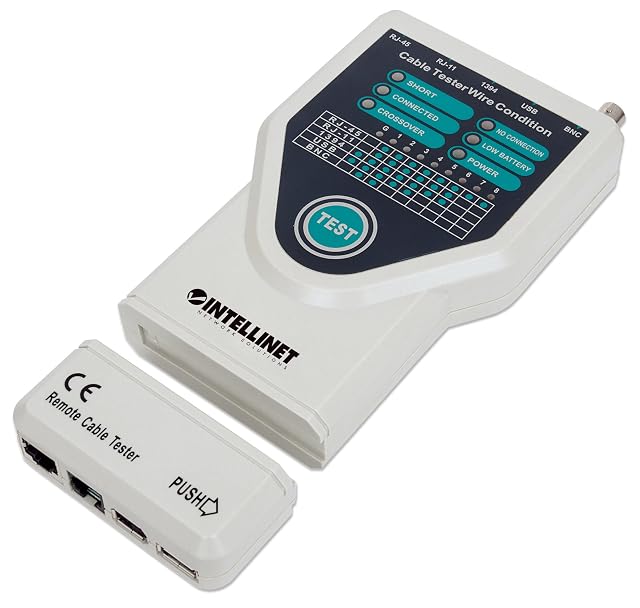
continuity tester · RJ45, RJ11, USB A and B, six-pin FireWire and coaxial · lights for eight conductors and the shield · three faults named · case and coaxial adapter supplied · no remote listed
A tester that reaches beyond network leads to USB, FireWire and coaxial, and whose contents list holds a case and an adapter and no remote unit.
Best for: A bench or a workshop drawer of assorted leads, where the network cables are only part of what needs checking and everything is within reach.
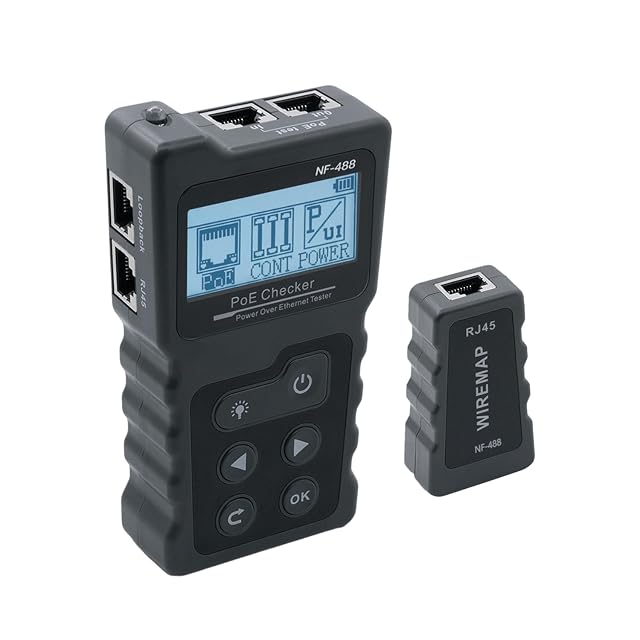
multifunction tester with an LCD · RJ45 · Cat 5e, Cat 6 and Cat 6a · PoE to af and at · loopback · cable tracing ruled out in writing · voltage described two ways
A screen-based RJ45 tester whose last bullet states in writing what it cannot do, and whose second and sixth bullets disagree about what its PoE test measures.
Best for: A network with powered devices on it, for a buyer who wants the limits of the instrument written down before it is ordered rather than found afterwards.