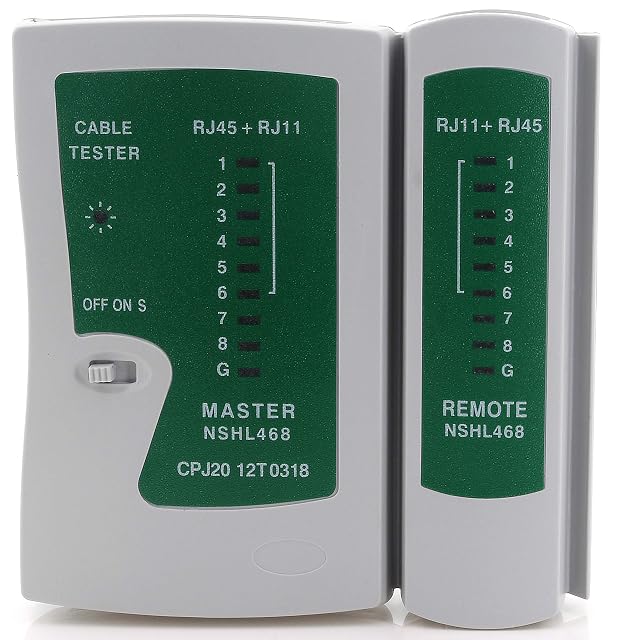
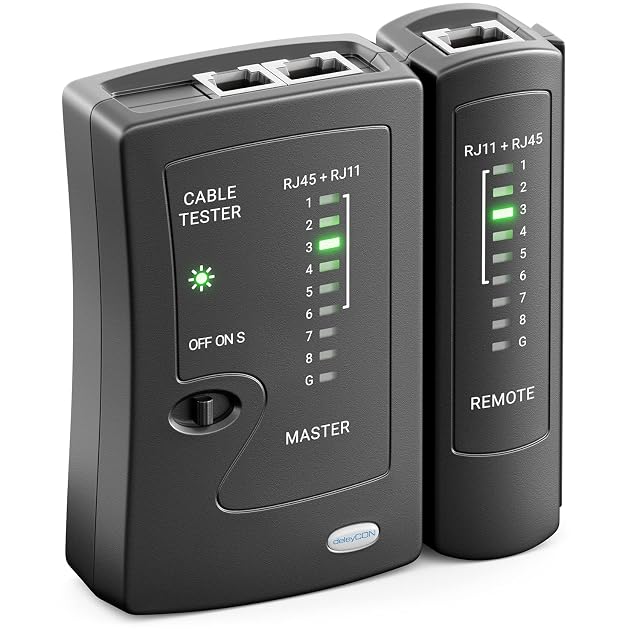
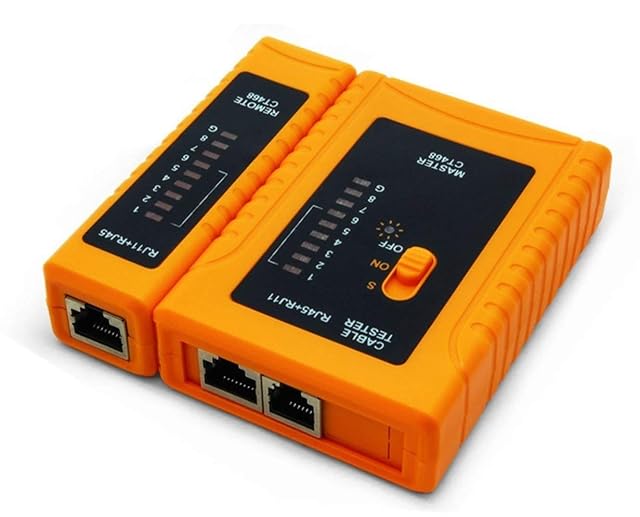
Read the first bullet and the fourth bullet together, because they cannot both be followed.
The first ends with a warning in parentheses: the NF-468S “cannot test network cables and telephone lines with power on, otherwise it will seriously burn the equipment”. The fourth states that the same unit “can test 60V power supply, quickly determine the power type and status of the POE switch”, supports 802.3af and 802.3at, and shows the result on LEDs. Power over Ethernet is, by definition, power on the cable. The function described in the fourth bullet requires exactly the condition the first bullet says will destroy the instrument, and nothing on the page resolves it.
This is not a small inconsistency. It sits on the most dangerous function the unit has, and a buyer following one bullet will do what the other forbids. Both are recorded here as published, and neither is chosen.
The second figure to read carefully is the reach. The third bullet gives a maximum test distance of 2,000 meters (6562 ft) for the host and remote arrangement. That is a continuity reach — how far apart the two halves can be and still see each other — and not a length measurement. The intro to this shelf separates the two deliberately: a continuity tester says the conductors arrive, a length-reporting tester says how far along a fault sits. Two thousand meters is ten times the range of the longest length measurement on this shelf, and it answers a different question entirely. Nothing on the page claims otherwise, and nothing on the page measures a distance.
What the unit does well is the crimp. The second bullet names a QC test giving continuity results — open circuit, crossover, straight through, short circuit — and states that it detects the crimping of the crystal head, which is the modular plug. Naming the plug as the thing being judged is unusual and useful: a badly seated plug is the commonest fault in a lead someone made themselves, and it is the one a pass-or-fail light hides.
The first bullet’s list of accepted leads is long and carries a typo: RJ45 with Cat 5, Cat 5e, Cat 6, Cat 6A and “CAT67”, which is not a category, plus RJ11, RJ12 and Cat 3 telephone wiring in 6P2C, 6P4C and 6P6C, shielded and unshielded. Naming the telephone pin counts individually is more precise than any published listing here manages.
Power is reported rather than specified: the fourth bullet says the unit prompts the battery level and warns of low voltage, and no cell type and no rechargeable pack is named anywhere. At $29.89 it is the third cheapest American tester here, and the two below it have no PoE claim of any kind.
Prices quoted in this text were read on October 7, 2026. The live price is at the top of the page.