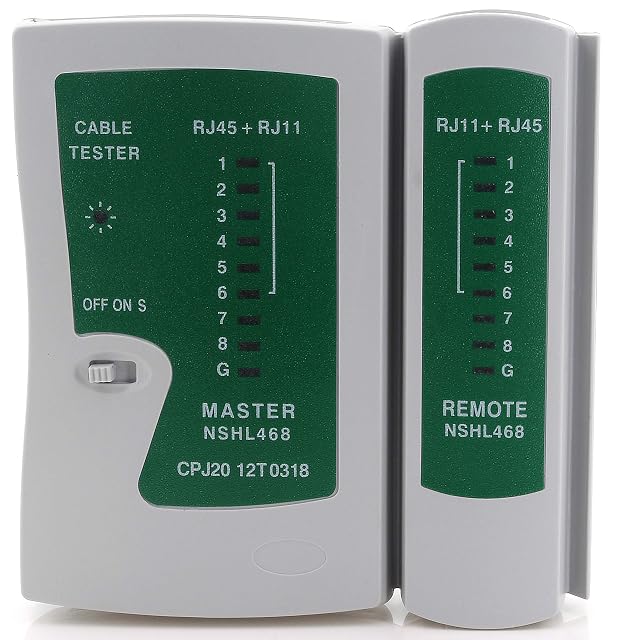
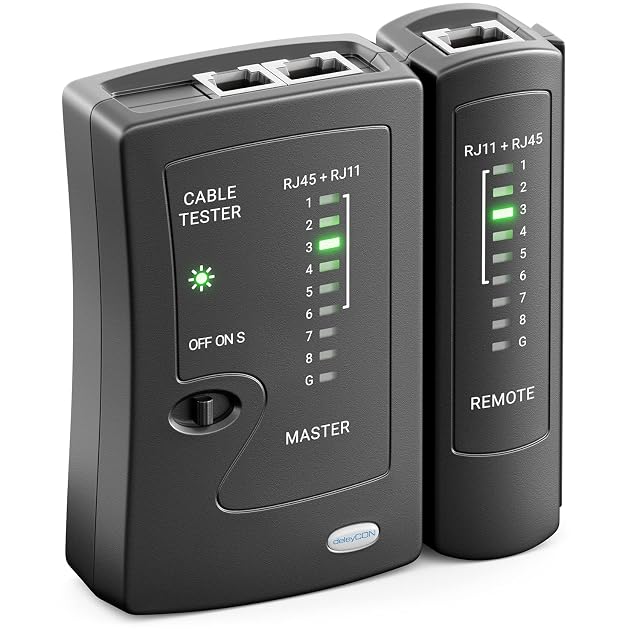
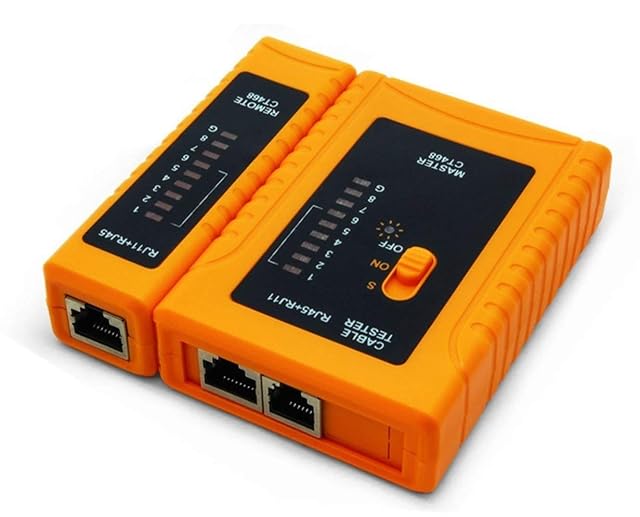
Nine dollars and ninety cents. At that price the question is what the page actually promises, and the answer has one hole in it.
The title reads “Network Cable Tester - with POE Wire Checker”. Not one of the five bullets mentions power over Ethernet, in either direction: not a voltage, not a standard, not a detection claim, not a warning. The bullets cover compatibility, automatic testing, portability, ease of reading and build quality. Several other listings on this shelf publish a PoE figure — 5 to 60 V on the NOYAFA NF-8209, the af and at standards on the NF-468S and the Mcbazel — and each puts it in a bullet. Here the claim lives in the title alone.
The reference is a second small discrepancy: the product record carries NF-466S while the title writes NF466.
What the bullets do support is a plain continuity tester. The first names RJ45, RJ11 and RJ12 interfaces with Cat 5, Cat 6 and Cat 7 UTP leads and telephone cable, and says the point is to avoid owning several tools. The second describes automatic full-range testing — every test run without manual steps — covering continuity, open circuits, short circuits and miswiring. Those are the four faults a row of lights can find, and they are what the intro to this shelf says accounts for most of what goes wrong with a hand-crimped lead.
The third bullet gives the power source in one line: a standard 9 V cell, for on-site work with no outlet. Several testers on this shelf never say what they run on at all, so a single clear line is worth something. It does not say whether the cell is supplied; one American tester here states that it is, and another states that it is not.
The fourth bullet gives clear indicator lights and states that no professional knowledge is required. The fifth is build-quality language with nothing measurable in it.
What the page does not claim is as useful as what it does. No length measurement, so the distance to a fault is out of reach — the intro to this shelf is explicit that only a length-reporting unit answers that question. No tone and probe, so the unit tests the lead in front of it and cannot find one inside a bundle. No split pair detection, which no listing on this shelf publishes: fifteen out of fifteen.
The product record gives 170 by 70 by 35 mm (1.38 in) and no weight.