Continuity, wire map and length are three different instruments in one word · review
KLEIN TOOLS VDV526-100, five named result states, remote stored in the body review
A single-button tester that names its five possible answers outright — pass, miswire, open, short and shield — stows its remote inside itself, and arrives with the cell already in.
Most continuity testers on this shelf describe what they detect. This one names what it will tell you. The third bullet gives five result states by name: Pass, Miswire, Open-Fault, Short-Fault and Shield. That is the complete set of answers the instrument can give, published as a list, which is a different and more useful thing than a sentence about detecting faults.
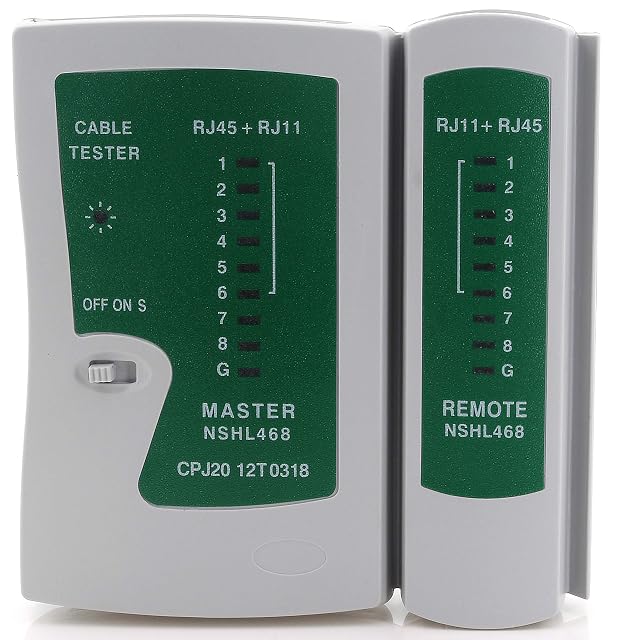
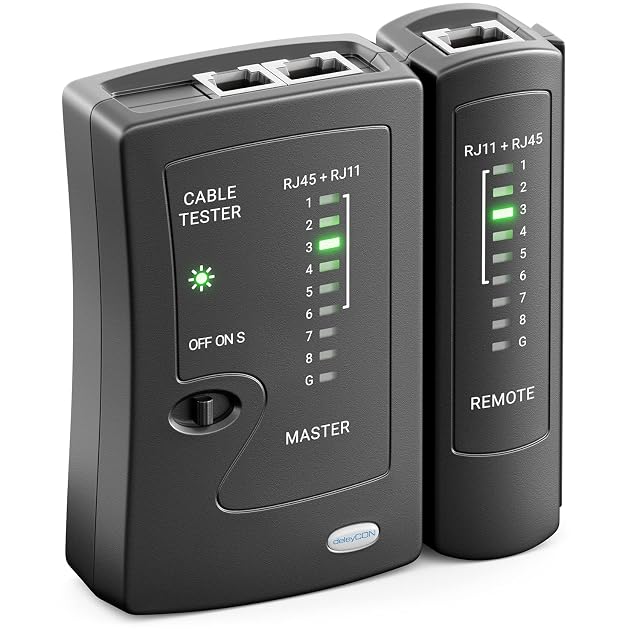
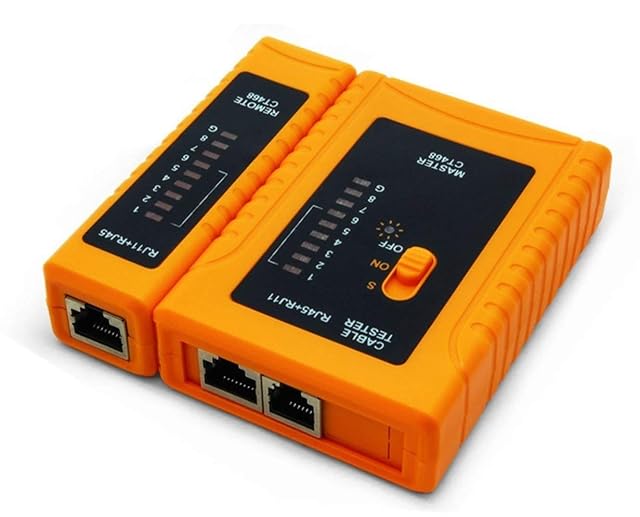
Shield as a result state is worth pausing on. Two published testers here give the shield or the ground its own indicator lamp alongside the eight conductors; this one treats it as one of five verdicts the unit returns. Three arrangements, three pages, same problem — a screened lead whose drain is not connected passing as good.
The remote stows in the tester body, stated in the fourth bullet. On a two-piece instrument that is the difference between owning a tester and owning two halves in separate drawers. One published listing on this shelf includes a plastic case for the same reason; this one needs none.
The sixth bullet supplies the cell: “Auto Power-off feature to conserve battery life (9V included)”. Of the fifteen listings on this shelf, this and the NOYAFA NF-8209 kit are the only ones that state a cell is in the box. Two published pages never mention a cell at all, two American ones state that it is required and not included, and the rechargeable units sidestep the question. Auto power-off and a low-battery indicator, in the sixth and seventh bullets, are the two features that make a 9 V block last.
The first bullet gives single-button testing of RJ11, RJ12 and RJ45 terminated voice and data leads; the second gives Cat 3, Cat 5e and Cat 6/6A. Cat 3 is the telephone-era category, and naming it puts older house wiring in reach. The fifth bullet says it fits in a pocket, and at 113 g (4 oz) and 127 by 64 by 32 mm (1.26 in) that is accurate rather than promotional — it is the lightest tester in this group.
What it does not do is anything beyond the row of lights. No length measurement, so the distance to a fault is out of reach; no tone and probe, so the lead must be found by hand; no PoE detection, so a live socket is not read before unplugging. And no split pair detection, which is the row no listing on this shelf fills.
At $21.00 it sits between the two ten-dollar testers here and the thirty-dollar one, and what the extra buys is the published list of answers, the stowed remote and the cell.
Prices quoted in this text were read on October 26, 2026. The live price is at the top of the page.
Where it holds up, and where it stops
Strengths
Publishes its five possible answers by name — pass, miswire, open, short and shield — rather than describing what it detects
One of two listings on this shelf that state a 9 V cell is supplied, with the NOYAFA NF-8209 kit
The remote stows inside the tester body, so a two-piece instrument stays one object
Auto power-off and a low-battery indicator, which are what make a 9 V block last in a tool bag
The lightest tester in this group at 113 g (4 oz), and Cat 3 named for older telephone wiring
Compromises
No length reporting, so the distance to a fault is out of reach
No tone and probe, so a lead cannot be identified inside a bundle — the maker sells that separately, also on this shelf
No PoE detection, so a live socket is not read before it is unplugged
A 9 V block cell rather than the common sizes, even if the first one arrives with it
Specifications
Tester type
A continuity tester in two pieces with single-button operation — the first bullet gives one-button testing of terminated leads and the third names five LED result states. No screen and no distance measurement appears anywhere on the page
Connector types accepted
RJ11, RJ12 and RJ45 — stated in the first bullet for terminated voice and data leads, with Cat 3, Cat 5e and Cat 6/6A named in the second. Cat 3 is the telephone-era category and puts older house wiring in reach
Wire map detection
Yes, with the possible answers published as a list — the third bullet names Pass, Miswire, Open-Fault, Short-Fault and Shield as the five states the LEDs indicate, which is the complete set of verdicts rather than a description of what is detected
Split pair detection
Not published on the listing — the five result states are pass, miswire, open, short and shield, and a pair that is continuous but wrongly twisted is none of them. No listing on this shelf publishes this row
Length reporting
Not published on the listing — no distance, no screen and no measurement appears in the title or in any of the seven bullets
Tone and probe function
Not published on the listing — no tone generator and no probe is named. The same maker sells a separate tone and probe kit, which is also on this shelf
Remote units supplied
One, stored in the tester body — stated in the fourth bullet. It is the only listing on this shelf whose remote has a home inside the instrument rather than in a case or a drawer
PoE detection
Not published on the listing — power over the network cable is not named in either direction, and the first bullet describes the leads as terminated voice and data cables
Power source
One 9 V cell, supplied — stated in the sixth bullet in parentheses alongside the auto power-off feature, with a low-battery indicator in the seventh. It is one of two listings on this shelf that state the cell is in the box, with the NOYAFA NF-8209 kit
Amazon reference
B07RT1J9MB
EAN
0092644692246
On Amazon.com
Amazon.com had an offer at $21 on October 26, 2026.
The questions that come up before an order
What can it actually tell me?
Five things, named in the third bullet: pass, miswire, open fault, short fault and shield. That is the complete set, published as a list rather than described.
Does the battery come with it?
Yes. The sixth bullet states 9 V included, alongside the auto power-off feature. It is the only listing on this shelf that says so.
Can it find a cable in a bundle?
No. There is no tone generator and no probe. The same maker sells a tone generator and probe kit, which is also on this shelf.
Against the rest of the network and storage gear
This network and storage gear share the category and the price bracket. Only what each one states is shown; an incomplete column would mislead.
Model
Price
Tester type
Connector types accepted
Wire map detection
Split pair detection
KLEIN TOOLS VDV526-100, five named result states, remote stored in the body
$21
A continuity tester in two pieces with single-button operation — the first bullet gives one-button testing of terminated leads and the third names five LED result states. No screen and no distance measurement appears anywhere on the page
RJ11, RJ12 and RJ45 — stated in the first bullet for terminated voice and data leads, with Cat 3, Cat 5e and Cat 6/6A named in the second. Cat 3 is the telephone-era category and puts older house wiring in reach
Yes, with the possible answers published as a list — the third bullet names Pass, Miswire, Open-Fault, Short-Fault and Shield as the five states the LEDs indicate, which is the complete set of verdicts rather than a description of what is detected
Not published on the listing — the five result states are pass, miswire, open, short and shield, and a pair that is continuous but wrongly twisted is none of them. No listing on this shelf publishes this row
A continuity tester in two pieces with an LED result display and a PoE check — the second and third bullets name a QC continuity test and a host and remote arrangement, and the fourth adds the PoE function. No screen and no distance measurement appears anywhere
RJ45, RJ11, RJ12 and Cat 3 telephone wiring — stated in the first bullet with Cat 5, Cat 5e, Cat 6, Cat 6A and "CAT67" named for RJ45, and 6P2C, 6P4C and 6P6C telephone formats named individually, shielded and unshielded. "CAT67" is not a category
Yes — the second bullet names open circuit, crossover, straight through and short circuit as the QC test results, and states that the test detects the crimping of the modular plug, which is the commonest fault in a hand-made lead
Not published on the listing — the four results named are open, crossover, straight through and short, and a pair that is continuous but wrongly twisted is none of them. No listing on this shelf publishes this row
A continuity tester with a visible LED display, in two pieces — the first bullet names automatic testing for continuity, open circuits, shorted and crossed pairs, and the description adds a detachable remote unit. No screen and no distance measurement appears anywhere
RJ45 and RJ11 — stated in the title and in the third bullet, with Cat 5, Cat 5e, Cat 6 and Cat 7 named in the fourth alongside RJ11 6P and RJ45 8P connectors
Yes — the first bullet names continuity, open circuits, shorted pairs and crossed pairs, shown on a visible LED display. The description adds a step mode checking one contact at a time, which is the finest form of this test on the shelf
Not published on the listing — the faults named are continuity, open, shorted and crossed pairs, and a pair that is continuous but wrongly twisted is none of them. No listing on this shelf publishes this row
A continuity tester with indicator lights — the second bullet describes automatic full-range testing covering continuity, open circuits, short circuits and miswiring, and the fourth gives clear indicator lights for reading the result. No screen and no distance measurement appears anywhere on the page
RJ45, RJ11 and RJ12 — stated in the title and in the first bullet, with Cat 5, Cat 6 and Cat 7 UTP network leads and telephone cable named
Yes — the second bullet names continuity, open circuits, short circuits and miswiring as what the automatic sequence checks, which is the order the conductors arrive in. No per-conductor indicator count is published
Not published on the listing — the four faults named are continuity, open circuit, short circuit and miswiring, and a pair that is continuous but wrongly twisted is none of those. No listing on this shelf publishes this row
What separates the models, in network and storage gear
If price decides: iMBAPrice IMBA-NF468, scan or step mode, detachable remote, at $10.
The buyer this one serves, among network and storage gear
A pocket tester for terminated leads where the five answers matter more than the price, and the remote should not go missing.
What this one costs among network and storage gear
Details checked on October 26, 2026.
What buyers actually choose
Amazon reports what buyers took in the month before this page was last checked: at least 1,000.
The figure is a floor, rounded by Amazon, and read through Keepa — it says what buyers picked, not what a maker claims.
Sources
Specifications: the manufacturer sheet for network and storage gear and the matching Amazon product page. Prices and availability: Keepa. Every figure on this page names its source.
continuity tester · RJ11, RJ12 and RJ45 · separate lights for pins 1 to 8 and for ground · shielding scanned automatically · scan speed low or high · 9 V block, not supplied
A two-piece tester that gives ground its own indicator alongside the eight pins, scans the shield automatically, and lets the scan speed be set.
Best for: Shielded leads and shielded sockets, where whether the screen is actually connected is as much a question as whether the eight conductors are.
continuity tester · RJ11, RJ12 and RJ45 · ISDN and Cat 6 to Cat 8 named · four named faults · lights for eight conductors on the remote · no power source stated
A continuity tester that names the four faults it looks for one by one, and never says what it runs on.
Best for: A house with both telephone and network wiring in the walls, where a single tester should cover the older sockets as well as RJ45.
continuity tester · RJ45 and RJ11 · Cat 5 to Cat 7 · scan mode or step mode, contact by contact · detachable remote · telephone line DC and ring detection · 9 V cell not supplied
The only tester on this shelf with a step mode that checks one contact at a time, and the only one that detects a telephone ring signal and tells anode from cathode.
Best for: A ten-dollar instrument for a house with both network and telephone wiring, where pinning a fault to one contact is worth the slower mode.