Port count, port speed, and whether the fan ever stops · review
NETGEAR GS308, eight-port unmanaged gigabit switch with an on-off switch review
An eight-socket unmanaged switch that names the cable grades its sockets expect and puts a power switch on the case, and publishes no figure for the unit as a whole.
The bottom line A plain unmanaged switch that gets the two practical details right: the cable grades and a way to turn the thing off. The absent capacity figure puts it with most of this shelf rather than behind it.
On the listing
Eight Ethernet sockets at 1.0 Gbps with automatic negotiation and compatibility with existing Cat5e and Cat6 cable; a Layer 2 unit for desk or wall mounting; plug and play with no software to install and no configuration; a compact metal case; a fanless design for silent running; IEEE 802.3az energy-efficient Ethernet; and an on-off switch on the case.
The on-off switch
It is in the title, and it earns its place there. A switch that has to be power-cycled is otherwise a switch that has to be reached, and reaching it usually means a cupboard, a cable tie and a torch. This is a small piece of hardware that makes a common chore a two-second one.
Cable grades, named
Cat5e and Cat6 appear in the first bullet. That is the line that ties this purchase to the building: a gigabit socket is only a gigabit socket if the copper behind it is rated for one, and a page that names the grades lets the check happen before the order.
What the page will not say
No capacity, no forwarding rate, no buffer. A switching capacity is the sum of every socket at full rate in both directions at once, and its absence here means this unit can only be compared with its shelf on the things that are countable: sockets, speed, case, fan.
And the supply
The on-off switch is advertised; what it switches is not described. Neither an adapter nor an internal supply appears anywhere on the page.
Before ordering
Check what grade the cable in the wall is. If it predates Cat5e, that is the purchase to make first.
Availability
Priced from 21 € to 22 € across the German, French, Italian and Spanish Amazon stores the day this page was checked.
The American and British Amazon stores returned nothing at all, so the buy button there opens a search in that country rather than a page that would not load.
Every figure in this section is what Keepa held on the day this page was last updated. Stock and prices move without warning.
Prices quoted in this text were read on 10 September 2026. The live price is at the top of the page.
Where it holds up, and where it stops
Strengths
Names Cat5e and Cat6 in the first bullet, which ties the socket speed to the cable already in the wall rather than leaving the buyer to work it out
A physical on-off switch is stated in the title, which is the difference between restarting the unit and crawling behind a cupboard to unplug it
Says unmanaged in as many words, and names Layer 2, so the two questions about what the unit decides are both answered
Compromises
No switching capacity, no forwarding rate and no buffer size, so the page describes one socket and never the unit
The power arrangement is unstated even though the on-off switch is advertised, which is an odd half-answer
Nothing lists the contents of the box
Specifications
Port count
Eight — stated in the title and in the first bullet as eight Ethernet sockets at 1.0 Gbps
Port speed
1.0 Gbps per socket, negotiated automatically — stated in the first bullet, which also names Cat5e and Cat6 as the cable grades the sockets work with; no BASE-T designation is printed
Managed or unmanaged
Unmanaged — stated in that word in the third bullet, with no software to install and no configuration required; the second bullet describes the unit as Layer 2
Stated switching capacity
Not published on the listing — no whole-unit total appears in the title or in the five bullets, and the only rate given is the 1.0 Gbps of one socket
Fanless or fan-cooled
Fanless — stated in the title and again in the fifth bullet, with IEEE 802.3az energy-efficient Ethernet named as lowering consumption without reducing speed
Case material
Metal — stated in the title as a robust metal case and repeated in the fourth bullet as a compact metal one
Desktop or rack mounting
Desk or wall — stated in the second and fourth bullets; no rack ears and no rack unit height are named
Power supply type
Not published on the listing — the title names an on-off switch on the case, and nothing says whether the power behind it arrives from an external adapter or an internal supply
Amazon reference
B07PTTX7MX (same reference on 4 Amazon marketplaces)
EAN
0606449140149
The questions that come up before an order
Why does a listing name Cat5e and Cat6?
Because the cable grade sets the ceiling as surely as the socket does. Gigabit over copper is specified to run on Cat5e and above, so naming the grades tells a buyer whether the wiring already in the walls will carry what the switch offers, or whether the upgrade is a cabling job rather than a switch purchase.
What does Layer 2 mean on an unmanaged switch?
That the unit forwards by hardware address, learning which machine sits behind each socket and sending frames only there. It is the ordinary behaviour of a switch, as distinct from a router, which forwards by network address. Naming it says what the unit decides, and it is not the same claim as being manageable.
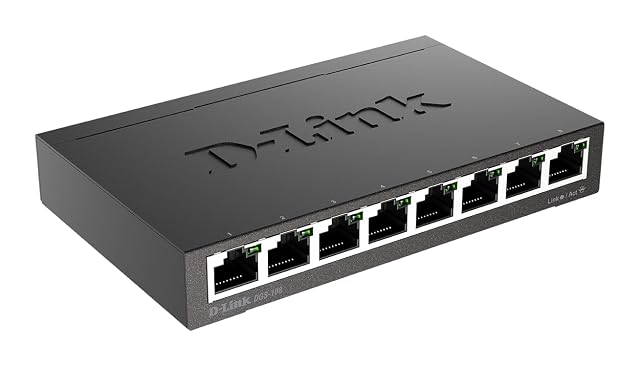
eight gigabit sockets · up to 2000 Mbit/s per socket in full duplex, stated · non-blocking architecture · Layer 2 · fanless · metal case, black
An eight-socket gigabit switch whose headline figure counts both directions of one socket at once, and which never says where the unit is meant to be mounted.
Best for: A shelf or a desk where the unit can simply sit, and where multicast television and a quiet metal case matter more than knowing how it mounts.
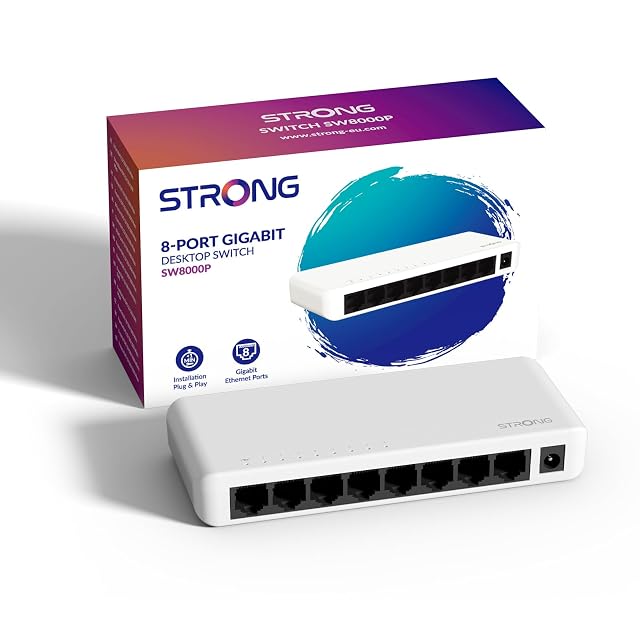
An eight-socket gigabit switch that publishes both the material of its case and a switching capacity, which is two answers more than most of this shelf gives.
Best for: A room that needs eight quiet wired sockets and a unit light enough to hang on a wall, where a plastic shell is a fair trade for the price.
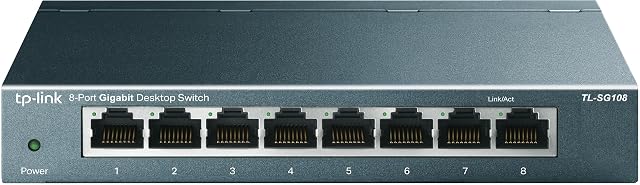
eight gigabit sockets · unmanaged, stated · 802.1p and DSCP QoS · IGMP snooping · fanless · metal case · power adapter in the box
An unmanaged eight-socket switch that names its traffic-priority and multicast standards and lists what arrives in the box, without printing any figure for the unit as a whole.
Best for: A living room or study where set-top boxes and streaming devices share the wiring, and where a metal case that never needs a fan is worth the small premium.