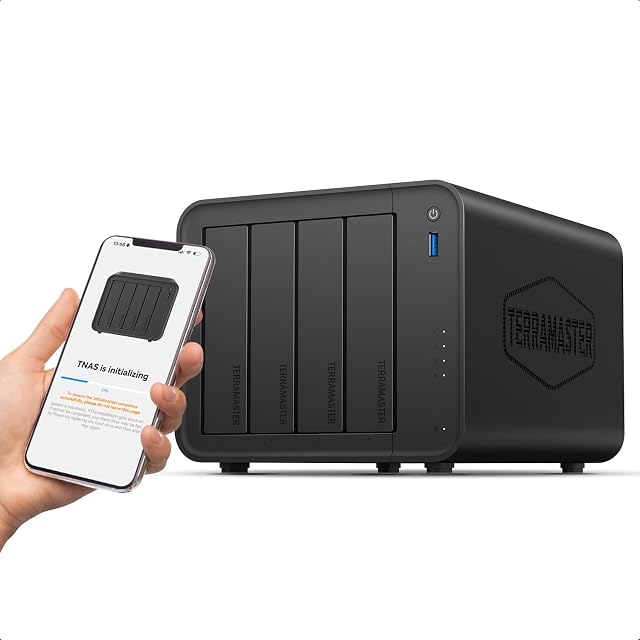
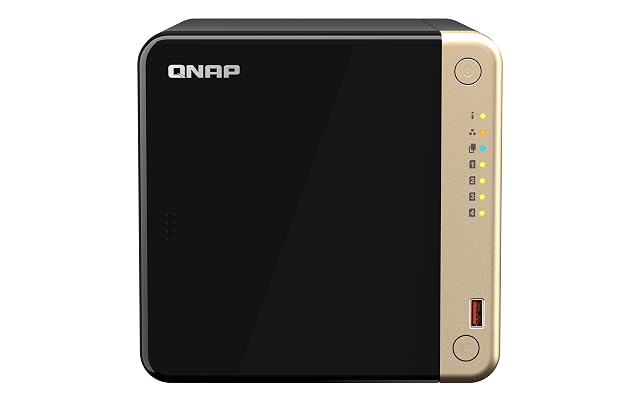
TERRAMASTER F4-425, four-bay enclosure with a stated 22 dB(A) and a named array scheme vs QNAP TS-464, four-bay enclosure sold behind a title in the wrong language
What can you actually learn about a four-bay enclosure from its listing?
Two four-bay enclosures, and only one page describes a product. The TERRAMASTER F4-425 names an Intel x86 quad-core, 4 GB of memory, a 2.5-gigabit socket, a 30 TB ceiling per bay, a TRAID array scheme and 22 dB(A) — one of only two acoustic figures on this whole shelf. The QNAP TS-464 carries four bullets promising quality, durability, robustness and flexible design, a bay count and a memory figure printed as “8 gb”, under a title in Spanish on a German shop.
TERRAMASTER F4-425, four-bay enclosure with a stated 22 dB(A) and a named array scheme
F4-425, four-bay enclosure with a stated 22 dB(A) and a named array scheme
TS-464, four-bay enclosure sold behind a title in the wrong language
Bay count
Four
Four — the only hardware figure the title carries besides the memory, printed in Spanish with the accented word broken by a substituted character
Drive interface
Not published as a size or a bus — 30 TB per bay is given and push-lock trays fitted in ten seconds are named, with no inch figure and no bus beside either
Not published — the four bullets say nothing about drives
Solid-state slot count
Not published — the storage arithmetic counts only the four bays
Not published
Processor
An Intel x86 quad-core processor, in exactly those words; no model number and no clock speed follows
Not published — no chip, no core count, no clock speed
Memory
4 GB; whether it can be added to is not stated
8 gb — printed in the title in that form, in lower case and without a memory type; the recorded reference for this listing is the fuller TS-464-8G, in which the same figure appears as a suffix
Ethernet port count
Not published as a figure — the 2.5-gigabit port is named in the singular, which describes one socket without counting them
Not published — no network socket is counted, on a product whose title names it a network storage server
Port speed
2.5GbE, given as what makes transfers fast and lets several people work at once
Not published — with no socket counted, none is given a rate
USB ports
Not published — no USB socket is counted, on a page that names Plex, Emby, Jellyfin, DLNA, CloudSync and TerraSync
Not published — no socket of any kind is named
Supported redundancy levels
TRAID, named and not numbered — the arrays are called flexible and said to save 30 per cent more space than conventional arrangements while keeping redundancy
Not published — the four bullets promise quality material, durability, robustness and flexible design
Published operating system
Not published by name — the TNAS Mobile app used for setup is named, and the software on the enclosure is never called anything
Not published — no software is named, described or alluded to
Stated idle power
Not published — no figure in watts, on a page that does publish a decibel value
Not published — consumption is never raised
Stated acoustic figure
22 dB(A), offered as making the unit suitable for a quiet room such as a bedroom — one of two acoustic figures on this whole shelf
Not published
Stated dimensions
Not published — how quickly a tray goes in is described rather than how much room the box takes
Not published
A tick means one listing published something the other did not, or published
a better figure. It does not mean the product is better, and the column is not
a score out of anything: a maker who says less loses lines here without losing
a comparison. The two verdicts below are where the page is settled.
Which one, for whom
Buy the TERRAMASTER F4-425, four-bay enclosure with a stated 22 dB(A) and a named array scheme
The F4-425 is the four-bay enclosure this shelf can actually be judged on. A quad-core processor, 4 GB, a 2.5-gigabit socket, 30 TB per bay and 120 TB in total, and 22 dB(A) — which matters, because a four-bay box in a bedroom is a noise decision as much as a storage one. TRAID is named and never given a level number, so what the arrangement does in numbers has to be read on the maker’s own site.
Buy the QNAP TS-464, four-bay enclosure sold behind a title in the wrong language
The TS-464 has four bullets and none of them describes the product: quality material, durability, robustness, flexible design. The title is in Spanish on a German shop with an accented character substituted, its memory is printed as “8 gb”, and the reference recorded for the listing is longer than the one shown. No processor, no socket, no software, no array scheme. QNAP builds serious hardware; this page tells you nothing about which piece of it you are buying.
The questions that come up before an order
Is TRAID a level of the usual numbered scheme?
The listing does not say so. It names TRAID, calls the arrangement flexible, and claims about 30 per cent more usable space than conventional arrays while keeping redundancy — and gives no level a number. Whatever the scheme is called, redundancy means carrying on through a drive failure. It is not a backup: it does not protect against a deletion, a fire or a theft.
Why does a stated 22 dB(A) matter?
Because four drives in a metal box are audible, and most listings on this shelf publish no figure at all — this is one of two that do. It is the maker’s own number under the maker’s own conditions, and it is quoted here as published. For a unit going in a room where anyone sleeps or records, having a figure to weigh is better than having none.
four bays · Intel x86 quad-core · 4 GB memory · one 2.5GbE socket · TRAID named · 22 dB(A) · 30 TB per bay, 120 TB in total
A four-bay enclosure that publishes an acoustic figure, a per-bay ceiling and the name of its array scheme, and that never says what size of drive its four bays take.
Best for: A media collection that has outgrown a two-bay unit and lives in a room where people sleep, bought by someone who will confirm the drive sizes separately.
four bays · 8 gb of memory · four bullets that describe no product · title in Spanish on a German shop · reference printed short of the product record
A four-bay enclosure whose page carries a bay count, a memory figure and four bullets that would fit any object at all, printed in a language the shop does not use.
Best for: A buyer who already knows this model from elsewhere and is here only for the price, since the page itself will not tell them what they are buying.