Skip to content

KALEA-INFORMATIQUE 11888237, dual-port 2.5-gigabit card on PCIe 3.1 ×1 with two Intel I226 controllers review

The only card on this shelf that publishes a PCIe generation and a lane count, and it puts two 2.5-gigabit sockets behind a single lane and says so.

The bottom line The most technically written page on this shelf: a generation, a lane count, four Ethernet standards and a controller with its stepping. The single lane behind two sockets is a fact it publishes rather than hides, and it is the fact to think about first.

On the listing

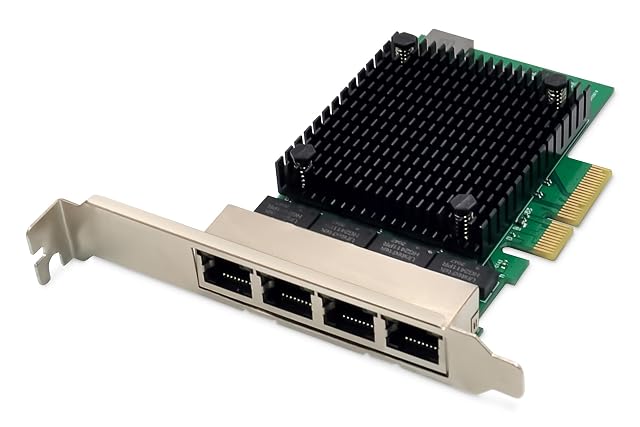
A PCIe network controller card at 2.5 G with two gigabit Ethernet ports on two RJ45 sockets, dual-chipset, built on Intel I226 SRKTU; described for office machines or servers in a PCIe ×1 connector, compatible across 10M, 100M, 1G and 2.5G; a compatibility list running from Windows ME and 98SE through to Windows 11 in both widths, Windows Server including Server 2025, FreeBSD, Linux, VMware and Mac; a PCIe 3.1 ×1 card that fits ×1, ×2, ×4, ×8 and ×16 connectors, with a copper RJ45 MDI interface to IEEE 802.3 for 2500BASE-T, 1000BASE-T, 100BASE-TX and 10BASE-Te under IEEE 802.3bz, 802.3ab, 802.3u and 802.3; flow control to IEEE 802.3x and 802.3z with software-controlled receive thresholds and transmit pause frames, automatic crossover detection, IEEE 1588 and 802.1AS, time-sensitive networking and IEEE 802.3az energy-efficient Ethernet; and full Wake-on-LAN, TCP, UDP and IPv4 checksum offload, transmit segmentation offload for IPv4 and IPv6, jumbo frames up to 9.5 KB, with high-profile and low-profile brackets supplied.

Two ports on one lane

PCIe 3.1 ×1, and two 2.5-gigabit sockets. The card states what it wants from the machine and then states how much work it intends to put through it. Both sockets share the one lane. What the pair can carry at the same moment is not published, and this page is the only one on the shelf that gives a reader enough to ask the question at all.

The 802.3 numbers, printed in full

2500BASE-T under 802.3bz. 1000BASE-T under 802.3ab. 100BASE-TX under 802.3u. 10BASE-Te under 802.3. Four rates, four standards, each in the form that can be checked against the port at the other end of the cable. Everywhere else on this shelf the rates arrive as bare figures.

Time-sensitive networking, named

IEEE 1588, 802.1AS and TSN belong to a different kind of installation from a gaming desktop: places where machines have to agree on the time to a very fine degree. They are properties of the controller, and this page can name them because it names the controller down to its stepping.

Before ordering

Read the first bullet twice. It describes the card as compatible with all high-speed 2.5-gigabit networks, which names no standard at all, while the third bullet names four. The third is the one to buy on.

Availability

Priced from 50 € to 55 € across the German, French, Italian and Spanish Amazon stores the day this page was checked.

It is stocked on the British Amazon store as well, in that country’s own currency. The range above leaves those out: it counts euro stores and no others.

In the American Amazon catalogue with no live offer against it: the reference exists, nobody is filling it.

Every figure in this section is what Keepa held on the day this page was last updated. Stock and prices move without warning.

Prices quoted in this text were read on 10 September 2026. The live price is at the top of the page.
Where it holds up, and where it stops

Strengths

  • Publishes a PCIe generation and a lane count, which is the pair of figures a card is chosen on and which six of the seven pages here leave out
  • Names the four Ethernet standards behind the four rates, so each socket can be matched against a switch port rather than against a marketing figure
  • Names time-sensitive networking, IEEE 1588 and 802.1AS, which is the vocabulary of an audio or industrial network rather than of a desktop upgrade

Compromises

  • Two 2.5-gigabit sockets share a stated single lane, and the page publishes the requirement without publishing what the pair can carry through it at the same moment
  • Nothing is said about cooling on a card carrying two controllers and a bridge chip
  • The first bullet describes compatibility with all high-speed 2.5-gigabit networks in a phrase that names no standard, next to a third bullet that names four

Specifications

PCIe generationPCIe 3.1 — stated in the third bullet, which describes the card as a PCIe 3.1 ×1 card compatible with ×1, ×2, ×4, ×8 and ×16 connectors
Lane countOne — stated in the third bullet as a ×1 card and in the first as a card for a PCIe ×1 connector. It is the requirement of the card, published, and the two 2.5-gigabit sockets sit behind it; the page gives the lane count and never says what the pair of sockets can carry through it together
Port speed standard2500BASE-T, 1000BASE-T, 100BASE-TX and 10BASE-Te — stated in the third bullet with the standards behind them, IEEE 802.3bz, IEEE 802.3ab, IEEE 802.3u and IEEE 802.3, and a copper RJ45 interface to IEEE 802.3 up to 2.5 Gb/s
Port countTwo — stated in the title as two gigabit Ethernet ports and two RJ45 ports on a dual-chipset card
Controller familyTwo Intel I226, marked SRKTU, joined by an ASM bridge — stated in the title and in the third bullet. It is the only card here with two controllers rather than one
Bracket heights suppliedTwo — the fifth bullet states that the card is supplied with high-profile and low-profile brackets
Cooling arrangementNot published on the listing — no heatsink, no fan and no reference to temperature appears in the title or in any of the five bullets, on a card carrying two controllers and a bridge
Stated operating system supportWindows ME, 98SE, 2000, XP, Vista, 7, 8, 10 and 11 in 32-bit and 64-bit, Windows Server including Server 2025, FreeBSD, Linux, VMware and Mac — stated in the second bullet, which is by some distance the longest such list on this shelf
Amazon referenceB0DWGKWH7V (same reference on 6 Amazon marketplaces)
EAN3760306797451

The questions that come up before an order

What does a single lane mean for a card carrying two 2.5-gigabit sockets?

It means the two sockets share one path into the machine, and the maker publishes which path that is: PCIe 3.1 ×1. Whether both sockets can be busy at once at their full rate is a question about that shared path, and this page does not answer it. What it does do is print the requirement, which is more than six of the seven cards here manage.

Why do IEEE 1588 and 802.1AS appear on a network card?

They are time synchronisation protocols, used where several machines have to agree very precisely on the moment something happened — audio over a network, measurement rigs, industrial control. They belong to the controller rather than to the socket, which is why a page naming the exact controller can name them at all.