The bottom line Well specified on the wired side and internally inconsistent on the antennas. For a mid-sized flat needing four Gigabit sockets it is a lot of stated hardware, and the two gain figures are the reminder to check the rest.
On the listing
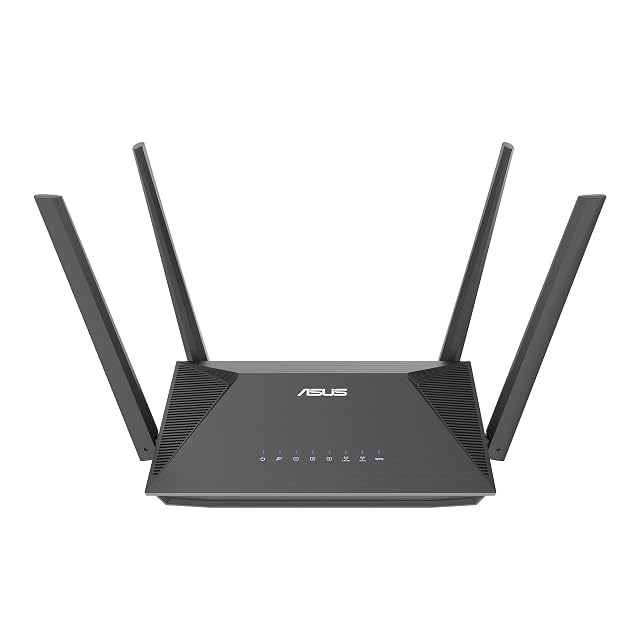
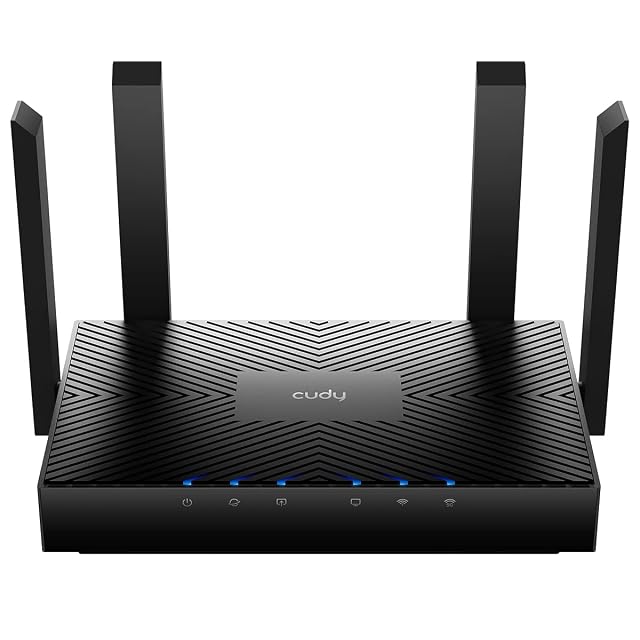
A dual-band AC1200 router with up to 1200 Mbit/s, made of 300 Mbit/s at 2.4 GHz and 867 Mbit/s at 5 GHz; four Gigabit LAN sockets recommended for connections above 100 Mbit/s or for moving large amounts of data; four external antennas with coverage claimed to 120 m²; MU-MIMO for talking to several devices at once; a 1 GHz processor with Beamforming+; WPA and WPA2 PSK mixed encryption; a box holding the router, a mains adapter, a network cable and an instruction leaflet; and a stated access point mode.
The badge and its parts
867 plus 300 is 1167. The badge says 1200. Both numbers are on the page, thirty-three apart, and the badge is the rounded one. A class figure is an arithmetic convention: it adds the theoretical peaks the standard sets for each radio and rounds the total upward.
The antennas, twice
The title sells four antennas at 5 dBi. The third bullet sells four antennas at 6 dBi. There is one set of antennas. We have recorded both figures and chosen neither, because choosing would mean deciding which half of the page to believe.
The wired side
Four Gigabit sockets, stated, with a reason attached. That is the clearest wired specification among the routers here, and on a router bought for a household with a television, a console and a desktop it is the line that decides the purchase.
Before ordering
Read the encryption bullet. WPA and WPA2 PSK mixed is what is offered; if WPA3 is a requirement for anything on the network, this is not the router for it.
Availability
Priced at roughly 26 € on the German, French, Italian and Spanish Amazon stores the day this page was checked.
It is stocked on the British Amazon store as well, in that country’s own currency. The range above leaves those out: it counts euro stores and no others.
The American Amazon store returned nothing at all, so the buy button there opens a search in that country rather than a page that would not load.
Every figure in this section is what Keepa held on the day this page was last updated. Stock and prices move without warning.
Prices quoted in this text were read on 10 September 2026. The live price is at the top of the page.
Where it holds up, and where it stops
Strengths
Publishes both band rates, so the badge can be checked against the arithmetic behind it
Four Gigabit LAN sockets stated plainly, with the reason for wanting them — connections above 100 Mbit/s — written in the same bullet
Names a 1 GHz processor and states an access point mode, so the unit can be redeployed behind another router later
Compromises
The same four antennas are rated 5 dBi in the title and 6 dBi in the bullets, and nothing on the page resolves it
Encryption is given as WPA and WPA2 PSK mixed, with no WPA3 named anywhere
No generation number and no 802.11 designation, so what a client needs in order to reach 867 Mbit/s is left unsaid
Specifications
Wi-Fi generation
Not published on the listing — the class figure carries an AC prefix and the bullets say WLAN AC, without a generation number for the radios
IEEE designation
Not published on the listing — ten bullets cover speed, sockets, antennas, processor, encryption and box contents, and no 802.11 letter appears among them
Stated class figure
AC1200 — stated in the title, with both parts published: 867 Mbit/s at 5 GHz and 300 Mbit/s at 2.4 GHz, which come to 1167, so the badge rounds up by 33
Band count
Two — stated: 2.4 GHz at 300 Mbit/s and 5 GHz at 867 Mbit/s
Stream count
Not published on the listing — MU-MIMO and Beamforming+ are named as features, without a 2×2 or 3×3 figure to go with them
WAN port speed
Not published on the listing — four Gigabit LAN sockets are counted and the socket the incoming line uses is never described separately
LAN port speed
Gigabit — stated for all four LAN sockets, and recommended in the bullets for connections faster than 100 Mbit/s
Port count
Four LAN sockets — stated in the title and in the second bullet; no total including a WAN socket is given
USB ports
Not published on the listing — the box contents run to the router, a mains adapter, a network cable and an instruction leaflet, with no USB socket named
Antenna arrangement
Four external antennas — stated, with two different gains for the same four: 5 dBi in the title and 6 dBi in the third bullet. Coverage of up to 120 m² is claimed alongside them
Amazon reference
B07DGPYKLP (same reference on 5 Amazon marketplaces)
EAN
4895199516908
The questions that come up before an order
Does an antenna gain figure of 5 or 6 dBi make a practical difference?
One decibel of gain is small in itself. What matters here is that a single page gives two figures for the same four antennas, which means one of them was not checked. That is a reason to treat the other numbers on the page with the same care rather than a reason to reject the router.
What is an access point mode good for?
It turns the router into a wireless outlet fed by a cable, with the routing left to another box. It is how a router earns a second life when the provider supplies a newer one, and this listing states the mode rather than leaving it to be discovered.
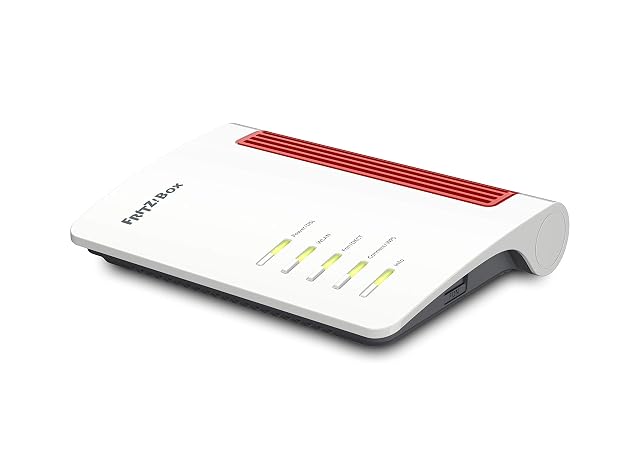
Wi-Fi 6 · 2.4 Gbit/s stated, exactly 1800 plus 600 · DSL modem built in · VoIP and DECT · not one Ethernet socket counted
The only router here with a modem and a telephone exchange inside it, and the only one whose headline figure is exactly the sum of the two rates printed beneath it.
Best for: A household on a DSL line that wants the modem, the telephony and the radios in one box rather than three.