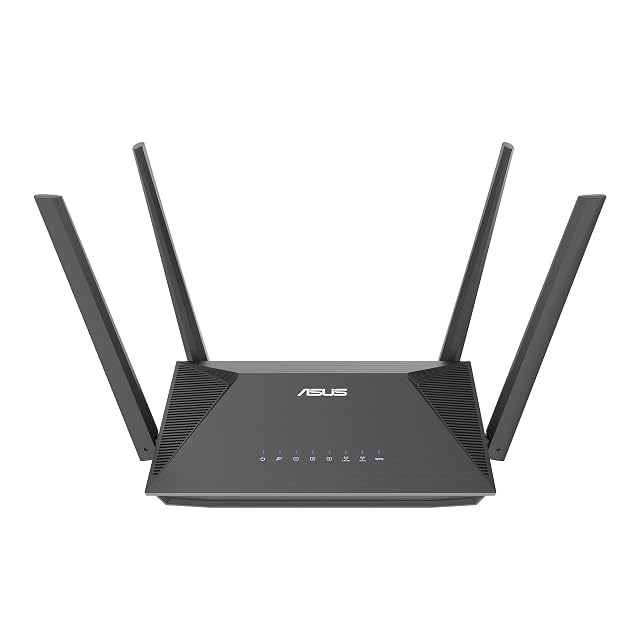
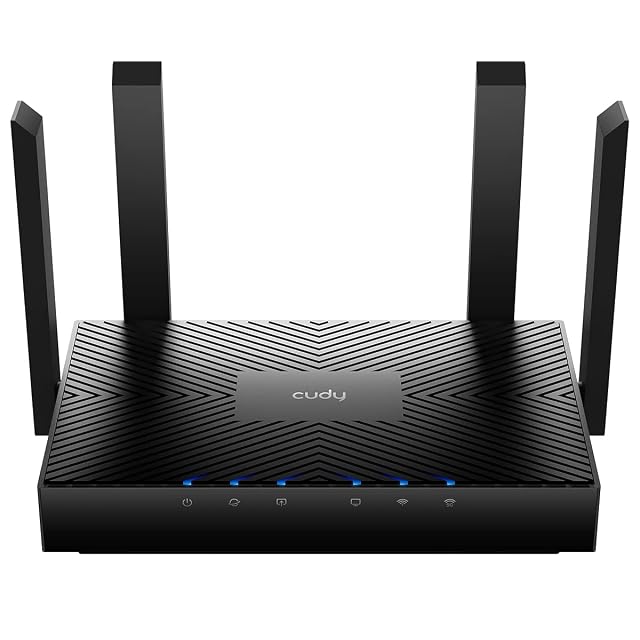
The bottom line A router that is unusually straight about what its headline number is and unusually quiet about everything with a cable in it. For a wireless-first household with modern clients the radio specification is clear; the sockets are the blank to fill in before ordering.
On the listing
A theoretical speed of up to 3000 Mbit/s from 1024-QAM and a 160 MHz channel, made of up to 574 Mbit/s at 2.4 GHz and 2402 Mbit/s at 5 GHz; both bands running at the same time with automatic switching, 5 GHz named for gaming and streaming and 2.4 GHz for wider coverage; a 160 MHz channel said to raise internet speed by 60 per cent or more on devices that support it; a coverage map and network diagnostics in the app; HarmonyOS Mesh+ joining several of the maker routers under one network name with automatic handover; and a warranty of 24 months plus 6 months extended.
The word in the first bullet
Theoretical. The maker uses it about its own headline figure, and it is the correct word. A class figure is produced by adding the peak rates the standard defines for each radio, which are computed from the channel width and the stream count rather than observed on a link. Most listings in this lot print the number without it.
574 plus 2402
That is 2976. The title says 3000. Twenty-four Mbit/s of rounding, visible because the parts are published.
The condition on the 60 per cent
The third bullet states the gain applies when the router is connected to devices that support 160 MHz. That is a condition, printed by the maker, on the mechanism that makes the badge as large as it is. It is worth more than the badge.
What is missing
Sockets, antennas, streams, USB. The page describes the radio and the software and never describes the box.
Before ordering
Check whether the phones and laptops in the house support a 160 MHz channel. The listing is explicit that the headline gain depends on it, and older clients see none of it.
Availability
Priced from 37 € to 40 € across the French, Italian and Spanish Amazon stores the day this page was checked.
It is stocked on the British Amazon store as well, in that country’s own currency. The range above leaves those out: it counts euro stores and no others.
In the German Amazon catalogue with no live offer against it: the reference exists, nobody is filling it.
The American Amazon store returned nothing at all, so the buy button there opens a search in that country rather than a page that would not load.
Every figure in this section is what Keepa held on the day this page was last updated. Stock and prices move without warning.
Prices quoted in this text were read on 10 September 2026. The live price is at the top of the page.
Where it holds up, and where it stops
Strengths
Calls its own headline figure a theoretical speed, in the maker’s own words, which is what a class figure is
Publishes both band rates and says what each is for: 5 GHz for speed, 2.4 GHz for coverage, with automatic switching between them
States a coverage diagnostic in the app — a map of the home with the network status and suggested fixes — rather than only a signal bar
Compromises
Not one Ethernet socket is counted or rated, on a router that has to take a cable from the modem
No antenna count and no stream count, so the 160 MHz claim cannot be traced through to the 2402 Mbit/s
The mesh claim is limited to the maker’s own routers under HarmonyOS, so it does not extend a network built from other brands
Specifications
Wi-Fi generation
Wi-Fi 6 — stated in the title
IEEE designation
Not published on the listing — six bullets cover speed, band switching, channel width, diagnostics, mesh and warranty, and no 802.11 letter pair is printed among them
Stated class figure
3000 Mbit/s — stated in the title, and described in the first bullet as a theoretical speed reached with 1024-QAM and a 160 MHz channel, made of up to 574 Mbit/s at 2.4 GHz and 2402 Mbit/s at 5 GHz. Those come to 2976, so the headline rounds up by 24
Band count
Two, each with a rate and stated as running at the same time — 2.4 GHz at up to 574 Mbit/s for wider coverage and 5 GHz at up to 2402 Mbit/s for speed, with automatic switching between them
Stream count
Not published on the listing — the 160 MHz channel width and 1024-QAM are named as the inputs to the figure, and the number of streams is not
WAN port speed
Not published on the listing — no socket for the incoming line is named in the title or in any bullet
LAN port speed
Not published on the listing — no wired socket is counted, so none is rated
Port count
Not published on the listing — the six bullets describe radios, software and warranty, and none counts a socket
USB ports
Not published on the listing — no USB socket appears anywhere on the page
Antenna arrangement
Not published on the listing — no antenna is counted, rated or described as internal or external
Amazon reference
B0F6LB6Y9N (same reference on 5 Amazon marketplaces)
EAN
6942103161551
The questions that come up before an order
What does a 160 MHz channel need at the other end?
A client that supports it. The listing states as much in its own third bullet, saying the increase applies when the router is connected to devices that support 160 MHz. A phone or laptop limited to 80 MHz sees half the channel and a correspondingly lower rate.
Is a theoretical speed a useful number?
It is useful for comparison and useless as a promise. Every maker calculates it the same way — channel width and stream count fed into the standard formula, radios added together — so two badges can be ranked against each other. What none of them describes is a connection.
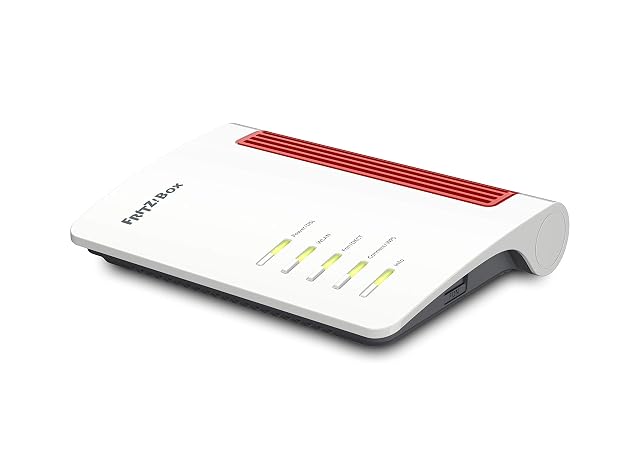
Wi-Fi 6 · 2.4 Gbit/s stated, exactly 1800 plus 600 · DSL modem built in · VoIP and DECT · not one Ethernet socket counted
The only router here with a modem and a telephone exchange inside it, and the only one whose headline figure is exactly the sum of the two rates printed beneath it.
Best for: A household on a DSL line that wants the modem, the telephony and the radios in one box rather than three.