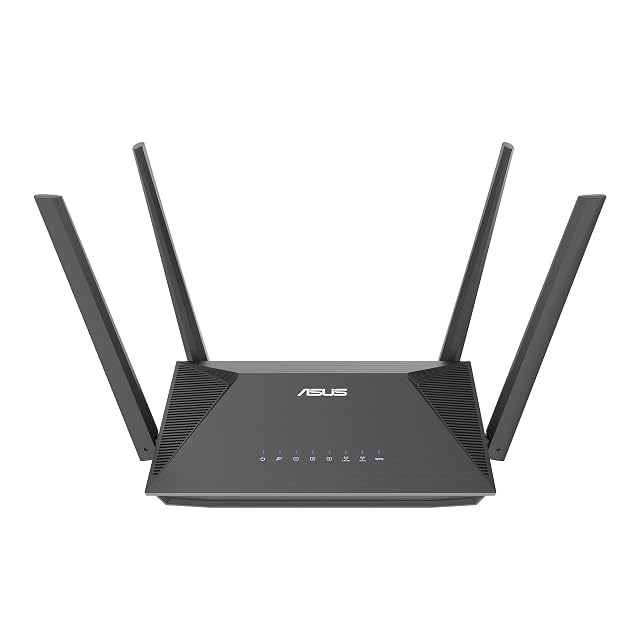
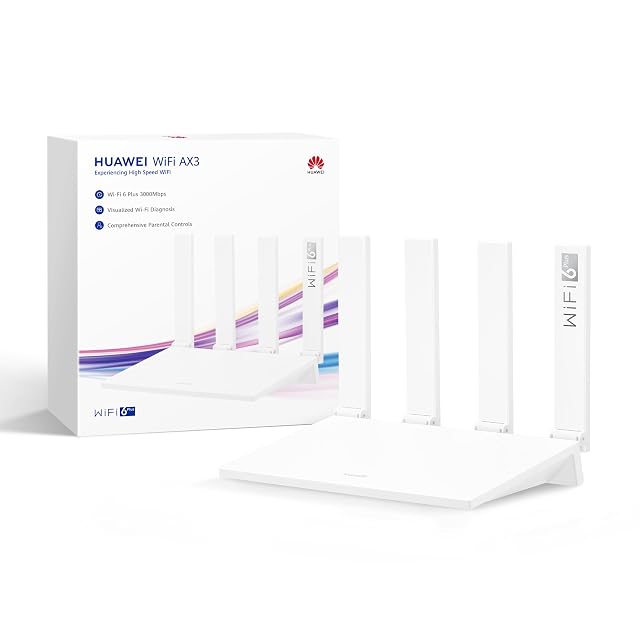
The bottom line A carefully described radio and processor bolted to an invisible chassis. As the wireless half of a network where the routing and switching sit elsewhere it specifies well; as the only box in the house, the missing sockets are the whole question.
On the listing
A dual-band AX3000 Wi-Fi 6 router with 160 MHz channels and 1024-QAM, described as reaching a total network speed of about 3000 Mbps and as 2.5 times the older two-stream dual-band routers it is compared with; a 1.3 GHz dual-core Cortex-A53 processor; a design for more than 100 connected devices; beamforming that aims signal at a device rather than in every direction; and downlink and uplink OFDMA with MU-MIMO, quoted at up to eight times the capacity on 2.4 GHz and sixteen times on 5 GHz. The title adds WireGuard, OpenVPN and WPA3.
What the badge counts
AX3000 sums the theoretical peaks of both radios, computed from the 160 MHz channel width and the stream count the standard defines. The maker’s own phrase is a total network speed, which is the right description of an addition and the wrong description of a link. The parts of that addition are not published.
The comparison that carries the only stream figure
The first bullet measures this router against 802.11ac two-stream dual-band routers. That 2×2 belongs to them. Nothing on the page says how many streams this router has, and without that the 3000 Mbps cannot be traced back to a channel width and a stream count.
The missing chassis
No socket count. No socket speed. No USB. No antenna count. Five bullets that describe the radio, the processor and the software, and nothing at all about what the box looks like from behind.
Before ordering
Ask for the socket count and speed. A router quoted at 3000 Mbps in the air and fitted with gigabit sockets has a wired ceiling that no radio specification lifts, and this page does not say which sockets it has.
Availability
Priced from 40 € to 44 € across the German, French, Italian and Spanish Amazon stores the day this page was checked.
It is stocked on the American and British Amazon stores as well, in that country’s own currency. The range above leaves those out: it counts euro stores and no others.
Every figure in this section is what Keepa held on the day this page was last updated. Stock and prices move without warning.
Prices quoted in this text were read on 10 September 2026. The live price is at the top of the page.
Where it holds up, and where it stops
Strengths
Names the processor exactly — a 1.3 GHz dual-core Cortex-A53 — which is the part that decides whether the routing keeps up with the radios
States the two Wi-Fi 6 mechanisms behind the badge, a 160 MHz channel and 1024-QAM, rather than only the badge
Publishes a device ceiling of more than 100 connections and quantifies the capacity gain as up to eight times on 2.4 GHz and sixteen times on 5 GHz
Compromises
Not one Ethernet socket is named anywhere, on a device whose job begins with a cable from the modem
The class figure is never split between the bands, so how much of the 3000 Mbps belongs to 2.4 GHz is unpublished
The only stream count on the page describes the routers this one is compared with, not this one
Specifications
Wi-Fi generation
Wi-Fi 6 — stated in the title and in the first bullet
IEEE designation
Not published on the listing for this router — 802.11ac appears only as the older kind of router the maker measures itself against, never as the designation of the radios inside this one
Stated class figure
AX3000 — stated in the title, and described in the first bullet as a total network speed of about 3000 Mbps produced by 160 MHz channels and 1024-QAM. The listing does not divide the figure between the two bands
Band count
Two — stated as dual-band, with 2.4 GHz and 5 GHz both named in the capacity bullet; neither is given a rate of its own
Stream count
Not published on the listing — MU-MIMO and downlink and uplink OFDMA are named, and the only stream figure on the page, 2×2, belongs to the older routers used as the comparison
WAN port speed
Not published on the listing — no socket for the incoming line is named in the title or in any of the five bullets
LAN port speed
Not published on the listing — no wired socket of any kind is named, so none is given a speed
Port count
Not published on the listing — the five bullets cover the radios, the processor, the device ceiling, beamforming and the capacity technologies, and none counts a socket
USB ports
Not published on the listing — no USB socket appears anywhere on the page
Antenna arrangement
Not published on the listing — beamforming is described as focusing the signal towards a device, and no antenna is counted or rated
Amazon reference
B0BRK3CYY3 (same reference on 6 Amazon marketplaces)
EAN
6971690792831
The questions that come up before an order
Why does the processor matter on a router?
Because routing, firewalling and any VPN work all run on it. A router whose radios are quoted at 3000 Mbps and whose processor cannot keep up will show its limit on the wired path rather than in the air. Naming the core and the clock, as this listing does, lets that be judged.
What is 1024-QAM?
A denser way of encoding data onto the radio signal, so each transmission carries more bits. It needs a strong, clean signal to work, which is why it delivers most near the router and least at the far end of the house. It is one of the inputs to the class figure printed on the box.
Wi-Fi 6 · 2.4 Gbit/s stated, exactly 1800 plus 600 · DSL modem built in · VoIP and DECT · not one Ethernet socket counted
The only router here with a modem and a telephone exchange inside it, and the only one whose headline figure is exactly the sum of the two rates printed beneath it.
Best for: A household on a DSL line that wants the modem, the telephony and the radios in one box rather than three.