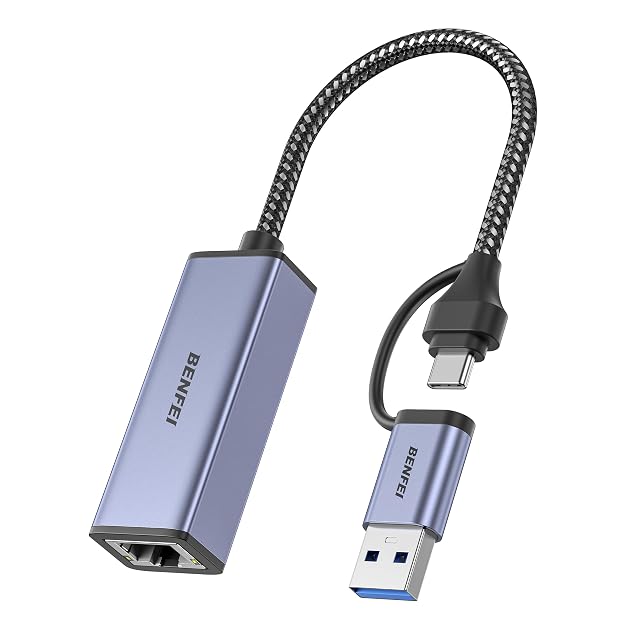
The bottom line The only adapter here that gives a socket back rather than taking one, and the one whose body and lead are described as parts. The chip is named by its maker alone, which is closer than most of this shelf gets.
On the listing
A USB-C to Ethernet adapter given as up to 2500 Mbit/s, named for 4K and 8K streaming, gaming, video calls and fast transfers on a local network; a built-in USB-C power socket supporting charging to 140 W under USB-PD 3.1 for compatible machines, with a 16-inch MacBook Pro named, and charging running alongside the 2.5-gigabit connection; steady performance at low consumption with plug-and-play working, and a recommendation to install the current Realtek USB 2.5G Ethernet controller driver, particularly on older systems and certain Linux kernel versions; an aluminium case for durability and heat dissipation with a flexible braided pigtail lead; and compatibility with USB-C, USB4 and Thunderbolt machines including MacBook, iMac, Dell XPS, iPad Pro and Surface, on Windows, macOS, Linux and ChromeOS, with routers, switches and network storage named.
The socket that keeps the laptop charged
Up to 140 W, under USB-PD 3.1, at the same time as the network. On a laptop with one Type-C socket, an ordinary adapter is a choice between being wired and being charged. This one removes the choice, and it names the standard the power side follows rather than printing a wattage on its own.
A controller maker without a model
The third bullet says which driver to fetch and where the difficulty usually is: older systems, and particular Linux kernel versions. It names the maker of the chip. It does not name the chip. That is more than four of the six pages on this shelf manage and less than the two that print a part number.
The braided lead, unmeasured
Braided, flexible, hard-wearing. All three are stated. How long it is, is not, and on a pigtail adapter the length decides whether the body hangs off the side of a laptop or lies flat on the desk beside it.
Before ordering
Check what the charger of the machine draws. The socket passes up to 140 W, and a laptop asking for more than that is a laptop still tethered to its own supply.
Availability
Priced from 30 € to 39 € across the German, French, Italian and Spanish Amazon stores the day this page was checked.
It is stocked on the American and British Amazon stores as well, in that country’s own currency. The range above leaves those out: it counts euro stores and no others.
Every figure in this section is what Keepa held on the day this page was last updated. Stock and prices move without warning.
Prices quoted in this text were read on 10 September 2026. The live price is at the top of the page.
Where it holds up, and where it stops
Strengths
Carries charging as well as the network, up to 140 W under USB-PD 3.1, which is the answer to a laptop that has one Type-C socket and needs both
Names the maker of the controller and the situations where the driver matters most, older systems and certain Linux kernels
A braided lead and an aluminium body, both stated rather than shown, which are the two parts of an adapter that wear out first
Compromises
The chip is identified by its maker and not by its model, so the exact driver still has to be found
No length for the lead, which on a pigtail adapter decides how it sits behind a laptop
Neither a USB generation nor a host rate for the data side, on a page that gives a precise standard for the power side
Specifications
USB generation
Not published on the listing — the page names USB-C, USB4 and Thunderbolt as hosts it works with, and USB-PD 3.1 for the charging socket, and never gives a USB data generation for the adapter itself
Stated link rate
Not published on the listing for the host link — no figure in gigabits per second is attached to the USB side. The only rate on the page, up to 2500 Mbit/s, belongs to the Ethernet socket
Connector type
USB-C, on a braided pigtail lead, with a second USB-C socket on the body for power. The second bullet states that the built-in USB-C power socket supports charging to 140 W under USB-PD 3.1 for compatible machines, naming a 16-inch MacBook Pro as an example, and that charging and the 2.5-gigabit connection run at the same time
Ethernet port speed standard
Up to 2500 Mbit/s — stated in the first bullet, described as a good deal more than a conventional one-gigabit adapter and named for 4K and 8K streaming, gaming, video calls and file transfers on a local network. No BASE-T designation is printed
Controller family
Not published on the listing as a part number — the third bullet recommends the current Realtek USB 2.5G Ethernet controller driver, particularly on older systems and certain Linux kernel versions, which names the maker of the chip without naming the chip
Stated operating system support
Windows, macOS, Linux and ChromeOS — stated in the fifth bullet without versions, alongside a list of machines: MacBook, iMac, Dell XPS, iPad Pro and Surface among others, and with routers, switches and network storage named as what it plugs into
Housing material
Aluminium — stated in the fourth bullet as an aluminium case for durability and heat dissipation
Cable arrangement
A braided pigtail lead — stated in the fourth bullet as flexible and hard-wearing and named for travelling, office and daily use on a laptop. No length is printed anywhere on the page
Amazon reference
B0FC61NLVD (same reference on 6 Amazon marketplaces)
EAN
0810115189343
The questions that come up before an order
What does a 140 W power socket on a network adapter do?
It passes the charger of the machine through the adapter, so one socket on the laptop carries both the network and the power. The figure is the ceiling of what the socket will pass under USB-PD 3.1, and the machine and the charger decide what is actually drawn. Without it, an adapter of this kind occupies the only socket a thin laptop has.
Is naming the maker of a chip as good as naming the chip?
It is halfway there. Knowing the driver comes from one maker narrows the search to a family, and this page even names the cases where fetching it matters. What it does not do is tell you which member of that family is inside, which is what would let the support be confirmed before the order.
USB 3.0 · 5 Gbit/s bus stated · USB-C plug · 10/100/1000 Mbit/s · 802.3, 802.3u, 802.3ab and 802.3az named · Category 6 asked for · 18-month warranty
A gigabit adapter that names four Ethernet standards and then asks for Category 6 cable if the gigabit is to be had, which is the chain stated by the maker rather than by us.
Best for: A laptop with a Type-C socket and no Ethernet, on a network already wired with Category 6 or better, where the gigabit is the whole requirement.
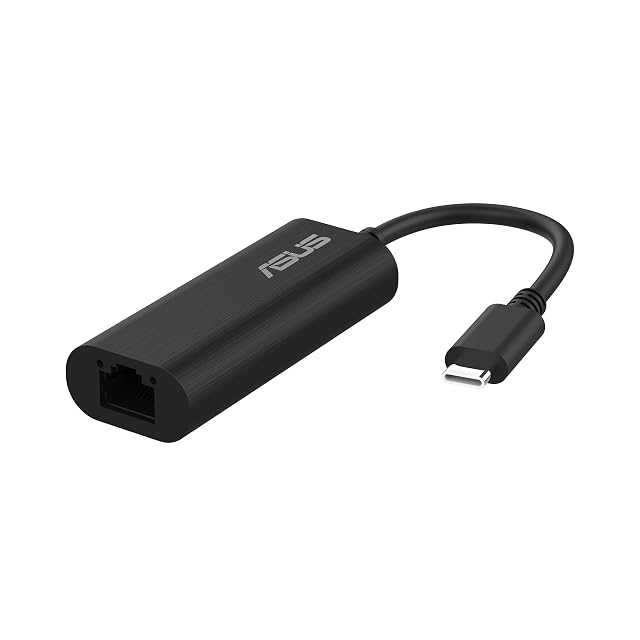
2.5G Ethernet named · USB-C · no driver stated · no host rate · no chip · no housing material · no operating system listed
A 2.5-gigabit Type-C adapter from a large name whose page publishes four short bullets and answers two of the eight questions this hub asks.
Best for: A buyer who is choosing on the name on the box and on a recent machine, where a Type-C socket and a 2.5-gigabit switch are already known quantities.
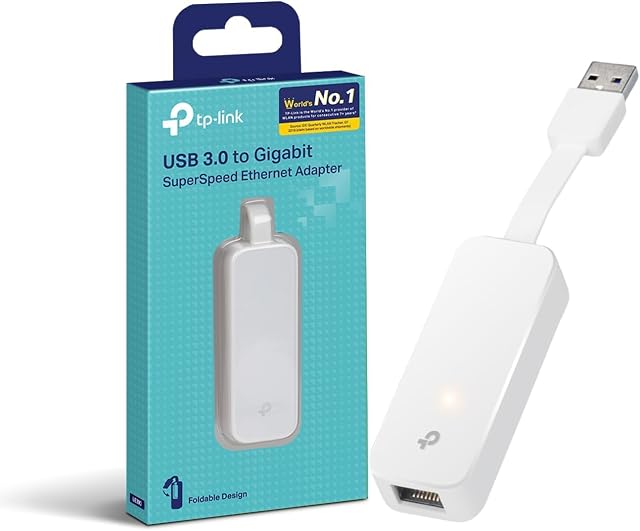
USB 3.0 · 1000 Mbit/s · plug folds into the body · no host rate published · no chip named · plug and play on four systems
A gigabit adapter built around one idea, a metal plug that folds away into the housing, on a page that never puts a rate on the USB side of the link.
Best for: A laptop bag, where an adapter with nothing sticking out of it survives better than one on a lead, and where a gigabit socket is all that is asked for.