The bottom line A well made travelling adapter that answers the questions of shape and system and skips the ones about the link and the chip. On a laptop bought in the last few years it is unlikely to matter; on an older machine, the missing Type letter is what to check first.
On the listing
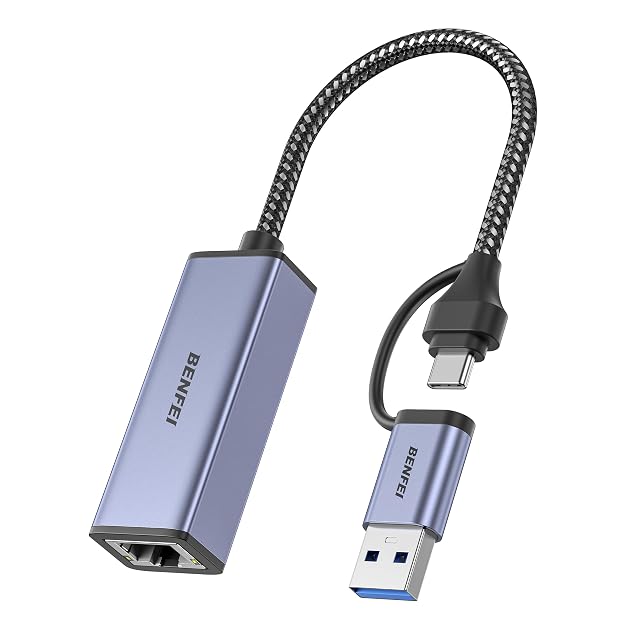
A USB 3.0 Ethernet adapter offered as a way of replacing a failed motherboard socket or of raising a wired connection to 1000 Mbit/s; a slot in the body of the UE300 that stows the sharp metal USB plug which would otherwise scratch the surface of a laptop; plug and play on Windows 11 and 10, macOS 10.9 and later, Chrome OS and Linux; a foldable and portable design named in the title; and a note that the UE300 does not support the Nintendo Switch while the UE306 does.
The plug that folds away
A slot in the body for the metal plug. It is the whole design, and it is why this adapter goes in a bag rather than staying on a desk. The reason given is the lid of a laptop, and anyone who has carried a bare USB plug loose in a case will recognise the problem it solves.
The bullet about the UE306
The last bullet is about a different product. It says the UE300 will not work with a games console and that another model will. Nothing else about the UE306 is carried across to this page: what is reported here is that this adapter is excluded and that the maker names the alternative, which is more than most listings do with an incompatibility.
No rate for the USB side
USB 3.0 is named. No figure follows it. The gigabit belongs to the Ethernet socket, and the link carrying it is described by a generation alone. On a modern laptop that is academic; on an older machine with mixed sockets it is the number that would have settled which one to use.
Before ordering
Look at the sockets on the machine, then at the photograph. The page never says Type-A or Type-C, and that is the one thing the picture can answer and the text cannot.
Availability
Priced from 9 € to 12 € across the German, French, Italian and Spanish Amazon stores the day this page was checked.
It is stocked on the American and British Amazon stores as well, in that country’s own currency. The range above leaves those out: it counts euro stores and no others.
Every figure in this section is what Keepa held on the day this page was last updated. Stock and prices move without warning.
Prices quoted in this text were read on 10 September 2026. The live price is at the top of the page.
Where it holds up, and where it stops
Strengths
The plug stows in the body, so there is nothing loose to catch in a bag and nothing sharp against the lid of a laptop
Plug and play is stated for four named systems rather than promised in general, and Chrome OS is among them
The fourth bullet names the model that does support the Nintendo Switch instead of leaving the buyer to find out this one does not
Compromises
No rate for the USB side, which is the link that sets the ceiling of everything behind it
The plug is never given a Type letter, so a machine with only Type-C sockets cannot be matched from the page alone
No chip named, on a family where the chip is what a driver is written for
Specifications
USB generation
USB 3.0 — stated in the title and in the first bullet, which describes the adapter as a way of replacing a failed motherboard socket or of raising a connection to 1000 Mbit/s
Stated link rate
Not published on the listing — no figure in gigabits per second is given for the USB side. The only rate on the page, 1000 Mbit/s, belongs to the Ethernet socket
Connector type
Not published on the listing as a Type letter — the title names a USB 3.0 plug and the second bullet describes a sharp metal USB plug that stows in a slot in the body, and neither says Type-A nor Type-C
Ethernet port speed standard
1000 Mbit/s — stated in the title and in the first bullet; no BASE-T designation and no fallback rates are printed anywhere on the page
Controller family
Not published on the listing — no chip, no chip maker and no part number appears in the title or in any of the four bullets
Stated operating system support
Plug and play on Windows 11 and 10, macOS 10.9 and later, Chrome OS and Linux — stated in the third bullet; the title names Windows 11/10, Mac OS and Linux without Chrome OS
Housing material
Not published on the listing as a body material — the second bullet calls the USB plug metallic and describes the slot that receives it, and never says what the housing around that slot is made of
Cable arrangement
No separate lead — the plug is part of the body and folds into a slot in it, stated in the second bullet, which gives protecting the surface of a laptop from scratches as the reason
Amazon reference
B00V4BGDKU (same reference on 6 Amazon marketplaces)
EAN
1210002617871
The questions that come up before an order
Why does a folding plug matter more than it sounds?
Because an adapter of this kind lives in a bag rather than on a desk. A plug that folds into the body has nothing to snap off, nothing to catch on a cable, and no exposed metal edge to drag across a laptop lid. The second bullet gives that last point as the reason for the design.
What is missing when the USB side has no rate?
The ceiling. A gigabit socket behind a slow host link is limited by the host link, and the figure printed on the box belongs to the socket. Here USB 3.0 is named without a figure, so the generation is the only clue and the number that goes with it has to be looked up elsewhere.
USB 3.0 · 5 Gbit/s bus stated · USB-C plug · 10/100/1000 Mbit/s · 802.3, 802.3u, 802.3ab and 802.3az named · Category 6 asked for · 18-month warranty
A gigabit adapter that names four Ethernet standards and then asks for Category 6 cable if the gigabit is to be had, which is the chain stated by the maker rather than by us.
Best for: A laptop with a Type-C socket and no Ethernet, on a network already wired with Category 6 or better, where the gigabit is the whole requirement.
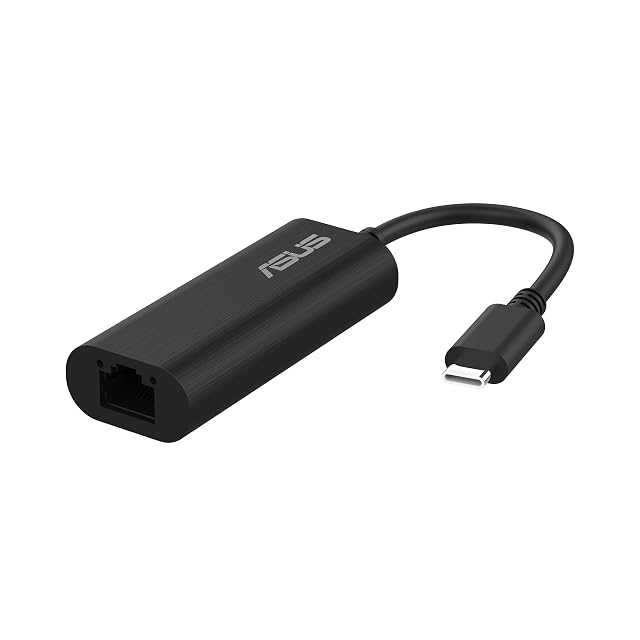
2.5G Ethernet named · USB-C · no driver stated · no host rate · no chip · no housing material · no operating system listed
A 2.5-gigabit Type-C adapter from a large name whose page publishes four short bullets and answers two of the eight questions this hub asks.
Best for: A buyer who is choosing on the name on the box and on a recent machine, where a Type-C socket and a 2.5-gigabit switch are already known quantities.
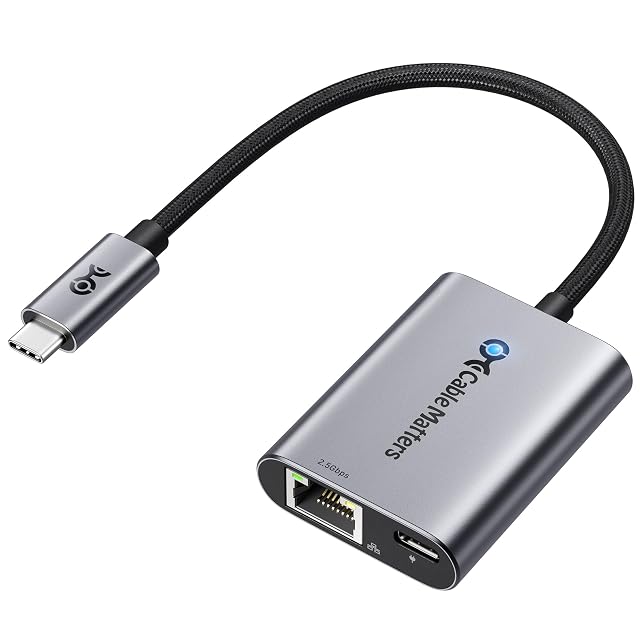
up to 2500 Mbit/s · USB-C · a second USB-C socket for charging to 140 W under USB-PD 3.1 · aluminium body · braided pigtail lead · controller maker named without a model
A 2.5-gigabit adapter that gives the single Type-C socket of a laptop back by carrying up to 140 W of charging alongside the network.
Best for: A modern laptop with a single Type-C socket that has to be charged and wired at the same time, on a desk where the adapter stays plugged in.