The bottom line A short page for a simple product, and the shortness is the finding. What it does is clear; what it needs from the machine, what drives it and what it is made of are all left out, which is a great deal to leave to a brand name.
On the listing
A USB-C adapter described as designed for the devices of today with seamless compatibility and strong performance; ultra-fast 2.5G Ethernet named for smooth streaming, lag-free gaming and quick file exchange; instant plug and play with no drivers and no trouble on all supported systems; and a slim, light, travel-friendly design named for field work, business travel and life on the move.
Four bullets, four adjectives
Seamless. Ultra-fast. Instant. Slim. Each bullet carries one, and between them they carry two facts: the connector is Type-C and the socket is 2.5G. Everything else on this page is a way of saying that the product is good.
No driver, no list
The third bullet promises nothing to install on all supported systems. The list of those systems does not appear in the title, in the bullets, or anywhere else. A claim of universal support without a list is the one thing a buyer cannot check, and on this family the list is what separates one adapter from the next.
Where the 2.5G stops
The figure appears twice and never acquires a designation, a rate in Mbit/s or a fallback. What happens against a gigabit switch is not stated. What happens against a 100 Mbit/s socket is not stated. The number is the beginning of a specification and the page treats it as the end of one.
Before ordering
Confirm the system you run is one of the supported ones. The bullet promises that it is and never says which they are.
Availability
Priced from 30 € to 40 € across the German, French, Italian and Spanish Amazon stores the day this page was checked.
It is stocked on the American and British Amazon stores as well, in that country’s own currency. The range above leaves those out: it counts euro stores and no others.
Every figure in this section is what Keepa held on the day this page was last updated. Stock and prices move without warning.
Prices quoted in this text were read on 10 September 2026. The live price is at the top of the page.
Where it holds up, and where it stops
Strengths
The connector and the network standard are both in the title, so the two things that decide whether it fits a machine can be read without opening the bullets
States that no driver is required rather than describing installation as easy, which is a claim a buyer can hold the seller to
Names travel and field work as what the shape is for, which is a use rather than an adjective
Compromises
Six of the eight questions this hub asks are unanswered, which is the emptiest page in this group
No operating system is named at all, next to a bullet claiming there are no drivers to install
The 2.5G is given without a designation, a figure in Mbit/s or a fallback, so it cannot be compared with the switch at the other end
Specifications
USB generation
Not published on the listing — the connector is named as USB-C in the title and in the first bullet, and no generation, no number and no rate is attached to it in any of the four bullets
Stated link rate
Not published on the listing for the host link — the only figure on the whole page, 2.5G, belongs to the Ethernet side
Connector type
USB Type-C — stated in the title and in the first bullet, which describes the connector as designed for the devices of today
Ethernet port speed standard
2.5G Ethernet — stated in the title and in the second bullet as ultra-high-speed connections for streaming, gaming and file transfer. No BASE-T designation, no figure in Mbit/s and no fallback rates are printed
Controller family
Not published on the listing — no chip, no chip maker and no part number appears in the title or in any of the four bullets
Stated operating system support
Not published on the listing as a list — the third bullet says there are no drivers and no trouble and that the adapter works on all supported systems, and never names one of them
Housing material
Not published on the listing — the fourth bullet calls the body slim, light and ready to use and describes it as compact and travel-friendly, without naming a material
Cable arrangement
Not published on the listing — no lead, no length and no statement of whether the plug is fixed to the body appears anywhere on the page
Amazon reference
B0BW8FTT2T (same reference on 6 Amazon marketplaces)
EAN
4711636101585
The questions that come up before an order
What does no drivers on all supported systems leave out?
Which systems are supported. The claim and the list belong together, and here only the claim is printed. On this family the list is the specification, because the outward hardware is much the same from one box to the next and what separates two adapters is what already recognises them.
Why insist on a BASE-T designation when 2.5G is clear enough?
Because the designation is what two pieces of equipment agree on. A switch port published as 2.5GBASE-T and an adapter published the same way share a channel width, a cable grade and a way of negotiating. 2.5G on its own is a marketing shorthand, and the shorthand is what this page prints.
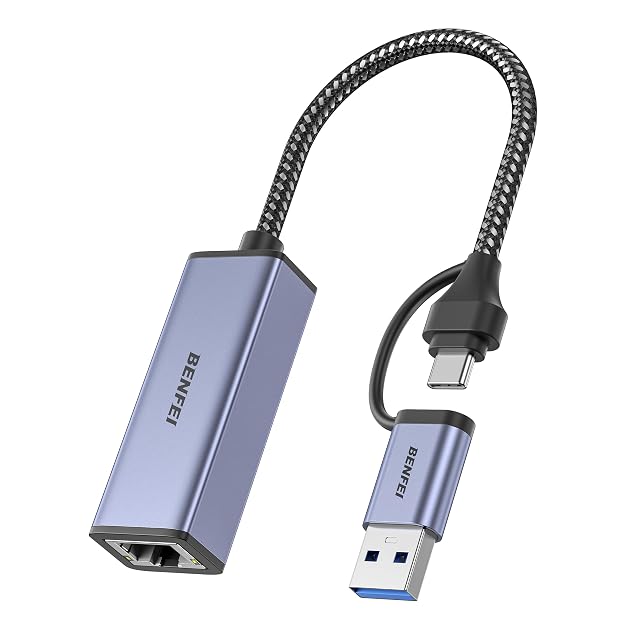
USB 3.0 · 5 Gbit/s bus stated · USB-C plug · 10/100/1000 Mbit/s · 802.3, 802.3u, 802.3ab and 802.3az named · Category 6 asked for · 18-month warranty
A gigabit adapter that names four Ethernet standards and then asks for Category 6 cable if the gigabit is to be had, which is the chain stated by the maker rather than by us.
Best for: A laptop with a Type-C socket and no Ethernet, on a network already wired with Category 6 or better, where the gigabit is the whole requirement.
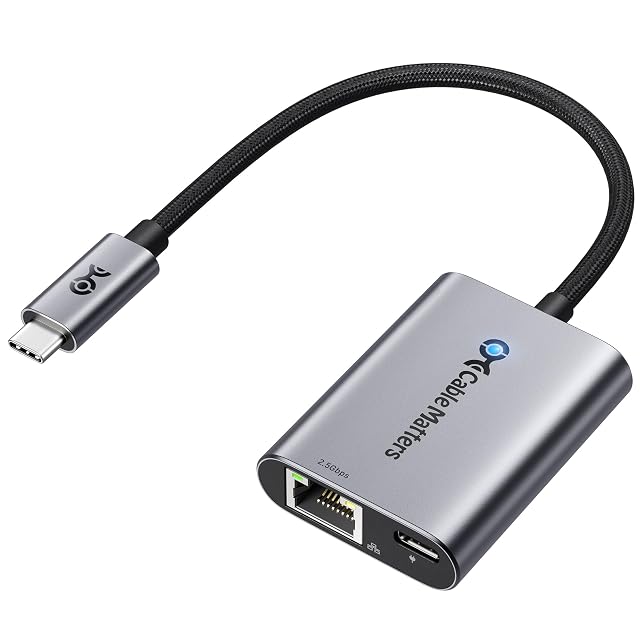
up to 2500 Mbit/s · USB-C · a second USB-C socket for charging to 140 W under USB-PD 3.1 · aluminium body · braided pigtail lead · controller maker named without a model
A 2.5-gigabit adapter that gives the single Type-C socket of a laptop back by carrying up to 140 W of charging alongside the network.
Best for: A modern laptop with a single Type-C socket that has to be charged and wired at the same time, on a desk where the adapter stays plugged in.
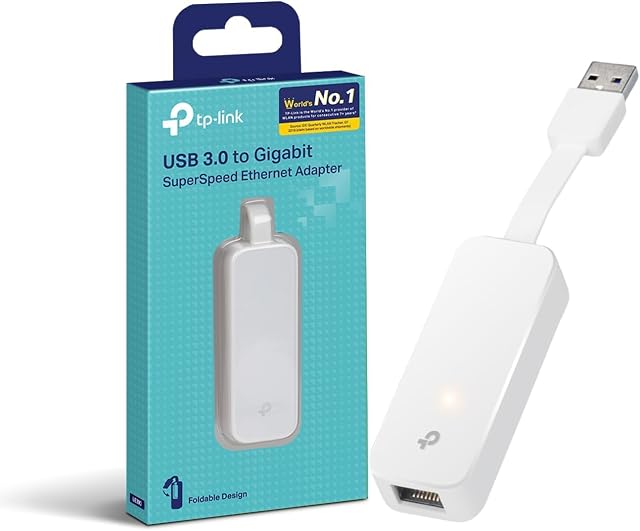
USB 3.0 · 1000 Mbit/s · plug folds into the body · no host rate published · no chip named · plug and play on four systems
A gigabit adapter built around one idea, a metal plug that folds away into the housing, on a page that never puts a rate on the USB side of the link.
Best for: A laptop bag, where an adapter with nothing sticking out of it survives better than one on a lead, and where a gigabit socket is all that is asked for.