Skip to content

StarTech.com PM1115P3, twelve protocols named and a Centronics port review

Twelve network protocols named on one page — more than the rest of this shelf names put together — on a server that puts a parallel printer from the 1990s onto a modern network.

The intro to this section says the protocols are what decide whether anything will find the printer at all, and that a unit naming none of them will want its own driver on every machine in the house. Here is the other end of that scale.

The first bullet names IPP, TCP/IP, LPR, RAW, AppleTalk, NetWare and SMB. The description adds IPX, RAW 9100 specifically, NetBEUI, and SNMP versions 1 and 2. Twelve, counted generously, and every one of them is a name a system administrator can act on. The nine other listings on this shelf name nine between them — two from the PM1115U2, one from the PM1115UW, six from the CSL listing that prints a video acronym by mistake — and none at all from the other six.

That matters particularly here because the printer has nothing of its own. A parallel printer from the late 1990s has no network stack, no IP address and no notion of a queue; everything the network sees is this box. The second bullet names the connection precisely — directly to the Centronics 36-pin port on the printer — which is more than the other parallel listing on this shelf does.

The third bullet is the one that explains who this is for: revitalizing legacy printers by adding wired network connectivity, with HP LaserJet, Epson, Canon, Lexmark and Brother named, and vinyl cutters and label printers named as well. Five makers rather than a model list, which is not the published compatibility list this shelf is judged on — the intro says to read it for the exact model — but it is a bounded claim rather than a percentage.

The fourth bullet gives Windows, macOS and Linux, with setup through Windows software or a web interface for the other two, and names what the web interface does: network and protocol configuration, print status and queue, reset, and firmware upgrade. A firmware upgrade path published on the page is rare on this shelf; so is a print queue visible from a browser.

The title says TAA, which is the American procurement rule on country of origin — a purchasing requirement rather than a technical one, and the reason this unit appears in government and education lists. The third bullet names those settings directly.

What is missing is the compatibility list proper and the scanner. No model-by-model list and no document to look one up in; five maker names and nothing finer. Scanning is not named in either direction, which on a parallel printer is almost never the question. No wireless, and no USB printer socket: this unit takes a parallel printer and nothing else.

At 45 g (1.6 oz) it is the lightest unit here. At $82.99 on October 26, 2026, it was the dearest of the three StarTech units and second only to the three-printer LOYALTY-SECU among the listings sold on Amazon.com..

Prices quoted in this text were read on October 26, 2026. The live price is at the top of the page.

Where it holds up, and where it stops

Strengths

  • Twelve protocols named on one page, more than the other nine listings on this shelf name between them
  • Names the printer socket exactly — Centronics 36-pin — rather than saying parallel and stopping
  • Windows, macOS and Linux all named, with a web interface for the two that have no installer
  • The web interface is described by what it does: protocol configuration, print status and queue, reset and firmware upgrade
  • TAA compliance stated, which is the procurement rule that puts a unit on a government or education purchase list

Compromises

  • No model-by-model compatibility list and no document to look one up in — five maker names is as fine as it gets
  • $82.99 on Amazon.com on October 26, 2026, for a single parallel printer — $8 more than the X-MEDIA parallel unit
  • No wireless and no USB printer socket: this unit takes a Centronics printer and nothing else
  • No scanner support named in either direction

Specifications

Printer connection typeParallel, on a Centronics 36-pin port — stated in the title and named precisely in the second bullet, which says the unit connects directly to that socket on the printer. No USB printer socket exists
Network port typeRJ45 copper — stated in the title as Ethernet, with the first bullet giving support for 10/100 Mbit/s local networks
Network port speed10/100 Mbit/s — stated in the title and in the first bullet, with the description adding support for both 10 and 100 Mbit/s speeds. No BASE-TX designation appears
Wireless supportNot published on the listing — no wireless, no band and no standard appears anywhere. The same maker’s wireless unit is on this shelf
Protocols publishedTwelve, counted across the page — IPP, TCP/IP, LPR, RAW, AppleTalk, NetWare and SMB in the first bullet, with IPX, RAW 9100, NetBEUI and SNMP versions 1 and 2 added in the description. It is more than the other nine listings on this shelf name between them
Number of printers servedOne — the title and the first bullet describe converting a parallel printer, in the singular, into a network printer
Scanner supportNot published on the listing — scanning is not named in either direction, which on a parallel printer is seldom the question
Stated operating system supportWindows, macOS and Linux — stated in the fourth bullet, with setup through Windows software or a web interface for macOS and Linux. The same bullet names what the interface does: network and protocol configuration, print status and queue, reset and firmware upgrade
Published printer compatibility listNot published as a list — the third bullet names HP LaserJet, Epson, Canon, Lexmark and Brother, and adds vinyl cutters and label printers. Five maker names is a bounded claim rather than the model-by-model list this family is judged on
Amazon referenceB0D9KCWSJC
EAN0065030897716
On Amazon.comAmazon.com had an offer at $83 on October 26, 2026.

The questions that come up before an order

Which protocols does it speak?

IPP, TCP/IP, LPR, RAW and RAW 9100, AppleTalk, NetWare, SMB, IPX, NetBEUI and SNMP versions 1 and 2, across the first bullet and the description. No other listing on this shelf comes close.

Will my printer work with it?

The third bullet names HP LaserJet, Epson, Canon, Lexmark and Brother, plus vinyl cutters and label printers. There is no model-by-model list, which this shelf’s own guidance says is the thing to check.

Can it take a USB printer?

No. The printer socket is a Centronics 36-pin parallel port. The same maker’s wireless USB unit is also on this shelf.

What does TAA mean here?

An American procurement rule about country of origin. It is a purchasing requirement rather than a technical specification, and it is why the third bullet names government and education settings.
Against the rest of the network and storage gear

This network and storage gear share the category and the price bracket. Only what each one states is shown; an incomplete column would mislead.

Model Price Printer connection typeNetwork port typeNetwork port speedWireless support
StarTech.com PM1115P3, twelve protocols named and a Centronics port $83 Parallel, on a Centronics 36-pin port — stated in the title and named precisely in the second bullet, which says the unit connects directly to that socket on the printer. No USB printer socket existsRJ45 copper — stated in the title as Ethernet, with the first bullet giving support for 10/100 Mbit/s local networks10/100 Mbit/s — stated in the title and in the first bullet, with the description adding support for both 10 and 100 Mbit/s speeds. No BASE-TX designation appearsNot published on the listing — no wireless, no band and no standard appears anywhere. The same maker’s wireless unit is on this shelf
StarTech.com PM1115UW, wireless and wired both — and AirPrint ruled out in writing $76 USB 2.0 — stated in the title as a one-port USB 2.0 print server and in the fourth bullet as USB 2.0 compliant, with the description adding compatibility with most USB printers on the marketBoth — an RJ45 copper socket and 802.11b/g/n wireless, stated in the first bullet. The description gives the wired port as a primary or backup interface. The SatcOp is the only other listing here to name both routes, and it gives no standard for either10/100 Mbit/s on the wired socket — stated in the first bullet, with the description naming IEEE 802.3 10BASE-T and IEEE 802.3u 100BASE-T compliance. Printing the clause numbers is more precise than the Fast Ethernet two listings here settle for802.11b/g/n — stated in the first bullet and in the description, with IEEE 802.11b/g/n compliance named. No band, no channel width and no stream count is published
X-MEDIA XM-PS110P, a Centronics parallel port with a self test and an email alert $75 Parallel, on a Centronics port — stated in the title. Two listings on this shelf take a parallel printer and the other eight are USBRJ45 copper — stated in the title as a Fast Ethernet print server, with the description describing the connection to the local network10/100 Mbit/s — stated in the title. No BASE-TX designation and no auto-sensing claim appears in the bulletsNot published on the listing — no wireless, no band and no standard appears anywhere
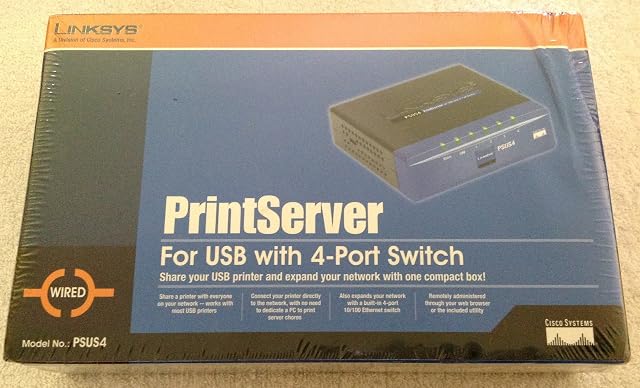
Linksys PSUS4, a print server with a four-port switch inside it $64 USB — stated in the title and in the second bullet, which describes connecting the printer directly to the network. No USB generation is publishedRJ45 copper, as part of a built-in four-port switch — stated in the third bullet. The description adds automatic MDI/MDI-X crossover detection on all four ports, so the cable type does not matter. It is the only listing on this shelf with a switch inside it10/100 on the switch ports, auto-negotiating — stated in the third bullet and in the description, which adds that each port independently settles on half or full duplex. The claim of up to 200 Mbit/s per port is a full-duplex link counted in both directions at once, not a transfer rateNot published on the listing — no wireless, no band and no standard appears anywhere. The route to the network is the switch

What separates the models, in network and storage gear

  • If price decides: Linksys PSUS4, a print server with a four-port switch inside it, at $64.

The buyer this one serves, among network and storage gear

A parallel printer on a network that still speaks more than one protocol, in an office where the queue has to be visible from a browser.

What this one costs among network and storage gear

Details checked on October 26, 2026.

What buyers actually choose

Amazon reports what buyers took in the month before this page was last checked: at least 50.

The figure is a floor, rounded by Amazon, and read through Keepa — it says what buyers picked, not what a maker claims.

Sources

Specifications: the manufacturer sheet for network and storage gear and the matching Amazon product page. Prices and availability: Keepa. Every figure on this page names its source.

What we look at on this network and storage gear