Everything here hangs on whether your exact printer is on the published list · review
DYMO S0929080, network adapter for LabelWriter printers of the 450 series review
A print server sold for one range of label printers, which makes it the only unit here whose compatibility is bounded in writing rather than described.
The bottom line The narrowest unit of the four and, for that reason, the clearest. It answers the question this family lives or dies on — which printers — and answers almost nothing else.
On the listing
A print server described as a network adapter for DYMO LabelWriter label printers; installation given as joining the print server to a LabelWriter label printer over USB and to the network over Ethernet; software available in English, French, German, Dutch and Italian; and a closing line joining every workstation of the network to a single LabelWriter label printer of the 450 series.
A range instead of a list
LabelWriter label printers of the 450 series. One maker, one series, written down. Compare that with the descriptions the rest of this shelf offers — normal printers, more than 95 per cent of brands — and the difference is the difference between a boundary and an impression. It is not a list of models, and it is the nearest thing to one in this group.
Five languages, no operating system
The third bullet names the languages the software speaks. Nothing anywhere names the systems it runs on. For a unit joining office machines to a shared label printer, that is the pair of facts the wrong way round.
The printer this box is for
Everything about this product follows from one decision: it drives label printers of one range. That narrowness is why it can skip protocols, speeds and compatibility notes without leaving much of a hole. A buyer either owns the printer it is for or does not, and there is very little in between.
Before ordering
Read the model number off the label printer itself. The 450 series is the boundary, and the sticker on the machine settles it in a second.
Availability
Priced from 134 € to 181 € across the German, French, Italian and Spanish Amazon stores the day this page was checked.
It is stocked on the British Amazon store as well, in that country’s own currency. The range above leaves those out: it counts euro stores and no others.
The American Amazon store returned nothing at all, so the buy button there opens a search in that country rather than a page that would not load.
Every figure in this section is what Keepa held on the day this page was last updated. Stock and prices move without warning.
Prices quoted in this text were read on 10 September 2026. The live price is at the top of the page.
Where it holds up, and where it stops
Strengths
The compatible printers are bounded in writing, one maker and one series, which resolves the question this family turns on more cleanly than a description ever does
One printer, one purpose, and a fourth bullet that says exactly what the result looks like from a workstation
The software is named in five languages, which for an office that runs in more than one is a real detail rather than a filler
Compromises
No operating system is named anywhere, and a list of software languages sits where that list should be
No protocol, no port speed and no connector designation on the network side
A unit tied to one series of one maker has no second life when that printer is replaced by something else
Specifications
Printer connection type
USB — stated in the second bullet, which describes joining the unit to a LabelWriter label printer over USB and to the network over Ethernet
Network port type
Ethernet — named in the second bullet and described no further. No connector type and no designation appears in the title or in any of the four bullets
Network port speed
Not published on the listing — no figure in Mbit/s, no designation and no auto-sensing claim appears anywhere on the page
Wireless support
Not published on the listing — no wireless is named in the title or in any bullet, and the route to the network is given only as Ethernet
Protocols published
Not published on the listing — not one printing or network protocol is named, and the fourth bullet describes the effect instead: every workstation on the network reaches a single label printer
Number of printers served
One — stated in the fourth bullet, which joins every workstation of the network to a single LabelWriter printer
Scanner support
Not published on the listing — scanning is not named in either direction, on a unit whose printer prints labels and has nothing to scan with
Stated operating system support
Not published on the listing — the third bullet names the languages the software is available in, English, French, German, Dutch and Italian, and no operating system appears in the title or in any of the four bullets. A list of languages is not a list of systems
Published printer compatibility list
Published as a range rather than as a list of models — the first and second bullets limit the unit to DYMO LabelWriter label printers and the fourth names the 450 series. No individual model is listed, and no printer of another maker is named. It is the narrowest and the most definite compatibility statement of the four units here
Amazon reference
B0045FVO3S (same reference on 5 Amazon marketplaces)
EAN
3501170929087
The questions that come up before an order
Is naming a series better than naming individual models?
It is a great deal better than describing a kind of printer, which is what two of the four units here do. A series is a boundary a buyer can check a machine against: either the label printer on the desk belongs to it or it does not. What it does not do is settle borderline cases, and for those the maker is the only source.
Why does a language list matter less than an operating system list?
Because a language decides what the setup software says and an operating system decides whether it runs at all. This page names five languages and no systems, which answers the smaller of the two questions in detail while leaving the larger one untouched.
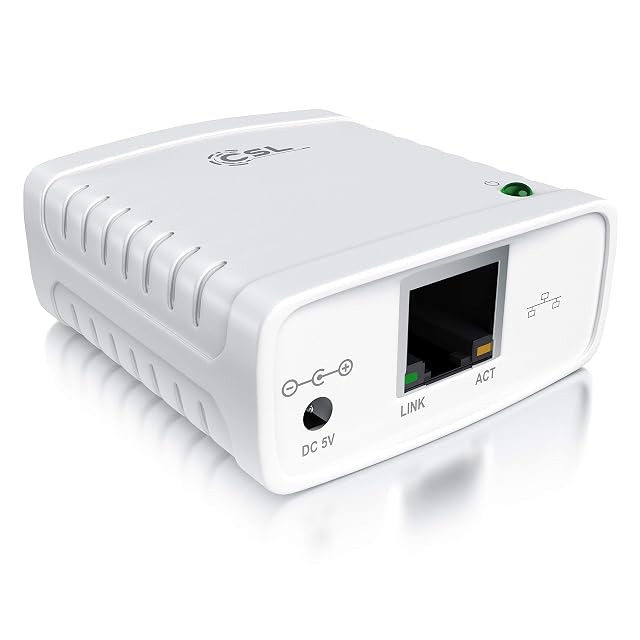
USB 2.0 to the printer · RJ45 to the network · Fast Ethernet, unrated · web management · protocol list printed with HDCP in it · no model list
A wired print server with a web page for setup, whose protocol list includes a video acronym and whose compatibility is described in words rather than published as a list.
Best for: A small office with an ordinary USB printer and Windows machines, where the printer should stand where it is convenient rather than beside one desk.
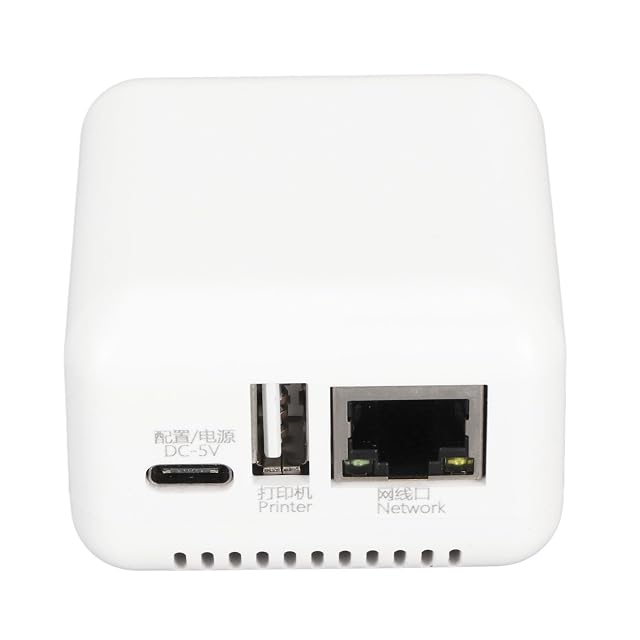
USB to the printer · a network cable interface, undescribed · wireless named without a standard · 95 per cent of brands claimed · a 256 GB figure with nothing attached · half the bullets empty
A wireless print server whose compatibility is given as a percentage, whose largest figure is measured in gigabytes, and half of whose bullet slots contain nothing at all.
Best for: A buyer who needs a printer somewhere no cable reaches and is prepared to establish everything about compatibility with the seller before ordering.
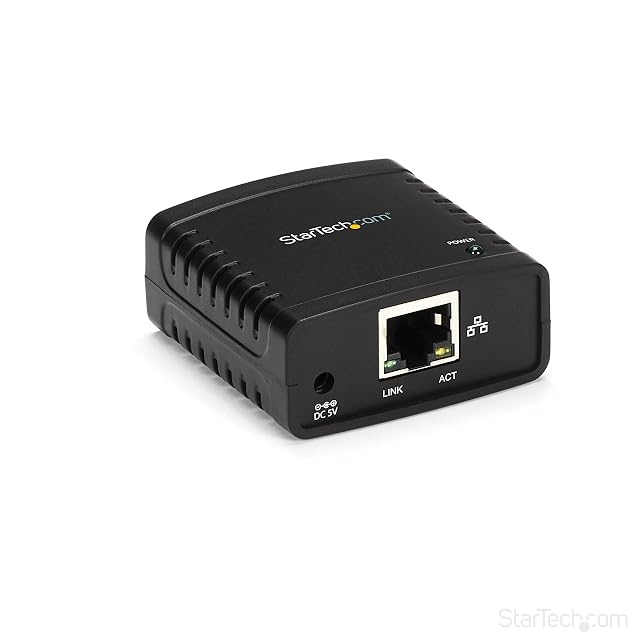
one USB 2.0 printer · 10BASE-T and 100BASE-TX auto-sensing · LPR and Bonjour named · Mac and Windows, no versions · network lead supplied · no model list
A one-printer server that names the two Ethernet designations behind its 10/100 and the two printing protocols it speaks, and publishes no list of printers.
Best for: A home or small office with one USB printer and a mixture of Mac and Windows machines, where Bonjour is what those machines already use to find things.