Two figures on this page are shaped differently from every other length figure on this shelf.
The third bullet states that the unit “Measures each twisted pair of CAT5/CAT6 cables and displays results in meters, feet, or yards” across a 2.5 to 200 meter (8.2 to 656.2 ft) range. Per pair, not per cable. A four-pair lead has four lengths, and when one of them is short the fault is in that pair rather than somewhere in the run — which is the difference between a measurement and a diagnosis. Two other listings on this shelf publish a length range; neither says it reports pair by pair. Three units of measurement is a second small kindness: an American installer working in feet does not have to convert.
The first bullet gives the other: live cable tracing up to 600 meters (1969 ft), with digital decoding and three modes — Normal, Anti-Interference and PoE. Six hundred meters is three times the length range of this same unit and it is a different operation: tracing finds which cable, measuring finds where on it. Naming an anti-interference mode and a PoE mode means the tracing is expected to happen in a working rack rather than on a bench, and that is the opposite of the Klein analog toner on this shelf, which requires the wire to be dead and under 60 volts.
The non-contact voltage pen in the same bullet is for mains rather than network wiring — alternating current detected without touching a conductor. One other listing on this shelf has that function and spells it two different ways on its own page.
The PoE section in the fourth bullet is the most detailed on this shelf. DC 5 to 60 volts, standard and non-standard supplies, identification of IEEE 802.3af and 802.3at, and a report of the power method, the voltage and the polarity. Port flash and a link test at 10M, 100M and 1000M sit beside it, so what a socket is actually running at is read rather than assumed.
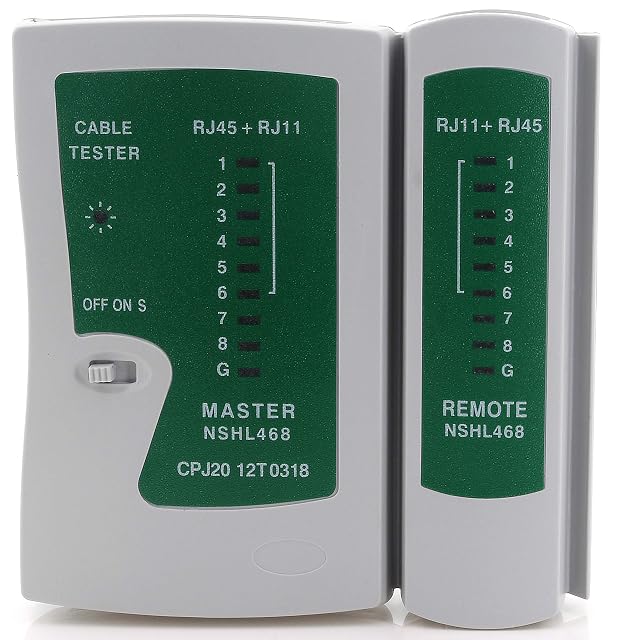
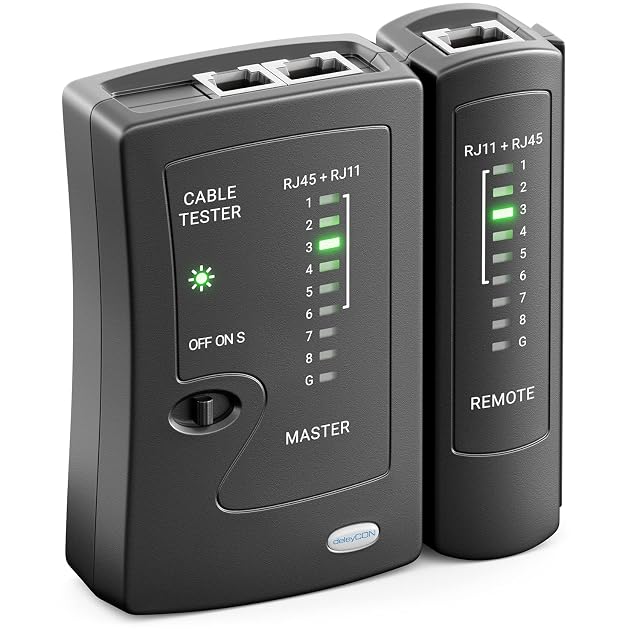
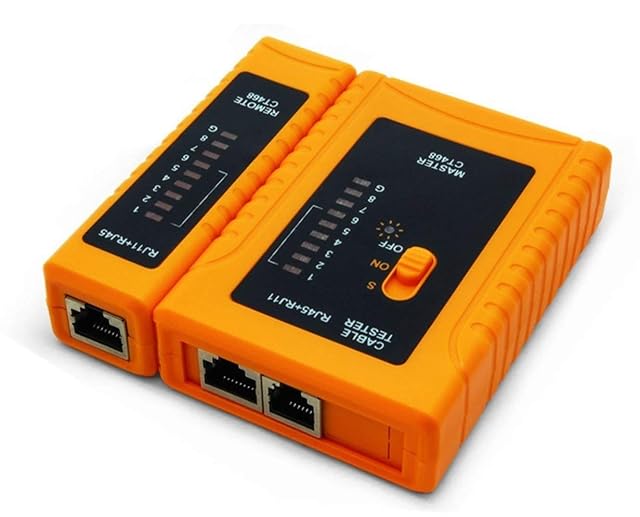
The second bullet covers the ordinary work: a remote adapter for one-to-one continuity on shielded and unshielded RJ45, testing for short circuits, open circuits, miswiring and a normal connection, with 8-pin network and 9-pin shielded leads both named. Nine pins means the drain of a screened lead is in the test rather than beside it.
The fifth bullet lists the kit completely: transmitter, receiver, remote adapter, cable set, tool bag, 9 V cell, Type-C cable, with the transmitter on a 3.7 V 950 mAh rechargeable pack, the receiver on a 9 V block, and an LED light. That split is worth noting — half the kit recharges and half takes a cell, so a flat transmitter is a cable away from working and a flat receiver needs a shop. One published tester on this shelf runs entirely on a rechargeable pack; this is the first mixed arrangement here.
Split pairs remain unaddressed, as on every one of the fifteen listings on this shelf. At $54.99 and 420 g (14.8 oz) this sat third of the four NOYAFA testers priced on Amazon.com on October 26, 2026, above the NF466 and the NF-468S and below the optical unit.
Prices quoted in this text were read on October 7, 2026. The live price is at the top of the page.